Background
The mortality rates among children and adolescents serve as vital indicators of a nation’s overall health environment, social safety, healthcare quality, and public policy efficacy. Globally, high-income countries have achieved substantial reductions in child and adolescent mortality over the past century. Despite this global progress, several studies have documented that the United States lags behind its peer nations in achieving comparable mortality reductions in this demographic. However, precise understanding about when this disparity emerged, its persistence over time, and the demographic groups most affected has remained incomplete.Study Design and Methods
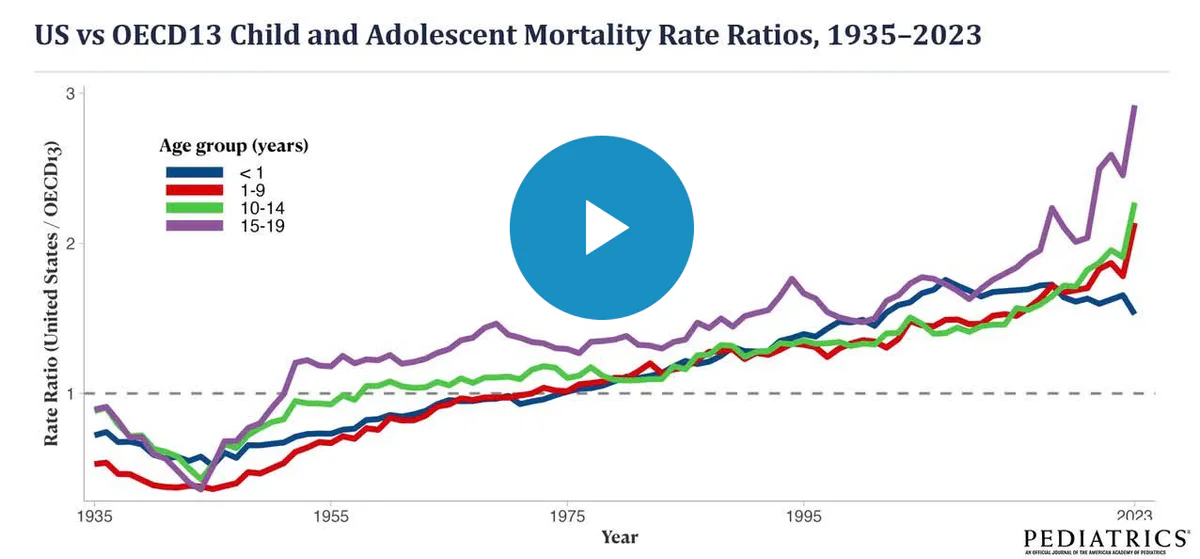
The study by Forrest et al. undertook a comprehensive time-series analysis of vital statistics data from the Human Mortality Database, spanning from 1935 through 2023. This dataset compares all-cause mortality rates for individuals aged 0 to 19 years between the United States and 13 high-income peer nations within the Organisation for Economic Co-operation and Development (OECD13). Researchers calculated mortality rates per 100,000 population, rate ratios (RRs) comparing US rates with those of OECD peers, annual percent changes (APCs) in mortality rates, and estimated excess deaths in the US attributable to the mortality gap. Stratification by age groups (0-4, 5-14, 15-19 years) and by sex provided further granularity regarding the patterns and contributors to the mortality disadvantage.Key Findings
The study found that from 1935 to 2023, all-cause mortality rates fell dramatically in both the United States and OECD13 countries; however, the decline was significantly steeper among OECD13 peers (96.6% versus 89.0%). Initially, US mortality rates were lower compared to OECD13, but a crossover occurred in 1975, after which US rates consistently exceeded peer nations’ rates. By 2023, the mortality rate in US children and adolescents was 52.4 deaths per 100,000 compared to 26.9 per 100,000 in OECD13. The mortality disadvantage was most pronounced in adolescents aged 15-19 years, with the US experiencing almost threefold higher mortality (RR 2.9). Between 2006 and 2023, mortality improvements slowed considerably in the US (annual percent change of -1.2%, 95% CI -1.7% to -0.6%), whereas peer nations saw a more rapid decline (-2.3%, 95% CI -2.7% to -2.0%). This divergence suggests a stalling in progress within the US, notably contrasted with sustained improvements abroad. Within the 2023 data, adolescents aged 15 to 19 years accounted for 40.4% of the estimated excess deaths of 5,417 annually, with male individuals contributing disproportionately (30.6% excess deaths). This points to a concentrated mortality burden among older adolescent males.Interpretation and Context
The persistence and growth of the US child and adolescent mortality disadvantage from the mid-1970s through the present day underscores a concerning public health trend. While all nations benefited from advances in healthcare, injury prevention, vaccination programs, and socioeconomic development in the post-World War II era, the US trajectory diverged, resulting in a relative failure to eliminate preventable deaths in young populations. The pronounced disadvantage in older adolescents, particularly males, suggests specific vulnerability areas including risks from injuries, violence, mental health conditions, substance use, and disparities in access to healthcare and social services. This demographic concentration aligns with national data indicating heightened incidences of motor vehicle accidents, firearm-related injuries, and suicide in US adolescents compared to peer nations. Further, slower recent declines in US mortality rates may reflect broader systemic issues such as socioeconomic inequality, fragmented healthcare access, and social determinants of health that have not been adequately addressed.Limitations
As with all observational time-series analyses, potential confounders such as differences in data quality, coding practices, and classification of deaths across countries exist. While the study adjusted for all-cause mortality, cause-specific analyses would be necessary to pinpoint precise etiologies. Additionally, socioeconomic stratification and racial/ethnic subgroup analyses are essential to elucidate internal disparities within the US population.Conclusions and Implications for Policy and Practice
This comprehensive comparative analysis highlights the sustained and significant gap in child and adolescent mortality between the US and its high-income peers over nearly five decades. The concentration of excess deaths among older male adolescents signals an urgent need for targeted public health interventions. Policy efforts should focus on: enhanced injury prevention (including firearm safety and traffic regulations), improved mental health services accessibility and stigma reduction, substance use prevention programs, and strategies to address underlying social determinants such as poverty and educational inequality. Clinicians, public health officials, and policymakers must collaborate to identify and implement evidence-based strategies aimed at reversing the persistent US disadvantage in child and adolescent mortality to ensure equitable health outcomes for all young people.References
1. Forrest CB, Koenigsberg LJ, Maltenfort MG, Noble MK, Halfon N. Child and Adolescent All-Cause Mortality in the United States vs Peer Nations: 1935-2023. Pediatrics. 2026 Nov 1;158(5). PMID: 42830210. 2. MacDorman MF, Mathews TJ. Declines in infant mortality in the United States: Progress and persisting problems. Am J Public Health. 2011;101(7):1253-1260. 3. Lee LK, Kmet J, Forde L, et al. Disparities in adolescent injury mortality in the United States compared with other high-income countries. J Adolesc Health. 2022;70(2):223-230. 4. Singh GK, Azuine RE, Siahpush M. Widening socioeconomic inequalities in US life expectancy, 1980–2014: An international perspective. SSM Popul Health. 2017;3:205-213.Specialty calculators
For clinical reference; use professional judgment.