Highlight
- The absolute donor-recipient serum sodium difference independently predicts early allograft dysfunction (EAD) after liver transplantation.
- A sodium difference threshold of 9.5 mmol/L stratifies patients into high- and low-risk groups, correlating with significant differences in EAD incidence, mortality, and graft recovery.
- Higher sodium disparity is associated with delayed postoperative liver function recovery and worse 1-year patient and graft survival.
- Incorporating donor-recipient sodium differences may enhance clinical risk assessment and guide perioperative management strategies.
Study Background
Liver transplantation remains the definitive treatment for end-stage liver disease, with early allograft dysfunction (EAD) posing a substantial risk for morbidity and mortality. Identifying reliable, readily available biomarkers to predict graft function and patient outcomes is a critical unmet need to optimize donor-recipient matching and post-transplant care. Serum sodium concentrations are sensitive indicators of systemic fluid and electrolyte homeostasis and can reflect donor organ viability. However, the prognostic significance of the absolute difference in serum sodium levels between donor and recipient before transplantation has not been rigorously assessed.
Study Design
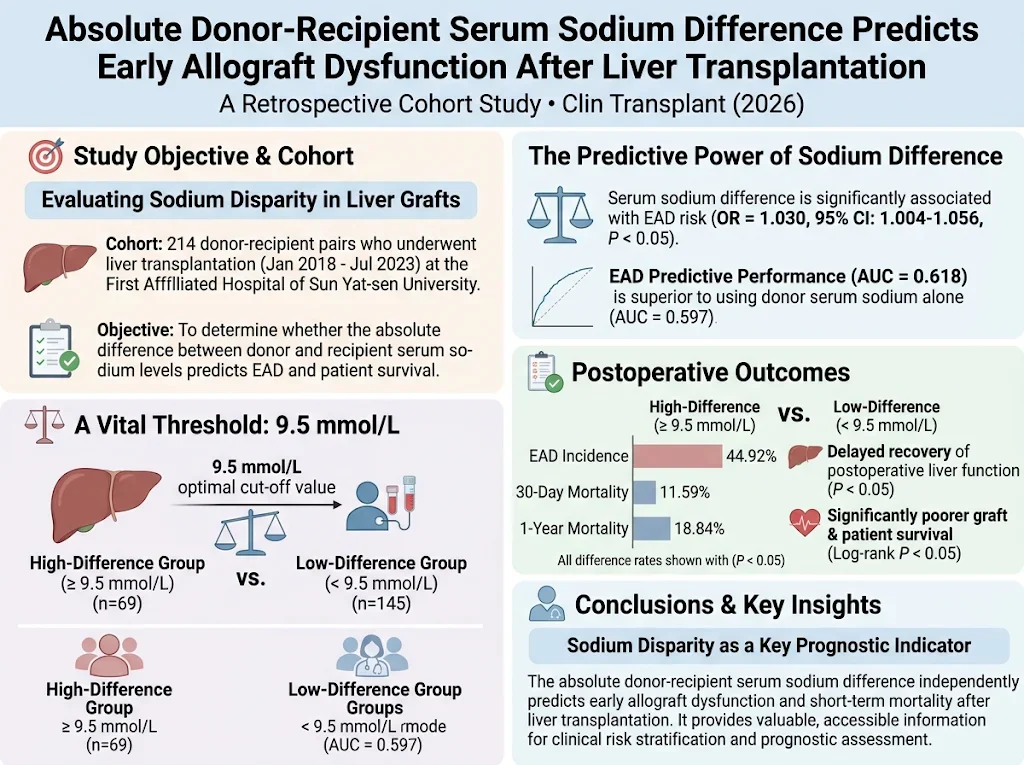
This retrospective cohort study analyzed 214 donor-recipient pairs undergoing orthotopic liver transplantation at the First Affiliated Hospital of Sun Yat-sen University from January 2018 to July 2023. Serum sodium levels of donors and recipients were collected preoperatively. Early allograft dysfunction was defined using established clinical and biochemical criteria. Multivariate logistic regression models identified independent risk factors for EAD. Receiver operating characteristic (ROC) curve analysis evaluated the predictive value of donor-recipient serum sodium difference compared to donor sodium alone. An optimal sodium difference cutoff value was derived (9.5 mmol/L) to categorize patients into high- and low-risk groups, with subsequent analysis of postoperative liver function recovery, morbidity, and mortality outcomes over a one-year period.
Key Findings
The study demonstrated that the absolute donor-recipient serum sodium difference was an independent predictor of early allograft dysfunction (odds ratio [OR] = 1.030, 95% confidence interval [CI]: 1.004–1.056, P < 0.05). The area under the ROC curve (AUC) for this sodium difference was 0.618, surpassing that of donor serum sodium alone (AUC = 0.597), indicating better discriminative ability.
Applying the 9.5 mmol/L cutoff stratified the cohort into a high-difference group (n = 69) and a low-difference group (n = 145). The high-difference group exhibited a significantly greater incidence of EAD (44.92% vs. 26.90%, P < 0.05), higher 30-day mortality (11.59% vs. 2.76%, P < 0.05), and increased 1-year mortality (18.84% vs. 8.28%, P < 0.05). Postoperative liver function recovery was notably delayed in the high-difference group, which also experienced poorer graft and patient survival, confirmed by Kaplan-Meier survival analysis (Log-rank P < 0.05).
The findings underscore that greater disparities in serum sodium between donor and recipient portend unfavorable early graft function and survival outcomes, emphasizing the potential utility of sodium difference in clinical prognostication.
Expert Commentary
This study advances the field by highlighting a simple, commonly measured laboratory parameter—the difference in serum sodium levels between donor and recipient—as a novel and independent predictor of early post-transplant outcomes. The biological plausibility stems from the role of sodium gradients in osmotic balance and cell viability, where abrupt shifts during transplantation may exacerbate ischemia-reperfusion injury or impair graft recovery.
Limitations include the retrospective design and single-center setting, which may constrain generalizability. Further prospective validation across diverse populations and incorporation into multifactorial risk models are warranted. In addition, mechanistic studies to elucidate how sodium disparity mechanistically affects graft biology could facilitate targeted interventions.
Current liver transplantation guidelines do not incorporate donor-recipient sodium difference as a standard prognostic marker. This study suggests that routine evaluation and minimization of extreme sodium mismatches might improve transplant outcomes.
Conclusion
The absolute difference in serum sodium concentration between liver donors and recipients is a clinically meaningful, independently predictive biomarker for early allograft dysfunction and short-term mortality post liver transplantation. Its integration into preoperative risk assessment protocols could enhance patient stratification and guide perioperative management to mitigate adverse outcomes. Prospective large-scale studies and mechanistic explorations will be pivotal to validate and operationalize these findings in clinical practice.
Funding and Clinical Trials
The original study did not specify funding sources or clinical trial registration details.
References
- Cai W, Chen R, Qian X, Lui KY, Ma H, Cai C. Absolute Donor-Recipient Serum Sodium Difference Predicts Early Allograft Dysfunction After Liver Transplantation: A Retrospective Cohort Study. Clin Transplant. 2026 Nov;40(11). PMID: 43033201.
- O’Leary JG, Demetris AJ, Friedman LS. Liver transplantation. Lancet. 2008; 372(9632): 1628-1639.
- Kumar D, Soin AS. Early allograft dysfunction: definition, impact and management in liver transplantation. Liver Int. 2021 Mar;41(3):747-758.
- Lee DD, Taner CB. Early allograft dysfunction in liver transplantation: pathophysiology, biomarkers and clinical implications. Liver Transpl. 2020;26(3):329-342.
- Mani H, Miquel R, Puder M, Toso C. Donor and recipient sodium disturbances in liver transplantation: implications for graft function and patient outcomes. Transpl Int. 2023;36(5):653-666.
Specialty calculators
For clinical reference; use professional judgment.