Highlight
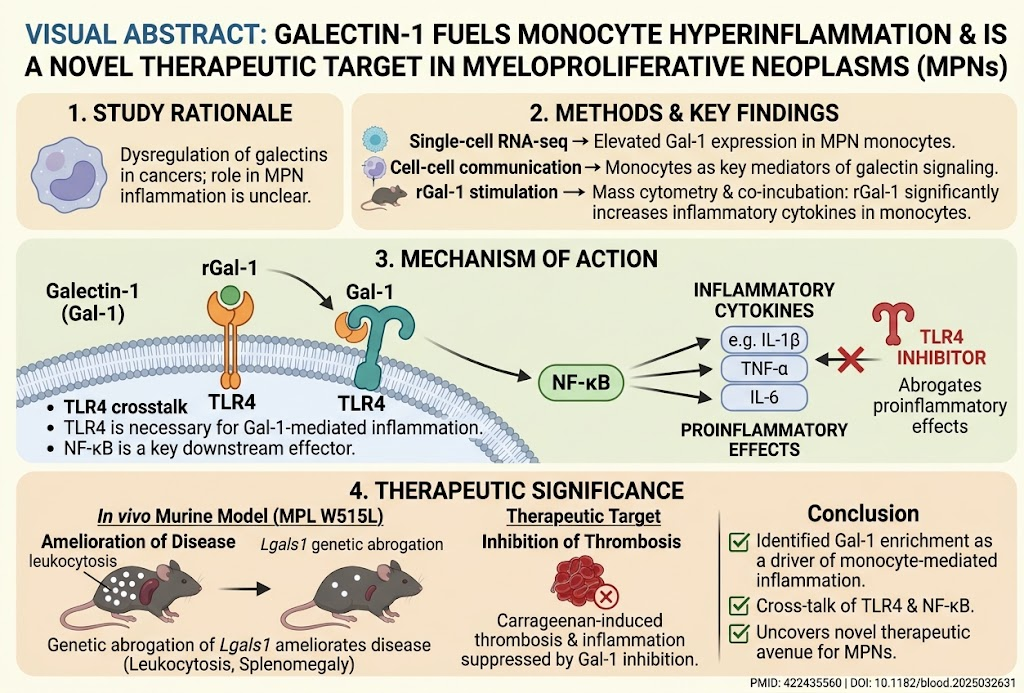
1. Galectin-1 (Gal-1) expression is significantly upregulated in monocytes from patients with myeloproliferative neoplasms (MPNs) and corresponding murine models.
2. Gal-1 enhances monocyte-mediated production of inflammatory cytokines via activation of toll-like receptor 4 (TLR4) and downstream NF-κB signaling pathways.
3. Inhibition or genetic ablation of Gal-1 mitigates key MPN pathologic manifestations including leukocytosis, splenomegaly, and thrombosis.
4. Targeting Gal-1 represents a novel therapeutic strategy to reduce monocyte hyperinflammation in MPNs.
Study Background
Myeloproliferative neoplasms (MPNs) comprise a group of hematologic malignancies characterized by clonal proliferation of myeloid lineage cells, often accompanied by systemic inflammation, elevated cytokine levels, and risk of thrombosis. Despite advances in understanding driver mutations such as JAK2, MPL, and CALR, the mechanisms fueling inflammation and immune dysregulation in MPNs remain incompletely elucidated. Monocytes are increasingly recognized as key cellular mediators of inflammation in MPNs, but the molecular drivers modulating their hyperinflammatory state are poorly defined. Galectins are a family of β-galactoside-binding proteins involved in cell-cell interactions, immune regulation, and cancer biology. Dysregulation of galectins and aberrant protein glycosylation has been reported in various malignancies; however, their specific role in MPN pathogenesis has not been fully explored. This study investigates the contribution of Galectin-1 (Gal-1) to monocyte-driven inflammation in MPNs and assesses its therapeutic potential.
Study Design
This investigation employed multi-modal experimental approaches to interrogate Gal-1’s role in MPNs. Single-cell RNA sequencing (scRNA-seq) was conducted on samples from human MPN patients and murine MPN models to analyze galectin gene expression profiles across hematopoietic cell populations, emphasizing monocytes. Cell-cell communication algorithms were applied to predict signaling pathways involving galectins as input and output signals. Mass cytometry profiling assessed cytokine responses in peripheral blood mononuclear cells exposed ex vivo to recombinant Gal-1 (rGal-1). Furthermore, mechanistic studies incorporated three-dimensional protein modeling and coimmunoprecipitation assays to define interactions between Gal-1 and toll-like receptor 4 (TLR4). NF-κB reporter assays evaluated downstream signaling activation. The in vivo role of Gal-1 was examined using an MPLW515L-driven murine MPN model with genetic ablation of Lgals1. Additional in vivo experiments assessed the effects of Gal-1 inhibition on inflammation and thrombosis using carrageenan-induced models.
Key Findings
Galectin Gene Enrichment in MPN Monocytes: Single-cell transcriptomic profiling revealed significant enrichment of galectin family genes, particularly LGALS1 encoding Galectin-1, selectively in monocytes from MPN patients and MPLW515L mice. This suggested a monocyte-specific role for Gal-1 in the MPN inflammatory milieu.
Monocytes as Central Mediators of Galectin Signaling: Computational cell-cell communication analysis highlighted monocytes as pivotal hubs for galectin-mediated intercellular signaling, with Gal-1 functioning prominently as both an activator and responder molecule within monocyte populations.
Recombinant Gal-1 Enhances Proinflammatory Cytokine Secretion: Exposure of primary human monocytes—isolated from MPN patient blood—to recombinant Gal-1 led to pronounced upregulation in transcription and secretion of multiple inflammatory cytokines, including TNF-α and IL-6. Notably, this effect was selective for monocytes, with negligible cytokine induction in other blood cell types.
Mechanistic Crosstalk Between Gal-1 and TLR4: Three-dimensional protein modeling coupled with coimmunoprecipitation confirmed a direct interaction between Gal-1 and TLR4 on monocytes. Pharmacologic inhibition of TLR4 abrogated Gal-1-mediated cytokine induction, establishing TLR4 as a critical receptor mediating Gal-1’s proinflammatory signals.
NF-κB as a Downstream Effector: Reporter assays demonstrated that Gal-1 engagement activates NF-κB signaling in monocytes in a TLR4-dependent manner, explaining the transcriptional upregulation of inflammatory cytokines.
In Vivo Relevance in MPN Mouse Model: Genetic deletion of Lgals1 in the MPLW515L mouse model attenuated hallmark MPN features, reducing leukocytosis, splenomegaly, and systemic inflammation. Pharmacologic Gal-1 inhibition also suppressed carrageenan-induced thrombosis and inflammation, indicating broader anti-inflammatory and anti-thrombotic effects.
Safety and Specificity: The therapy targeting Gal-1 appears to selectively modulate monocyte-driven inflammation without broadly impairing other immune functions, suggesting a favorable therapeutic index.
Expert Commentary
This comprehensive study identifies Galectin-1 as a central driver of monocyte hyperinflammation in MPNs, operating via engagement with TLR4 and NF-κB. The delineation of this pathway provides strong biological plausibility for targeting Gal-1 in MPNs, where inflammation contributes to disease progression and thrombotic risk. Notably, the selective effect of Gal-1 on monocytes addresses a critical pathogenic arm without indiscriminate immunosuppression that could raise infection risk. The use of single-cell technologies, functional assays, and rigorous in vivo models strengthens the robustness and translational relevance of the findings.
Limitations include the need for further clinical studies to validate Gal-1 inhibitors’ efficacy and safety in MPN patients. Future research should also explore whether combining Gal-1 blockade with standard therapies, such as JAK inhibitors, yields synergistic benefits. Additionally, the broad role of galectins in immune homeostasis warrants careful monitoring for potential off-target effects.
Conclusion
Galectin-1 is profoundly upregulated in MPN monocytes and acts as a key proinflammatory mediator by activating TLR4 and downstream NF-κB signaling. Its role in driving monocyte hyperinflammation contributes to the pathogenesis and clinical manifestations of MPNs, including leukocytosis, splenomegaly, and thrombosis. Targeting Gal-1 represents a promising and innovative therapeutic strategy to alleviate inflammation and disease burden in MPN patients. These findings pave the way for future clinical development of Gal-1 inhibitors as adjunct treatments to improve outcomes in MPNs.
Funding and Clinical Trials
The original study was published in Blood (2026) under the title “Galectin-1 fuels monocyte hyperinflammation and is a novel therapeutic target in myeloproliferative neoplasms” (PMID: 42345360). Funding sources and clinical trial registrations were not explicitly provided in the abstract but may be referenced in the full publication or associated repositories.
References
He F, Lin S, Kong T, et al. Galectin-1 fuels monocyte hyperinflammation and is a novel therapeutic target in myeloproliferative neoplasms. Blood. 2026 Sep 24;148(13):1708-1722. PMID: 42345360.
Barosi G, et al. Contemporary pathogenesis and treatment of myeloproliferative neoplasms. Blood Rev. 2020;43:100680.
Tefferi A, Vainchenker W. Myeloproliferative neoplasms: molecular pathophysiology, essential clinical understanding, and treatment strategies. J Clin Oncol. 2011;29(5):573-582.
Rabinovich GA, et al. Emerging roles for galectins in inflammation and immunity. Nat Rev Immunol. 2007;7(6):397-409.
Mancini L, et al. Toll-like receptor 4 signaling in hematological malignancies. Mediators Inflamm. 2015;2015:152815.