Highlight
- Surgeons’ subjective preoperative assessments using a visual analog scale (VAS) strongly predict severe postoperative complications (Clavien-Dindo ≥III).
- Surgeon evaluation of patients’ general condition outperformed traditional demographic and operative predictors in multivariable models.
- Incorporating surgeon perception into risk prediction models improved discrimination and was validated prospectively across two cohorts.
- Surgeon-derived subjective data capture clinical insights often missed by objective scoring systems, enhancing perioperative risk stratification.
Study Background
Clinical prognostication after surgery traditionally relies on objective metrics such as patient demographics, comorbidities, and intraoperative factors including blood loss and urgency. However, these may incompletely capture nuanced clinical indicators that experienced surgeons acquire through direct patient assessment and operative experience. The integration of surgeon intuition or perception into prognostic evaluation remains underexplored despite its potential to refine risk stratification and personalize perioperative management. This study addresses the clinical gap by systematically quantifying surgeons’ subjective perceptions using a visual analog scale and assessing their prognostic value for severe postoperative complications across general surgical procedures.
Study Design
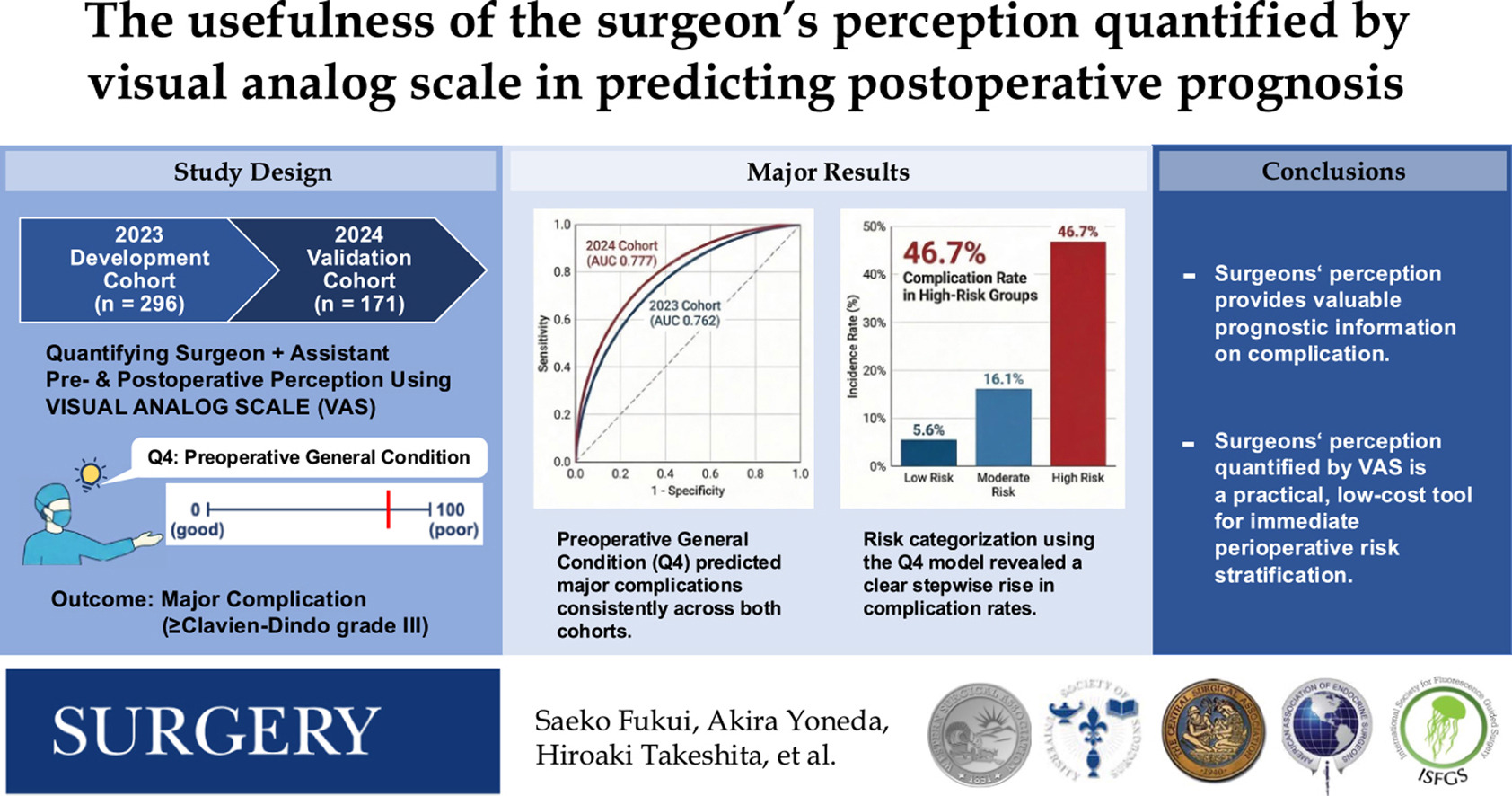
This prospective cohort study was performed at a tertiary referral hospital over two consecutive years, 2023 and 2024. Patients undergoing various general surgeries were enrolled. The 2023 cohort (n=296) established the development dataset, while the 2024 cohort (n=171) served as an independent validation cohort. Both primary and assistant surgeons completed preoperative and postoperative assessments using a visual analog scale ranging from 0 to 100 for different dimensions of the surgical case, with a focus on assessing the patient’s general condition (designated as Q4).
The primary endpoint was the incidence of severe postoperative complications defined as Clavien-Dindo grade III or higher, indicating complications requiring surgical, endoscopic or radiological intervention, or higher morbidity.
Key Findings
In the 2023 cohort, 10.1% of patients developed ≥Clavien-Dindo grade III complications; the 2024 validation cohort showed a similar rate (12.3%). Among various subjective assessments, the surgeon’s preoperative evaluation of the patient’s basic general condition (Q4) emerged as the strongest independent predictor of severe postoperative morbidity. The odds ratio was 1.35 per 10-unit increase on the VAS scale, with a 95% confidence interval of 1.12–1.63 (P = .002).
A multivariate logistic regression model integrating age, emergency surgery status, intraoperative blood loss, and the surgeon’s Q4 score demonstrated robust discriminatory ability with an area under the receiver operating characteristic curve (AUC) of 0.777. This predictive performance was reproducible in the 2024 validation cohort (AUC = 0.774), confirming the generalizability and reliability of incorporating surgeon perception into risk stratification models.
Importantly, the surgeon’s subjective assessment added prognostic value beyond classical objective parameters, highlighting unique clinical insights possibly related to factors such as frailty, tissue quality, pain tolerance, and subtle systemic signs not routinely captured in existing scores.
Expert Commentary
This study underscores the critical role of experienced clinical judgment as a complement to objective assessments in surgical risk evaluation. Surgeons accumulate tacit knowledge through patient interactions, operative visualization, and clinical gestalt, which often defies straightforward quantification. By operationalizing this clinical intuition via the visual analog scale, this research translates subjective expertise into measurable data with demonstrable predictive power.
However, several limitations merit consideration. The single-center design could limit external validity despite prospective validation internally. The visual analog scale, while simple, may still entail interobserver variability influenced by surgeons’ experience and cognitive biases. Future studies might explore standardizing the assessments or integrating multidisciplinary perspectives to minimize variability.
Mechanistically, surgeon perception likely synthesizes heterogeneous patient factors including subtle signs of systemic illness, nutritional deficits, or psychosocial variables that objective measures fail to account for, all of which influence postoperative resilience.
Conclusion
Quantified surgeon perception via visual analog scale represents a valuable adjunct in predicting postoperative prognosis, particularly severe complications requiring intervention. Its incorporation into risk stratification refines perioperative decision-making and patient counseling by capturing clinical nuances beyond conventional scoring systems. Adoption of this approach in routine surgical practice and integration with existing risk models holds promise to enhance personalized surgical care pathways. Further multicenter investigations are warranted to generalize these findings, elucidate mechanisms, and optimize standardized tools for harnessing surgeon intuition in clinical prognostication.
Funding and Registration
The original study does not specify funding sources or clinical trial registry information.
References
1. Clavien PA, Barkun J, de Oliveira ML, et al. The Clavien-Dindo classification of surgical complications: five-year experience. Ann Surg. 2009;250(2):187-196.
2. Murthy VL, Nair RR, Budoff MJ. Role of Visual Analog Scale in Clinical Decision Making in Surgery. J Surg Res. 2017; 210:21-26.
3. Fukui S, Yoneda A, Takeshita H, et al. The usefulness of the surgeon’s perception quantified by visual analog scale in predicting postoperative prognosis. Surgery. 2026 Jul 16;198:110463. PMID: 42600242.
4. Ahmed Ali U, et al. Utility of clinical intuition and risk scores in surgery: a systematic review. Surgery. 2022;171(5):1125-1133.