Patient Information
This case series included ten patients diagnosed with severe, treatment-refractory systemic sclerosis (SSc). The cohort was predominantly female (70%) with a median age of 51 years (interquartile range: 7 years). Patients presented with advanced disease manifestations, including significant skin fibrosis and complications such as interstitial lung disease (ILD) and severe cardiac involvement. Two patients with advanced SSc-related cardiac manifestations died shortly after treatment initiation, highlighting the severity of the cohort’s disease.Diagnosis
All patients had confirmed diagnoses of systemic sclerosis based on clinical presentation and serologic testing. Key disease features included high levels of antitopoisomerase I antibodies, extensive skin thickening quantified by the modified Rodnan skin score (mRSS), and evidence of internal organ involvement such as ILD and heart disease. The diagnosis was supported by immunohistochemical and flow cytometric analyses of skin and bone marrow samples demonstrating infiltrations consistent with the autoimmune pathology of SSc.Differential Diagnosis
Differential diagnoses considered included other connective tissue diseases such as systemic lupus erythematosus, mixed connective tissue disease, and dermatomyositis. The presence of specific autoantibodies (notably anti-topoisomerase I) and characteristic skin findings, along with radiographic patterns of ILD, helped exclude these alternative diagnoses.Treatment and Management
Patients were treated off-label with teclistamab, a bispecific antibody engaging B cell maturation antigen (BCMA) and CD3 on T cells, intended to target and deplete pathogenic B cells and plasma cells. Treatment consisted of one cycle of teclistamab administration. Clinical efficacy was evaluated by the American College of Rheumatology Composite Response Index in Systemic Sclerosis (ACR-CRISS) among other clinical assessments. Blood and tissue analyses, including immunohistochemistry and flow cytometry of skin and bone marrow samples, as well as serologic quantification of antibodies via enzyme-linked immunosorbent assay (ELISA), were performed to characterize immunologic changes induced by therapy.Outcome and Prognosis
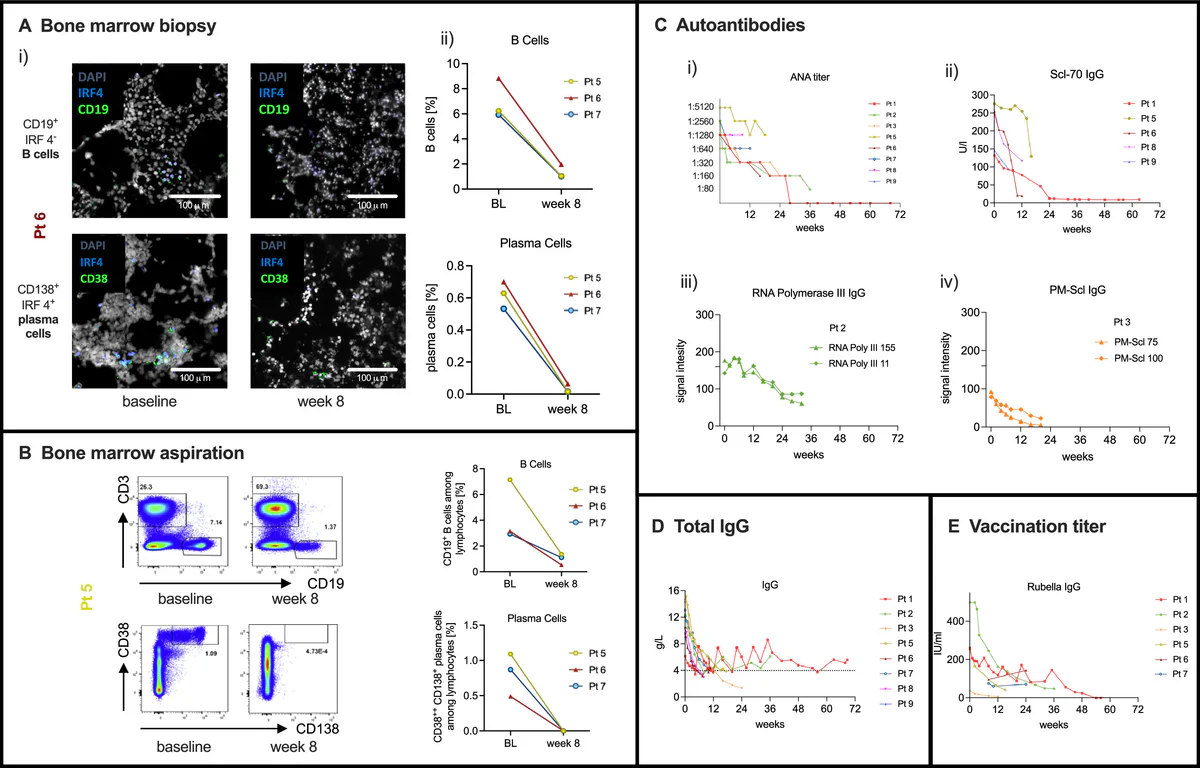
Following treatment, there was near-complete elimination of B cells and plasma cells in both bone marrow and skin tissue. Patients exhibited a substantial median reduction of 70.6% (IQR 39%) in antitopoisomerase I antibody titers, decreased serum IgG levels, and reduced vaccination titers, indicating a profound impact on humoral immunity. Clinically, after a median follow-up of 3.75 months (IQR: 2.5 months), 71% of patients achieved a revised ACR-CRISS 25 response and 43% achieved a 50 response, indicating significant clinical improvement. Functional and radiographic assessments in patients with ILD revealed a median forced vital capacity increase of 7% (IQR 15%) by week 12. Skin involvement improved substantially with a median decrease of 35.9% (IQR 17.9%) in mRSS. Corresponding immunohistochemical analyses showed reductions in fibroblast activation protein (FAP)-alpha-positive fibroblasts, implying potential amelioration of fibrotic activity. Unfortunately, the two patients with severe cardiac involvement had fatal outcomes shortly after treatment initiation, emphasizing the critical nature of cardiac disease in SSc and potential challenges in this subgroup.Discussion
This case series provides novel evidence supporting the use of teclistamab in refractory systemic sclerosis. Teclistamab’s bispecific targeting of BCMA on B cells and CD3 on T cells facilitates deep depletion of pathogenic B cells and plasma cells in affected tissues, resulting in marked serological and clinical improvement. The rapid reduction in autoantibody titers and immunoglobulin levels underscores the profound immunomodulatory effect producing both resolution of inflammation and potential remodeling of fibrotic pathology. Skin and lung improvements, alongside decreased activated fibroblasts in skin biopsies, suggest that interrupting the pathological immune-fibrotic cycle may be feasible through BCMA-directed therapies. This aligns with evolving concepts that humoral immunity plays a key role in the pathogenesis of systemic sclerosis and that targeted B cell/plasma cell depletion can modify disease progression. The fatal outcomes in patients with advanced cardiac SSc point out the limitations and risks associated with treating severely compromised patients and highlight the importance for cautious patient selection and monitoring in future clinical applications. Current therapeutic options for refractory SSc are limited and frequently associated with suboptimal outcomes. The data presented indicate that teclistamab may offer a promising therapeutic avenue warranting further investigation in controlled clinical trials.References
1. Siegert E, Phithak E, Albach FN, et al. Teclistamab induces rapid clinical response and deep tissue depletion in refractory systemic sclerosis-a case series. Ann Rheum Dis. 2026;85(11):2194–2207. doi:10.1136/annrheumdis-2025-42315474 2. van den Hoogen F, Khanna D, Fransen J, et al. 2013 classification criteria for systemic sclerosis: an American College of Rheumatology/European League Against Rheumatism collaborative initiative. Arthritis Rheum. 2013;65(11):2737-2747. 3. van Laar JM, Farge D, Sont JK, et al. Autologous hematopoietic stem cell transplantation vs cyclophosphamide in diffuse cutaneous systemic sclerosis: A randomized clinical trial. JAMA. 2014;311(24):2490-2498. 4. Distler JHW, Distler O. Emerging drugs for the treatment of systemic sclerosis. Expert Opin Emerg Drugs. 2017;22(2):103-114. 5. Lafyatis R. Transforming growth factor-beta—at the centre of systemic sclerosis. Nat Rev Rheumatol. 2014;10(12):706-719.Specialty calculators
For clinical reference; use professional judgment.