Highlight
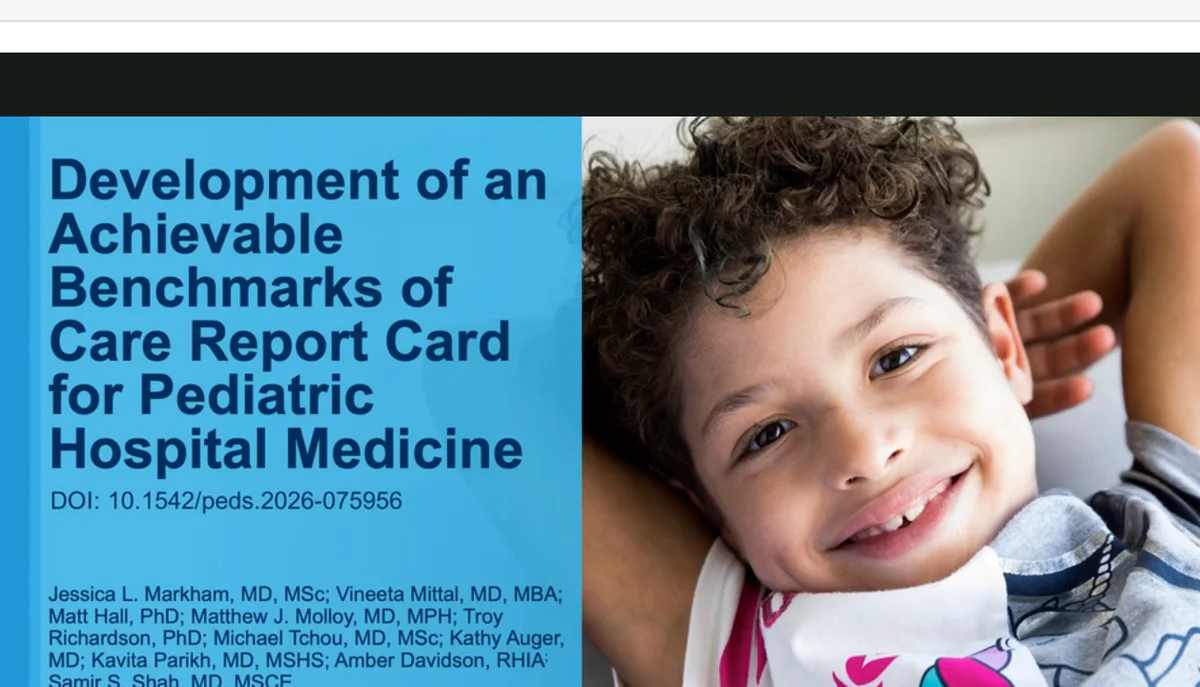
- Development of pediatric hospital medicine-specific Achievable Benchmarks of Care (ABCs) for 13 common conditions using a large multisite database.
- Quantification of performance gaps in length of stay and readmission rates across hospitals to guide quality improvement.
- Introduction of condition-specific measures including imaging, laboratory, procedures, and medication utilization benchmarks.
- The ABC report card provides actionable data for local and multicenter efforts to improve pediatric inpatient care efficiency and safety.
Study Background
Pediatric Hospital Medicine (PHM) cares for a diverse spectrum of acute pediatric illnesses requiring inpatient management. Variability in quality and resource utilization among hospitals can lead to inefficiencies and suboptimal outcomes. Establishing evidence-based benchmarks promotes standardization, identifies best practices, and drives improvement. However, prior to this study, comprehensive benchmarks tailored specifically for pediatric hospital medicine across common conditions had not been established. The study addresses the unmet need for achievable, data-driven care standards that PHM clinicians and health systems can employ to evaluate and enhance clinical performance. By focusing on hospital length of stay (LOS), readmission rates, and condition-specific utilization metrics, the research aims to deliver a practical roadmap for balancing high quality with cost-effective care.Study Design
This retrospective cross-sectional study utilized the Pediatric Health Information System (PHIS) database capturing inpatient encounters between January 1, 2023, and December 31, 2024. The study population encompassed 237,283 hospitalizations for 13 common pediatric conditions accounting for 33.5% of nonsurgical pediatric discharges. Conditions studied included:- Bronchiolitis
- Asthma
- Pneumonia
- Urinary tract infection
- Constipation
- Gastroenteritis
- Cervical lymphadenitis
- Skin and soft tissue infection
- Orbital cellulitis
- Osteomyelitis
- Septic arthritis
- Neonatal fever
- Simple febrile seizure
Key Findings
The study established 115 distinct measures spanning the 13 conditions, derived from over 237,000 hospitalizations.Length of Stay (LOS)
Eleven of the studied conditions had an ABC LOS under 48 hours, demonstrating that efficient inpatient management is possible in most common pediatric illnesses. Notably, osteomyelitis and septic arthritis had longer benchmark LOS values under 74 hours and exhibited the greatest performance gaps. This likely reflects the complexity and required treatment duration for these invasive infections.Readmission Rates
Across all conditions, ABC readmission rates were impressively low at less than 2.0%, indicating that reduced length of hospitalization did not compromise patient safety or increase preventable returns to hospital.Condition-Specific Utilization Measures
Chest radiograph use varied markedly among respiratory conditions, with ABCs ranging from 20.6% to 57.9%. The performance gap—the difference between median hospital use and top performers—spanned 18.3% to 22.4%, highlighting substantial potential for reducing unnecessary imaging without sacrificing care quality. Together, these data provide actionable insights for quality improvement by specifying where hospitals have room to improve efficiency, decrease unwarranted resource use, and maintain or improve clinical outcomes.Expert Commentary
The development of PHM-specific ABCs constitutes a pivotal advancement in pediatric quality measurement and benchmarking. By harnessing real-world multisite data, Markham et al. have created a practical framework that aligns with value-based care principles. The stringent selection of top performers to define benchmarks ensures that targets are not theoretical but achievable under current clinical practice conditions. However, certain limitations merit consideration. The study’s reliance on administrative data may not capture nuanced clinical factors influencing care variation, such as social determinants or illness severity. Additionally, the retrospective design precludes causal inference. Validation of these benchmarks through prospective interventional studies would strengthen their utility. The notably larger performance gaps in complex conditions like osteomyelitis and septic arthritis suggest a need to standardize clinical pathways for these diagnoses. Conversely, the varied utilization of chest radiographs points to persistent overuse in some centers, emphasizing the opportunity for diagnostic stewardship within PHM. Overall, the ABC report card serves as a catalyst to reduce unwarranted variation, optimize resource allocation, and promote evidence-based pediatric inpatient care.Conclusion
This study successfully established a comprehensive set of Achievable Benchmarks of Care tailored to pediatric hospital medicine. These benchmarks quantify attainable standards for length of stay, readmission rates, and condition-specific resource use across common pediatric conditions. Adoption of the ABC report card by hospitals and PHM practitioners can guide targeted quality improvement initiatives at local and multicenter levels. Implementation of these benchmarks promises to enhance clinical outcomes, reduce inefficiencies, and support value-based care delivery for hospitalized children. Future research should focus on prospective validation, exploration of underlying causes for performance gaps, and development of best practice bundles informed by the ABC data. Ultimately, this work lays a robust foundation for measurable advancement in pediatric inpatient care quality and safety.Funding and ClinicalTrials.gov
The original publication did not report funding sources or clinical trial registration for this retrospective database study.References
1. Markham JL, Mittal V, Hall M, et al. Development of an Achievable Benchmarks of Care Report Card for Pediatric Hospital Medicine. Pediatrics. 2026 Nov 1;158(5). PMID: 42833656. 2. Mangione-Smith R, et al. Quality improvement in pediatric hospital medicine. Pediatr Clin North Am. 2020;67(3):397-411. 3. Sharek PJ, et al. Measuring and improving value in pediatric hospital medicine. J Hosp Med. 2019;14(4):229-235. 4. Schwarz Norberg SM, et al. Practice variation in pediatric hospital medicine: A focus on diagnostic imaging. J Hosp Med. 2023;18(7):467-473. 5. Institute of Medicine. Crossing the Quality Chasm: A New Health System for the 21st Century. National Academies Press; 2001.Specialty calculators
For clinical reference; use professional judgment.