Highlight
The SMART-REACH2 model provides a validated, sex-specific tool for estimating lifetime risk of recurrent cardiovascular events in patients with established atherosclerotic cardiovascular disease (ASCVD), recalibrated to distinct global risk regions. It captures geographical variations in risk and estimates personalized treatment benefits from lipid-lowering and blood pressure reduction strategies. The model facilitates clinical shared decision-making by projecting gains in cardiovascular disease-free life expectancy tailored to individual patient profiles.
Study Background
Atherosclerotic cardiovascular disease remains a leading cause of morbidity and mortality worldwide, with recurrent cardiovascular events posing a persistent risk despite secondary prevention efforts. Effective stratification of individual patient risk and estimation of attainable benefits from intensified preventive therapies are critical for guiding treatment decisions. In 2021, the European Society of Cardiology (ESC) recommended the use of the SMART-REACH lifetime risk model to aid decision-making in patients with established ASCVD; however, the model previously lacked systematic recalibration for different global populations, limiting its broad applicability.
The SMART-REACH2 study was designed to enhance risk prediction and treatment benefit estimation by updating the original model using comprehensive European and international datasets, thus addressing international heterogeneity in recurrent cardiovascular risks and enabling personalized, evidence-based preventive strategies.
Study Design
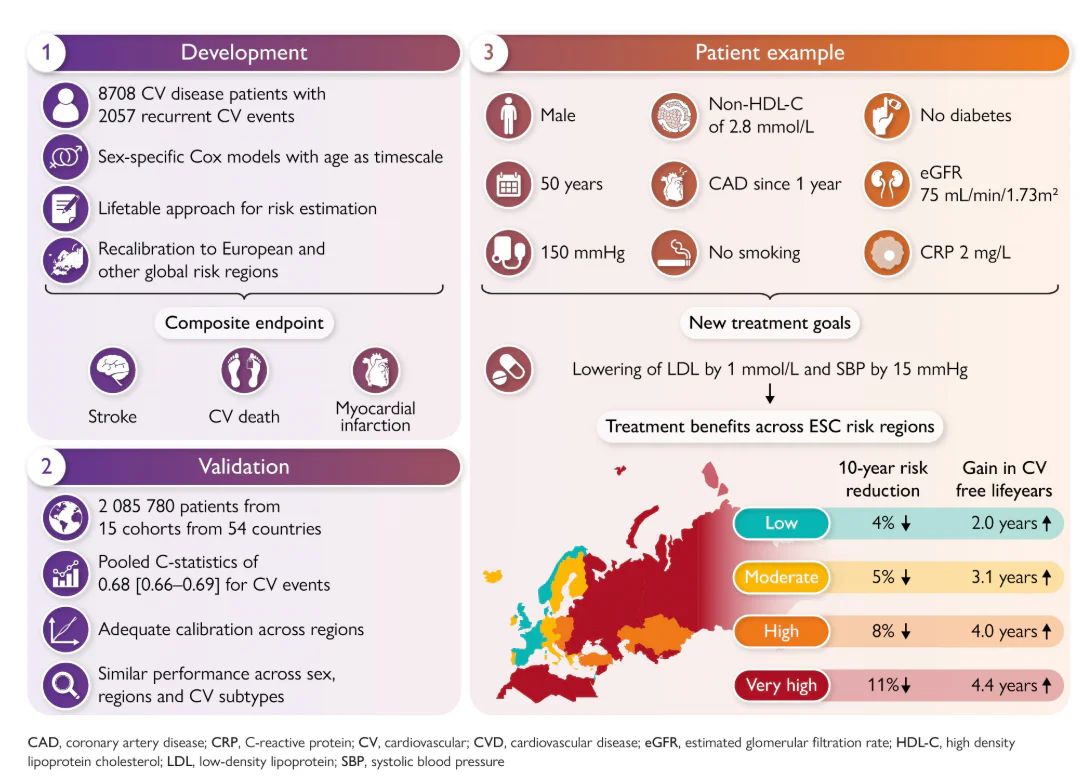
The study derived the SMART-REACH2 model using data from 8,708 individuals aged 40 to 90 years with documented coronary artery disease, cerebrovascular disease, peripheral artery disease, and/or abdominal aortic aneurysm enrolled in the University Medical Center Utrecht Secondary Manifestations of ARTerial disease (UCC-SMART) cohort.
Sex-stratified, cause-specific Cox proportional hazards models were developed with age as the timescale, incorporating routinely collected clinical predictors to estimate the risk of recurrent cardiovascular events versus non-cardiovascular death. Recurrent events included a composite endpoint of myocardial infarction, stroke, or cardiovascular death. The model was recalibrated systematically using representative cohorts from four distinct European risk regions and other global areas defined by varying baseline cardiovascular risk profiles.
External validation was extensive, encompassing 2,085,780 patients from 54 countries, with model performance evaluated by calibration plots and discrimination metrics, including Harrell’s C-statistic.
Key Findings
During a median follow-up of 8.5 years (interquartile range 4.3 to 13.0) in the derivation cohort, 2,057 recurrent cardiovascular events were observed. In the external validation cohort, which captured a broader geographic and clinical spectrum, 307,706 events occurred.
The model demonstrated moderate discrimination with a pooled C-statistic of 0.68 (95% CI 0.66-0.69) overall, ranging from 0.66 in European low-risk regions to 0.72 in Latin America, indicating acceptable ability to differentiate between patients with and without recurrent events across diverse populations. Calibration was appropriate across all risk regions, affirming the model’s reliability in real-world settings.
Importantly, the model performed consistently regardless of sex or the specific form of ASCVD, including coronary, cerebrovascular, or peripheral artery disease, supporting its broad clinical applicability.
Using the SMART-REACH2 tool, treatment effect simulations were conducted to estimate gains in cardiovascular disease-free life expectancy for a prototypical 50-year-old patient undergoing intensified preventive treatment. This involved systolic blood pressure reduction by 15 mmHg and low-density lipoprotein cholesterol (LDL-C) lowering by 1.0 mmol/L. Results indicated that potential gains in CV disease-free life expectancy varied according to regional baseline risk, from approximately 2 years in low-risk European regions up to 4.4 years in very-high-risk regions.
Expert Commentary
The SMART-REACH2 model represents a significant advancement in secondary prevention risk stratification by integrating geographically tailored recalibration and sex-specific analyses. This aligns well with ESC guideline recommendations advocating for personalized risk assessment and shared decision-making when intensifying preventive therapies in ASCVD patients.
The model’s moderate C-statistic is consistent with the challenges of predicting recurrent events in heterogeneous clinical populations and highlights the multifactorial nature of cardiovascular risk, which may include variables not captured by routine predictors. Despite this, its practical recalibration to diverse global populations mitigates limitations related to temporal and geographical differences in disease epidemiology and management.
Nevertheless, limitations include potential residual confounding inherent in observational cohorts and the exclusion of novel biomarkers or imaging data that could refine risk estimates. Also, the model’s clinical utility depends on its integration into practice workflows and clinician familiarity with lifetime risk communication tools.
Conclusion
The SMART-REACH2 model is a robust, externally validated tool for estimating lifetime risk of recurrent cardiovascular events and the benefits of preventive treatment in patients with established atherosclerotic cardiovascular disease. Its recalibration for different global risk regions and consistency across sexes and disease subtypes enhances clinical applicability worldwide.
By quantifying gains in cardiovascular disease-free life expectancy, the model supports guideline-endorsed shared decision-making, enabling clinicians and patients to personalize preventive strategies based on a comprehensive understanding of risks and benefits. Future directions include incorporating emerging risk markers and digital tools to facilitate broader adoption and dynamic risk re-assessment.
Funding and ClinicalTrials.gov
The study was supported by institutional research funds and collaborative networks as part of the ESC Cardiovascular Risk Collaboration. No clinical trial registration number is cited as this analysis used observational cohort data.
References
- Holtrop J, et al. Predicting lifetime cardiovascular risk and benefits of preventive treatment in patients with established atherosclerotic cardiovascular disease: the SMART-REACH2 model. Eur Heart J. 2026;47(39):5840-5856. PMID: 42246978.
- Visseren FLJ, et al. 2021 ESC Guidelines on cardiovascular disease prevention in clinical practice. Eur Heart J. 2021;42(34):3227-3337.
- Yeh RW, et al. Risk prediction for patients with cardiovascular disease: current methodologies and emerging applications. Circulation. 2020;141(11):890-902.