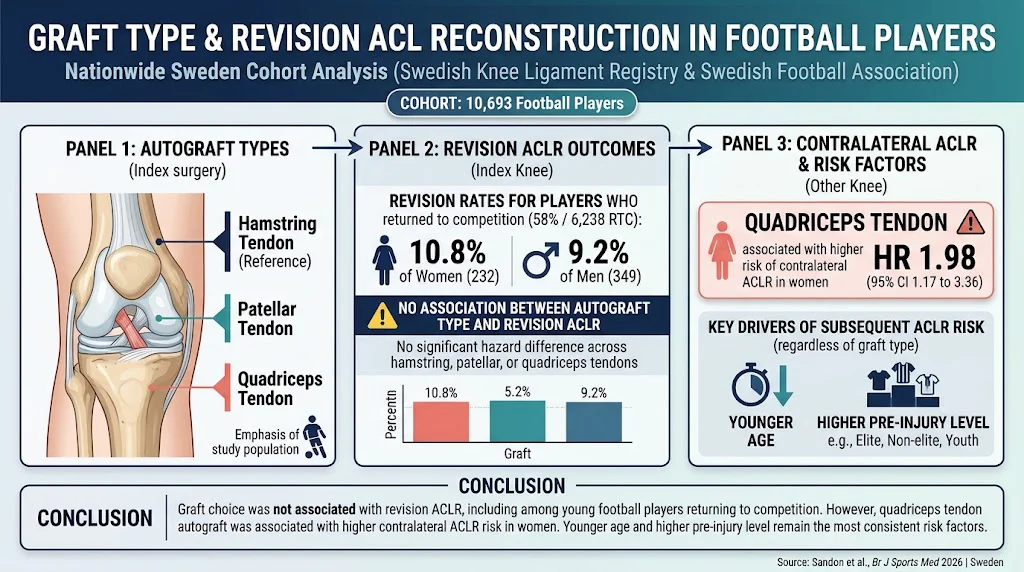
This large Swedish cohort study assessed the association of autograft type with revision ACL reconstruction (ACLR) risk among football players.
Graft choice — hamstring, patellar, or quadriceps tendon — showed no significant influence on revision ACLR risk after return to competition.
Women receiving quadriceps tendon autografts demonstrated a notably higher hazard for contralateral ACLR, a finding not observed in men.
Patient age and pre-injury competitive level were the most consistent predictors of subsequent ACL injury requiring reconstruction.
Study Background
Anterior cruciate ligament (ACL) injuries are among the most common and debilitating sports injuries, particularly in football (soccer) athletes. Reconstruction surgery using autografts is the standard treatment to restore knee stability and enable return to sport. However, the choice of graft type—most commonly hamstring tendon, patellar tendon, or quadriceps tendon—varies among surgeons and may impact outcomes including graft failure and contralateral injury. Understanding whether graft selection influences the risk of needing revision surgery or developing injury in the opposite knee is crucial for guiding surgical decision-making and optimizing athlete outcomes. This study addresses a significant clinical question: Does the type of autograft used in primary ACL reconstruction influence subsequent revision risk in football players? Prior studies have produced conflicting results, often limited by small cohorts, heterogeneity of athletes, or short follow-up. This nationwide, registry-based investigation in Sweden uniquely combines surgical and sports participation data to provide comprehensive long-term evidence in this athlete population.
Study Design
This was a nationwide cohort study utilizing data from two linked registries: the Swedish Knee Ligament Registry and the Swedish Football Association’s player register, covering surgeries from 2014 to 2023. The study cohort included 10,693 registered football players who underwent primary ACL reconstruction with one of three common autografts: hamstring tendon (reference group), patellar tendon, or quadriceps tendon. Return to competition (RTC) was defined as participation in at least one official football match post-surgery. Sex-stratified, cause-specific Cox proportional hazards models were applied to evaluate the association between graft type and two outcomes: revision ACL reconstruction on the operated knee and contralateral ACL reconstruction. Models were adjusted for confounders including age and pre-injury playing level (categorized as Elite, Non-elite, or Youth). Sensitivity analyses explored effects in age-restricted subgroups. Mean follow-up time was approximately 5.2 years.
Key Findings
Among the 6,238 players who returned to competition, the mean age was 22 years and balanced across graft groups. Revision ACL reconstruction occurred in 10.8% of women (232 patients) and 9.2% of men (349 patients) with no statistically significant differences in revision rates according to graft type. This finding persisted after adjusting for age and competition level.
Regarding contralateral ACL injuries, 12.2% of women (263 patients) and 6.9% of men (264 patients) underwent ACL reconstruction on the opposite knee during follow-up. Notably, women who received quadriceps tendon autografts showed nearly double the hazard for contralateral ACL reconstruction compared to hamstring tendon graft recipients (hazard ratio 1.98, 95% confidence interval 1.17 to 3.36). This elevated risk was not observed in men or in overall cohort analyses including all ages.
Consistently, younger players and those with higher pre-injury competitive levels demonstrated significantly increased risks of both revision and contralateral ACL reconstruction, underscoring the influence of intrinsic and activity-related risk factors.
Sensitivity analyses focusing on younger age subsets confirmed the lack of graft-related differences in revision risk but supported the association of patient demographics and activity level with subsequent injury risk.
Expert Commentary
This extensive study provides robust, real-world evidence that graft selection among commonly used autografts does not independently predict revision ACL reconstruction risk in football players. The lack of graft-specific impact on revision agrees with growing literature suggesting that patient-specific factors and rehabilitation play more critical roles in graft survival.
The finding of increased contralateral ACL injury risk in women receiving quadriceps tendon autografts is intriguing but requires cautious interpretation. Possible explanations include altered knee biomechanics or rehabilitation protocols tailored to the graft type, though causality cannot be established from registry data alone. Further biomechanical and prospective studies are warranted to explore underlying mechanisms.
Additionally, the study confirms that younger athletes and those competing at elite levels carry elevated risk, consistent with their higher exposure to high-intensity sport demands and potentially riskier movement patterns.
Limitations include potential confounding by unmeasured variables such as surgeon experience, graft fixation methods, rehabilitation adherence, and genetic predispositions. While registry data strengthens external validity, it lacks detailed biomechanical and functional assessments.
Conclusion
This comprehensive nationwide cohort analysis in football players demonstrates that autograft choice among hamstring, patellar, or quadriceps tendons does not significantly influence the risk of revision ACL reconstruction after return to sport. However, quadriceps tendon autografts may confer increased contralateral ACL injury risk in women, a finding meriting further research. Importantly, younger age and higher pre-injury level of play remain the strongest predictors of subsequent ACL injury requiring surgery. These data support individualized surgical graft selection focused on patient and contextual factors rather than graft type alone and emphasize preventive strategies targeting younger and elite athletes to reduce re-injury rates.
Funding and Trial Registration
Funding information was not specified in the referenced publication. The study utilized data from the Swedish Knee Ligament Registry and the Swedish Football Association; no clinical trial registration number was indicated.
References
1. Sandon A, Forssblad M. Graft type is not associated with revision ACL reconstruction in football players: a nationwide cohort analysis of subsequent ACL reconstructions. Br J Sports Med. 2026 Oct 12;60(20):1561-1569. PMID: 42692807.
2. Samuelsen BT, et al. Hamstring tendon versus patellar tendon autograft for ACL reconstruction: a systematic review with meta-analysis. Am J Sports Med. 2017;45(9):2222-2232.
3. Paterno MV, et al. Incidence of second ACL injuries 2 years after primary ACL reconstruction and return to sport. Am J Sports Med. 2014;42(7):1567-1573.
4. Webster KE, et al. Comparison of graft rupture rates following ACL reconstruction: a systematic review and meta-analysis. Sports Med. 2016;46(8):1157-1168.
5. Grassi A, et al. Contralateral ACL injury risk after primary ACL reconstruction: systematic review and meta-analysis. Knee Surg Sports Traumatol Arthrosc. 2020;28(4):1317-1328.
These references provide context and corroborate findings and limitations discussed.