Highlight
- Testosterone replacement therapy (TRT) and androgen deprivation therapy (ADT) exert distinct and tissue-specific effects on lipid metabolism in plasma and skeletal muscle in men.
- TRT suppresses circulating lipid species in plasma but promotes intramuscular lipid accumulation, whereas ADT causes depletion of intramuscular lipid classes and increases fat mass.
- Skeletal muscle emerges as a pivotal site for androgen-sensitive metabolic regulation, revealing mechanisms potentially underpinning cardiometabolic risks associated with male hypogonadism.
Study Background
Male hypogonadism, characterized by reduced serum testosterone levels, is recognized for its association with adverse cardiometabolic outcomes, including increased risk of type 2 diabetes, cardiovascular disease, and unfavorable body composition changes. Despite this clinical significance, the precise tissue-specific metabolic pathways disrupted in hypogonadism remain inadequately understood, limiting targeted therapeutic approaches. Prior metabolomic studies in hypogonadism have primarily focused on plasma profiling, providing limited insight into local tissue metabolism, particularly within skeletal muscle, a central organ for systemic metabolic homeostasis and lipid utilization.
Study Design
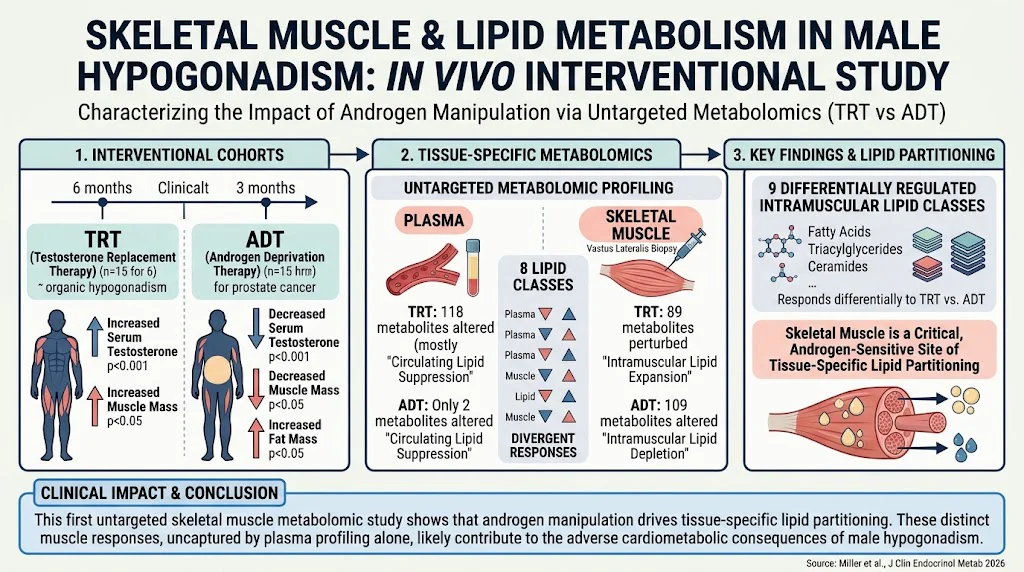
This parallel, prospective interventional study was designed to elucidate tissue-specific metabolic alterations consequent to manipulation of androgen levels. Two cohorts of men were enrolled: one initiating testosterone replacement therapy (TRT) for organic hypogonadism (n=15) and the other undergoing androgen deprivation therapy (ADT) for prostate cancer (n=15). Both interventions lasted six months for TRT and three months for ADT. Comprehensive metabolic phenotyping was conducted, including plasma sampling and skeletal muscle biopsies from the vastus lateralis muscle before and after intervention. Untargeted metabolomic profiling was performed on both plasma and muscle samples at baseline and post-treatment to map global metabolic changes associated with androgen modulation.
Key Findings
Serum testosterone levels rose significantly following TRT (p<0.001), accompanied by a measurable increase in muscle mass (p<0.05). Conversely, ADT resulted in marked testosterone suppression (p<0.001), decreased muscle mass (p<0.05), and increased fat mass (p<0.05).
In plasma, TRT considerably altered 118 metabolites, predominantly reflecting a suppression of circulating lipid species. Notably, ADT influenced only two plasma metabolites, indicating minimal plasma metabolomic changes despite substantial systemic androgen suppression.
Contrastingly, skeletal muscle metabolomics revealed robust responses to both interventions. TRT modified 89 muscle metabolites characterized by an expansion of intramuscular lipid species, suggesting augmented lipid storage or altered lipid processing within muscle tissue. ADT altered 109 metabolites in muscle, primarily demonstrating depletion across multiple intramuscular lipid classes including fatty acids, triacylglycerides, and ceramides.
Comparing plasma and muscle responses, eight lipid classes displayed divergent behavior following TRT, underscoring tissue-specific partitioning of lipid metabolic changes. Furthermore, nine lipid classes in muscle demonstrated differential modulation between TRT and ADT, emphasizing the distinct metabolic consequences of increasing versus depleting androgen activity in muscle.
Expert Commentary
This study provides compelling evidence for skeletal muscle as a central regulator of androgen-sensitive lipid metabolism, revealing complexity beyond plasma biomarker profiles. The dissociation between plasma and muscle metabolomic responses underscores the limitations of plasma-only studies in revealing tissue-specific metabolic alterations underpinning hypogonadism’s cardiometabolic phenotypes.
Intramuscular lipid accumulation observed with TRT may reflect enhanced lipid storage capacity, potentially beneficial for muscle function and insulin sensitivity. Conversely, ADT-associated lipid depletion and fat mass gain suggest disrupted lipid homeostasis contributing to metabolic deterioration. These findings align with clinical observations of worsened metabolic profiles in men undergoing ADT and improved parameters with TRT, offering mechanistic insights into their divergent metabolic impacts.
While the sample size was moderate, the use of paired biopsies and comprehensive metabolomic profiling strengthens the validity of the conclusions. However, longer-term studies and functional metabolic assays are needed to fully delineate causality and explore the reversibility of these metabolic alterations.
Conclusion and Summary
This pioneering in vivo, untargeted metabolomic study delineates the distinct and tissue-specific effects of androgen manipulation on lipid metabolism in men. It firmly positions skeletal muscle as a critical organ in the metabolic sequelae of male hypogonadism, with implications for cardiometabolic risk stratification and therapeutic targeting.
Understanding tissue-specific metabolic responses to androgen therapies may pave the way for improved management strategies, balancing anabolic benefits with metabolic risk. Future research should aim to integrate metabolomic findings with functional metabolic tests and clinical outcomes, ultimately guiding personalized hypogonadism treatment and cardiovascular risk reduction.
Funding and Trial Registration
Funding sources for this study were not specified in the original article abstract. Details on registration in clinical trial databases were not provided.
References
- Miller C, Cussen L, McDonnell T, et al. Skeletal muscle is a critical site of disrupted lipid metabolism in male hypogonadism: an in vivo interventional study. The Journal of Clinical Endocrinology and Metabolism. 2026 Oct 22; PMID: 42908258. Available from: https://pubmed.ncbi.nlm.nih.gov/42908258/
- Corona G, Rastrelli G, Vignozzi L, Maggi M. Hypogonadism as a risk factor for cardiovascular mortality. Nat Rev Endocrinol. 2015;11(7):436-446.
- Basaria S. Male hypogonadism. Lancet. 2014;383(9924):1250-1263.