Highlights
- Multisite mucous membrane pemphigoid (MMP) exhibits heterogeneity in site-specific treatment response, with persistent oral and ocular disease frequently preventing comprehensive remission.
- Concurrent complete remission across all involved sites (multisite complete remission, mCR) is achieved in fewer than half of multisite MMP patients, despite high rates of site-level remission.
- Rituximab-based regimens and Janus kinase (JAK) inhibitors demonstrate promising efficacy in improving mucosal lesions, though treatment-related adverse events necessitate careful management.
- Relapse after site-level complete remission is common, particularly in oral and ocular mucosa, underscoring the need for vigilant monitoring and tailored therapeutic strategies.
Background
Mucous membrane pemphigoid (MMP) is a rare, chronic autoimmune blistering disorder characterized by subepithelial blistering predominantly affecting mucous membranes. Progressive fibrosis and scarring following inflammation often culminate in significant morbidity, including blindness and airway compromise, particularly when high-risk sites such as ocular, laryngeal, esophageal, or anogenital mucosa are involved. The multisite nature of MMP complicates therapeutic management and outcome assessment. Historically, remission rates have been reported in cohorts mixing localized with multisite disease, limiting understanding of disease trajectory and therapeutic efficacy across simultaneous mucosal sites. The heterogeneity inherent in individual site response and relapse patterns necessitates a refined understanding to guide optimized, site-specific management.Key Content
Comprehensive Review of Multisite Disease and Remission Patterns
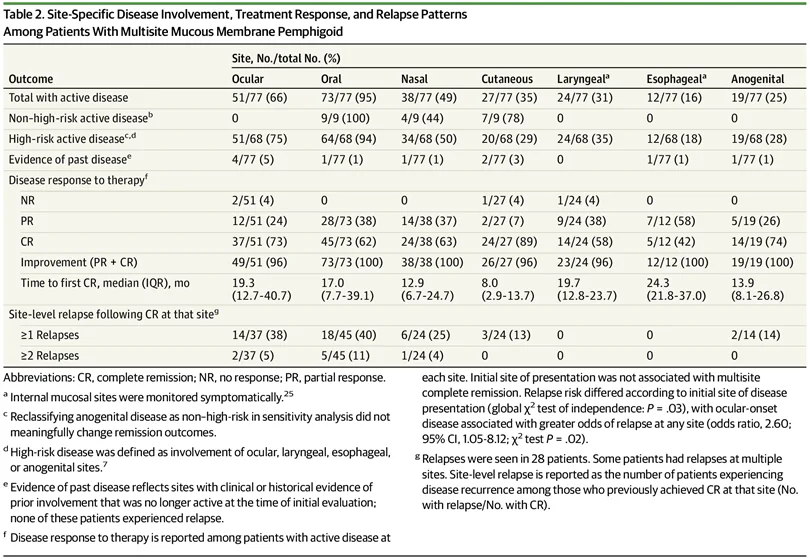
In the landmark retrospective cohort by McAleer et al. (2026), 77 patients with biopsy-confirmed multisite MMP and minimum 12-month follow-up were studied to elucidate concurrent remission patterns. High-risk involvement was prevalent (88%) with oral mucosa being the most commonly affected site (95%), followed by ocular (66%) and nasal mucosa (49%). While 83% attained complete remission (CR) at one or more individual sites, only 45% reached multisite complete remission (mCR), defined as simultaneous CR across all affected sites regardless of ongoing therapy. The median time to mCR was approximately 32 months, reflecting the chronic and relapsing nature of disease. Relapse occurred in 44% of patients post site-level CR, disproportionately affecting oral (64% of relapses) and ocular mucosa (50%). Multi-site relapses highlighted the dynamic disease behavior and the challenges of maintaining durable control especially in these high-risk sites.Therapeutic Classes and Efficacy
Rituximab-based regimens, an anti-CD20 monoclonal antibody targeting B cells, emerged as an effective treatment modality, with notable improvement across multiple mucosal sites. Its immunomodulatory role aligns with pathogenic mechanisms involving autoantibody-producing B-cells, supporting its therapeutic rationale. Janus kinase inhibitors (JAKi) also demonstrated high rates of mucosal improvement, representing a novel immunomodulatory approach targeting intracellular signaling pathways crucial in inflammation and autoimmunity. However, serious adverse events were notably frequent among patients receiving cyclophosphamide monotherapy and JAK inhibitors, underscoring the delicate balance between efficacy and safety in MMP management.Site-Specific Disease Behavior and Outcome Measures
Persistent oral and ocular involvement underpin the core barriers to achieving global disease control. The site-specific resistance to remission may be attributable to unique microenvironmental factors, tissue-specific immune responses, or differential drug penetration and pharmacodynamics. This recognition prompts a paradigm shift from conventional aggregated remission outcomes to implementing standardized multisite remission metrics. Such metrics would capture the nuanced disease activity across distinct mucosal territories, offering more precise monitoring and therapeutic tailoring.Expert Commentary
The study by McAleer et al. advances the field by illuminating the complexity of multisite MMP and emphasizing the importance of comprehensive disease assessment beyond single-site evaluation. Their findings corroborate prior smaller-scale studies suggesting that oral and ocular mucosa are particularly challenging to control and are predilection sites for relapse. Therapeutic advances with rituximab have been increasingly adopted since early 2010s, supported by growing evidence from real-world cohorts reflecting significant clinical benefit. JAK inhibitors, while promising, still require cautious integration into practice given the emerging safety signals and limited controlled trial data. Mechanistically, MMP pathogenesis involves autoantibodies targeting various basement membrane zone components, with site-specific antigen expression potentially influencing disease phenotype and treatment response. Persistent inflammation and fibrosis in oral and ocular mucosa could also reflect tissue-specific immunopathology and repair mechanisms, necessitating targeted adjunctive therapies. The study’s retrospective design and single-center setting limit generalizability; nevertheless, it underscores the unmet need for multicentric prospective registries and clinical trials incorporating multisite-specific outcome measures. Future research should focus on elucidating mechanistic underpinnings of site-specific disease persistence, optimizing therapeutic sequencing, and mitigating adverse effects.Conclusion
Multisite mucous membrane pemphigoid presents a formidable clinical challenge due to heterogeneous site involvement, differential response patterns, and high relapse rates, particularly in oral and ocular mucosa. The realization that fewer than half of patients achieve simultaneous remission across all sites despite effective therapies calls for a refined approach emphasizing site-specific disease behavior and outcomes. Rituximab-based therapy remains a mainstay for multisite MMP, complemented by emerging JAK inhibitors. Clinicians must balance efficacy with safety, especially when employing cyclophosphamide and JAK inhibitors. Standardizing multisite remission definitions and incorporating them into clinical practice and research is imperative to advance personalized management strategies, improve patient outcomes, and facilitate comparability across studies. Interdisciplinary care involving dermatology, ophthalmology, otolaryngology, and gastroenterology remains critical given anatomical complexity.References
- McAleer L, La T, Li M, Cao JH, Dominguez AR. Site-Specific Treatment and Remission Patterns in Multisite Mucous Membrane Pemphigoid. JAMA Dermatol. 2026 Oct 28. PMID: 42949703.
- Nguyen VT, Murrell DF. Mucous membrane pemphigoid: an update on diagnosis and treatment. Expert Rev Clin Immunol. 2017;13(8):733-744. PMID: 28697357.
- Frew JW, Murrell DF. Pemphigoid diseases. Dermatol Clin. 2018;36(4):419-431. PMID: 30013097.
- Chan LS et al. The recognition, classification, management, and pathogenesis of mucous membrane pemphigoid. Autoimmun Rev. 2015;14(4):353-369. PMID: 25883098.
- Chen M, et al. The safety and efficacy of rituximab treatment in autoimmune blistering diseases: a systematic review. Autoimmun Rev. 2018;17(3):295-304. PMID: 29303433.
- Jacobelli S, et al. Janus kinase inhibitors in dermatology: emerging evidence and future directions. Front Med (Lausanne). 2022;9:902338. PMID: 35782166.
Specialty calculators
For clinical reference; use professional judgment.