Highlight
Dupilumab, an IL-4 and IL-13 pathway inhibitor, significantly improved multiple lung function parameters in patients with chronic obstructive pulmonary disease (COPD) and type 2 inflammation across the BOREAS and NOTUS trials. Improvements were observed early (within 12 weeks) and sustained through 52 weeks, independent of smoking status or coexisting emphysema, with the greatest benefit seen in patients exhibiting higher baseline eosinophils or fractional exhaled nitric oxide (FeNO).
Study Background
Chronic obstructive pulmonary disease (COPD) is a leading cause of morbidity and mortality worldwide, characterized by progressive airflow limitation and exacerbations primarily driven by chronic inflammation. While traditionally associated with neutrophilic inflammation, approximately 20% to 40% of COPD patients exhibit type 2 inflammation, marked by elevated eosinophils and biomarkers such as FeNO, which may represent a distinct endotype responsive to targeted biologic therapies. Dupilumab is a monoclonal antibody that blocks the shared receptor subunit for interleukin-4 (IL-4) and interleukin-13 (IL-13), pivotal cytokines driving type 2 inflammation. It has shown efficacy in asthma and atopic diseases but its benefit in COPD with type 2 inflammatory features remains underexplored.
Study Design
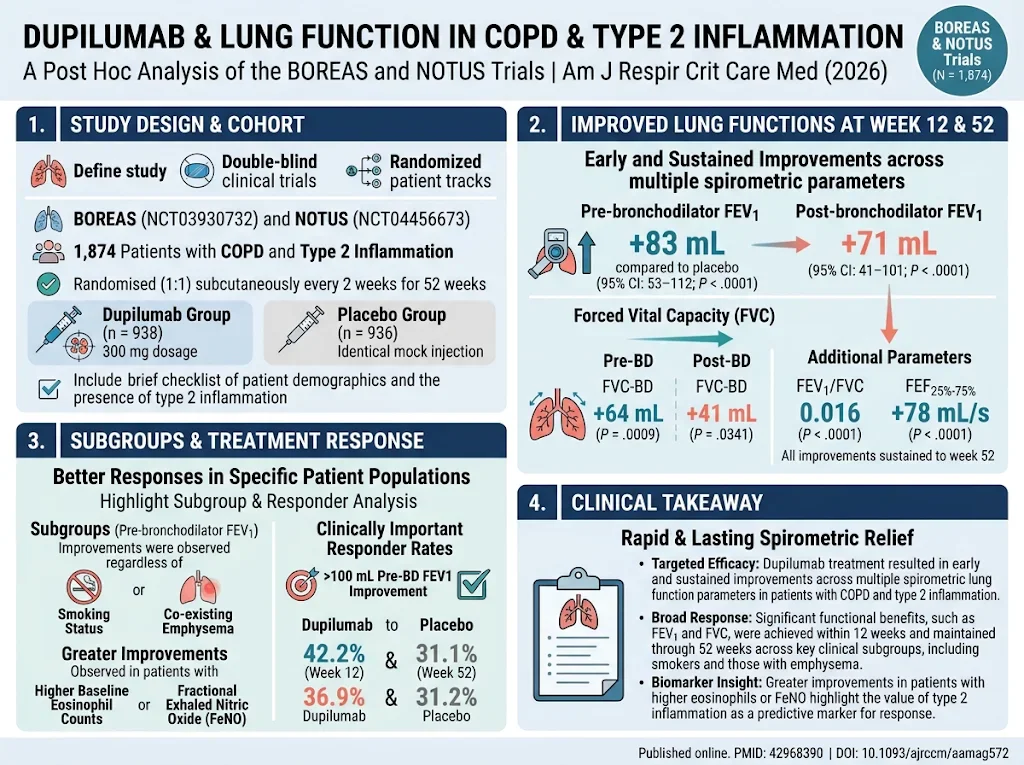
The BOREAS (NCT03930732) and NOTUS (NCT04456673) clinical trials were randomized, double-blind, placebo-controlled studies investigating the efficacy of dupilumab 300 mg administered subcutaneously every two weeks over 52 weeks in adult patients with moderate to severe COPD associated with type 2 inflammation. Type 2 inflammation was identified based on biomarkers including peripheral blood eosinophil counts and fractional exhaled nitric oxide levels. Patients were randomized to either dupilumab (n=938) or placebo (n=936). Primary endpoints included changes in lung function measures such as forced expiratory volume in 1 second (FEV1) and forced vital capacity (FVC) at predefined time points.
Key Findings
Data pooled from these trials revealed robust improvements in lung function with dupilumab compared to placebo. Notably, pre-bronchodilator FEV1 showed a least squares mean difference of 83 mL (95% CI: 53-112 mL; P < .0001) at week 12, sustained through week 52. Post-bronchodilator FEV1 improved by 71 mL (95% CI: 41-101 mL; P < .0001). Similar significant benefits were observed for pre- and post-bronchodilator FVC and post-bronchodilator FEV1/FVC ratios, indicative of better airflow and lung volume.
Forced expiratory flow between 25% and 75% of FVC, a marker of small airway function, improved by 78 mL/s (95% CI: 45-111 mL/s; P < .0001) at week 12. Importantly, nearly 42.2% of patients treated with dupilumab achieved clinically meaningful improvements (>100 mL) in pre-bronchodilator FEV1 at 12 weeks versus 31.1% on placebo; this relative advantage persisted through 52 weeks.
The efficacy of dupilumab was consistent regardless of patients’ smoking status or the presence of emphysema. Stratified analyses indicated that patients with higher baseline eosinophil counts or FeNO levels derived greater lung function benefits, supporting the concept that dupilumab’s mechanism targets a type 2-high COPD endotype.
Safety analyses, while not detailed in the abstract, from parent studies suggest that dupilumab was generally well tolerated, consistent with its safety profile in other indications.
Expert Commentary
The findings from the BOREAS and NOTUS post hoc analyses represent an important advance in COPD therapeutics, suggesting that biologic therapy targeted at type 2 inflammation can substantially improve lung function in a subset of patients. This aligns with emerging precision medicine approaches that tailor treatment based on inflammatory phenotypes rather than solely clinical severity.
However, limitations include the post hoc nature of the analyses and reliance on biomarker-defined subgroups, which may limit generalizability. Further prospective trials focusing on clinical outcomes such as exacerbation reduction and quality of life in type 2-high COPD are warranted. The biological plausibility is supported by dupilumab’s inhibition of IL-4/IL-13 signaling, cytokines implicated in airway remodeling and eosinophilic inflammation.
Conclusion
Dupilumab demonstrates early and sustained improvements in multiple spirometric parameters in patients with COPD characterized by type 2 inflammation, regardless of smoking status and emphysema. These data support the role of type 2 inflammation as a treatable trait in COPD and position dupilumab as a promising targeted therapy in this patient subgroup. Incorporation of biomarker profiling into routine COPD assessment may enable clinicians to identify patients likely to benefit from this biologic intervention, addressing an unmet need in COPD management.
Funding and ClinicalTrials.gov Information
The BOREAS and NOTUS trials were sponsored by the pharmaceutical company developing dupilumab, with clinical trial registrations NCT03930732 and NCT04456673 respectively. Details on funding sources can be found in the published trial manuscripts.
References
- Han MK, Rabe KF, Sciurba FC, Vogelmeier CF, Bhatt SP, Anzueto A, et al. Dupilumab is associated with improved lung functions in patients with COPD and type 2 inflammation: a post hoc analysis of the BOREAS and NOTUS trials. Am J Respir Crit Care Med. 2026; PMID: 42968390.
- Global Initiative for Chronic Obstructive Lung Disease (GOLD). Global Strategy for the Diagnosis, Management, and Prevention of COPD. 2024 Report.
- Agusti A, Bel E, Thomas M, Vogelmeier C, Brusselle G, Holgate S, et al. Treatable traits: toward precision medicine of chronic airway diseases. Eur Respir J. 2016;47(2):410-419.
Specialty calculators
For clinical reference; use professional judgment.