Highlight
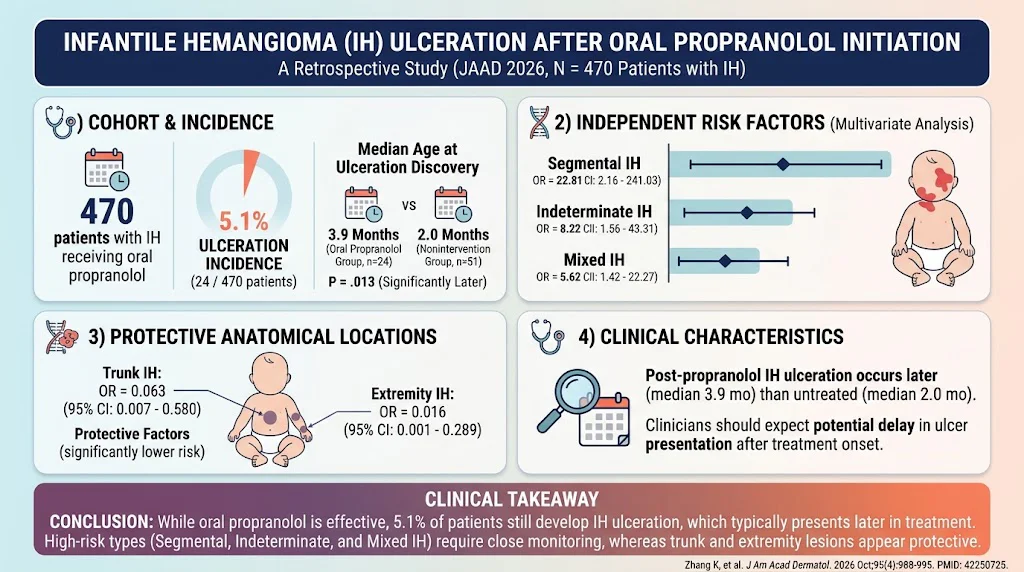
- Incidence of infantile hemangioma (IH) ulceration during oral propranolol therapy is 5.1% in a cohort of 470 treated patients.
- Ulceration onset occurs significantly later under propranolol treatment compared to untreated ulcerations (median 3.9 vs. 2.0 months).
- Multivariate analysis identifies mixed, indeterminate, and segmental IH subtypes as independent risk factors for ulceration during propranolol therapy.
- IHs located on the trunk and extremities exhibit a protective effect against ulceration compared to head and neck regions.
Study Background
Infantile hemangioma (IH) is the most common benign vascular tumor of infancy, often appearing within the first weeks of life. While many IHs spontaneously regress without intervention, a subset develops complications such as ulceration, which can cause pain, bleeding, infection, and potential scarring. Ulceration represents a significant clinical challenge in management due to its morbidity and impact on cosmetic and functional outcomes. Since 2008, oral propranolol has become the first-line treatment for problematic IH owing to its efficacy in promoting lesion involution. However, ulceration can still occur during propranolol therapy, a phenomenon that has not been thoroughly characterized in terms of frequency, timing, clinical features, and risk factors. Understanding which patients remain at higher risk during treatment could improve monitoring strategies and outcomes.Study Design
This retrospective single-center study was conducted at a tertiary referral center, evaluating 470 patients who received oral propranolol therapy for IH and comparing 51 patients with ulcerated IHs who did not receive intervention. Oral propranolol dosing and treatment regimens followed institutional protocols. The primary outcome was the incidence of ulceration occurring after propranolol initiation. Secondary analyses examined timing of ulceration onset, hemangioma subtype classification (focal, segmental, mixed, indeterminate), anatomical location, and associated risk factors. Ulceration diagnosis was clinical. Multivariate logistic regression was used to identify independent predictors of ulceration among propranolol-treated infants.Key Findings
The study confirmed that ulceration during propranolol treatment occurs in 5.1% (24/470) of patients, a noteworthy subset given propranolol’s high efficacy in hemangioma management. Importantly, ulceration onset during oral propranolol was later—median age 3.9 months—compared to earlier ulcerations in untreated infants, median 2.0 months (P = .013). Risk factor analysis yielded meaningful insights: – The mixed subtype of IH increased the odds of ulceration 5.6-fold (OR 5.620, 95% CI 1.419–22.265). – Indeterminate hemangiomas were associated with an 8.2-fold increased risk (OR 8.219, 95% CI 1.560–43.305). – Segmental IHs demonstrated the highest risk, with an OR of 22.8 (95% CI 2.157–241.028), indicating these lesions are particularly vulnerable to ulceration despite propranolol therapy. Conversely, IH locations on the trunk and extremities were protective against ulceration, with ORs 0.063 (trunk) and 0.016 (extremities), suggesting that anatomic site influences ulceration risk. This may reflect differences in skin thickness, vascular supply, or mechanical stress at different sites.Clinical Characteristics
Ulcerations during treatment were consistent with typical painful necrotic lesions on the IH surface, necessitating careful wound management. The delay in ulceration onset in propranolol-treated patients may indicate a protective but not absolute effect of therapy or reflect a different ulceration pathophysiology under treatment conditions.Expert Commentary
This study addresses a clinically significant gap by quantifying ulceration risk post-propranolol initiation and identifying high-risk subtypes and anatomical sites. The markedly increased risk seen in segmental IHs aligns with known associations of this subtype with complications, likely related to their larger size and deeper involvement. Notably, the protective effect seen with trunk and extremity IHs supports prior observations that IH morphology and location impact clinical course. These findings may influence prophylactic strategies and tailored monitoring in clinical practice. However, as a single-center retrospective study, the results may reflect referral biases or local treatment protocols limiting external generalizability. Prospective multicenter validation would strengthen confidence in these associations. Mechanistically, the ulceration during propranolol treatment might be influenced by differential vascular remodeling or localized ischemia in high-risk subtypes. Further mechanistic studies could elucidate these pathways and refine therapeutic approaches.Conclusion
Oral propranolol remains transformative in IH management, yet ulceration occurs in a modest but clinically important fraction of treated infants. This study reveals that ulceration risk is higher in segmental, mixed, and indeterminate IH subtypes and is mitigated by lesions located on the trunk or extremities. Clinicians should maintain heightened vigilance for ulceration signs in these high-risk populations during propranolol therapy to optimize outcomes. This insight underpins a more personalized risk-based approach to IH management, including patient counseling and monitoring. Future research should explore prospective risk stratification models and investigate adjunctive or alternative therapies for ulceration-prone IH subtypes. Ultimately, optimizing treatment algorithms will reduce ulceration-associated morbidity and improve quality of life for affected infants.Funding and ClinicalTrials.gov
The study did not specify funding sources or clinical trial registration, highlighting a need for future prospective trials with standardized reporting.References
1. Léauté-Labrèze C, Hoeger P, Mazereeuw-Hautier J, et al. A randomized, controlled trial of oral propranolol in infantile hemangioma. N Engl J Med. 2015;372(8):735-746. 2. Drolet BA, Frommelt PC, Chamlin SL, et al. Initiation and use of propranolol for infantile hemangioma: report of a consensus conference. Pediatrics. 2013;131(1):128-140. 3. Tollefson MM, Frieden IJ. Early growth of infantile hemangiomas: what a prospective study tells us. Pediatrics. 2012;130(1):e 27-34. 4. Zhang K, Qiu T, Gong X, et al. Incidence, clinical characteristics and risk factors for infantile hemangioma ulceration after oral propranolol initiation: A retrospective study. J Am Acad Dermatol. 2026 Jun;95(4):988-995. PMID: 42250725.Specialty calculators
For clinical reference; use professional judgment.