Highlight
- One-shade and multi-shade flowable composites demonstrated similar objective color matching in NCCL restoration.
- Both composites exhibited high retention rates and satisfactory clinical performance over 18 months.
- Multi-shade composites showed a statistically superior visual color match, but all restorations remained clinically acceptable.
- The one-shade composite offers a simplified restorative approach by eliminating shade selection without compromising durability or esthetics.
Study Background
Non-carious cervical lesions (NCCLs) represent a common clinical challenge characterized by loss of dental hard tissue at the cementoenamel junction without caries involvement. Their multifactorial etiology—ranging from mechanical abrasion to erosion and abfraction—makes effective restorative treatment imperative to prevent hypersensitivity, further tissue loss, and aesthetic concerns. Clinicians commonly utilize resin-based flowable composites for NCCL restoration, valuing their adaptability and minimally invasive placement.
Accurate color matching between restorative material and natural tooth structure is critical, particularly in esthetically sensitive regions such as the cervical third. Traditionally, multi-shade composites allow tailored color selection to match the patient’s dentition. However, this process is time-consuming and reliant on clinician expertise and lighting conditions, with potential for error.
Recently, one-shade composite materials designed to adapt optically to adjacent tooth color have emerged to simplify clinical workflow. Nonetheless, there remains limited high-quality clinical evidence comparing one-shade composites to conventional multi-shade flowable composites in NCCLs, particularly in terms of objective color matching and longitudinal clinical performance.
Study Design
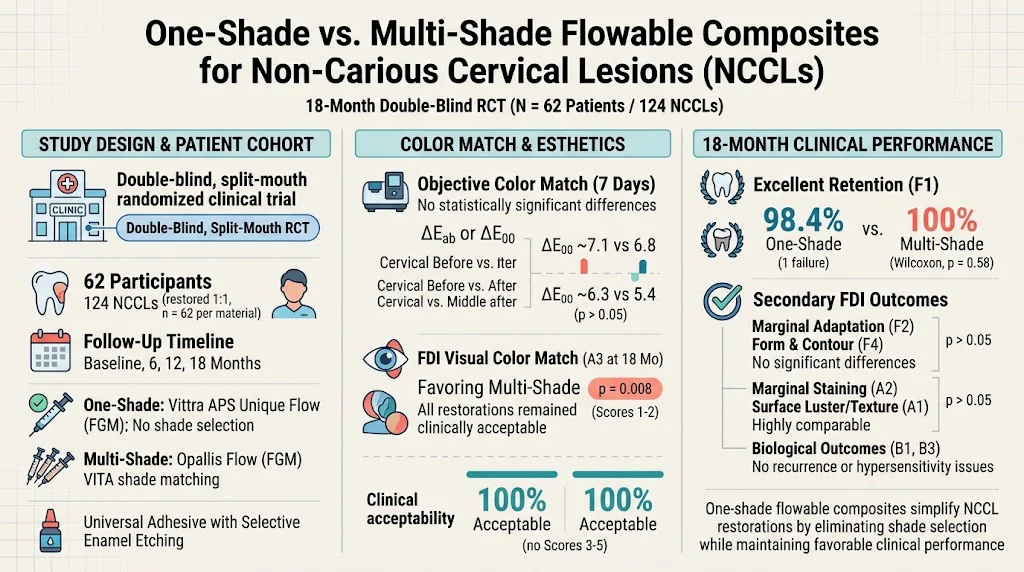
This multicenter, double-blind, split-mouth randomized clinical trial enrolled 62 adult participants presenting with bilateral NCCLs. Each participant received two restorations: one with a one-shade flowable composite (Vittra APS Unique Flow, FGM) and the other with a conventional multi-shade flowable composite (Opallis Flow, FGM), randomized to tooth side. The split-mouth design minimized inter-subject variability in oral environment and occlusal forces.
Objective color matching was quantitatively assessed 7 days post-restoration using spectrophotometry, comparing color differences (ΔEab and ΔE00) between cervical thirds before and after restoration, and between cervical and middle thirds after restoration. Clinical evaluations were conducted at baseline, 6, 12, and 18 months using validated Fédération Dentaire Internationale (FDI) criteria assessing retention, color match, surface texture, marginal integrity, biological compatibility, and patient-reported outcomes.
Statistical analyses included paired Student’s t-tests and Wilcoxon signed-rank tests with a significance threshold of α = 0.05.
Key Findings
A total of 124 restorations were analyzed (62 per composite type). Objective color difference metrics (ΔEab and ΔE00) showed no significant differences between one-shade and multi-shade composites at 7 days (p > 0.05), indicating comparable initial color blending at a quantitative level.
Over the 18-month follow-up period, retention failures were minimal, with 98.4% retention for one-shade composites and 100% for multi-shade composites; the difference was not statistically significant. Other clinical parameters including marginal adaptation, surface texture, biological response, and functional criteria demonstrated equivalence between materials.
Visual color match assessments revealed the multi-shade flowable composite achieved a higher frequency of clinically excellent or very good ratings at 18 months (p = 0.008). Nevertheless, all restorations, irrespective of composite used, maintained clinically acceptable color match scores, implying no esthetic compromise with the one-shade system.
No significant adverse events or hypersensitivity issues attributable to the materials were reported, supporting safety profiles consistent with resin-based composite standards.
Expert Commentary
This rigorously designed trial addresses an important clinical dilemma by objectively quantifying and clinically corroborating the esthetic and functional equivalence of one-shade versus multi-shade flowable composites in NCCL restoration. The split-mouth design and blinded evaluation strengthen internal validity.
While the superior visual color match of multi-shade composites suggests a potential esthetic advantage, the one-shade composite’s performance remains within clinically acceptable thresholds. In clinical practice, the simplified, rapid application of one-shade materials without shade selection is advantageous, especially in high-volume or resource-constrained settings.
Limitations include the relatively short follow-up for restorations expected to last multiple years and the exclusive use of composites from the same manufacturer, which may limit generalizability.
Future research should evaluate longer-term outcomes, patient-centered esthetic satisfaction, and performance in varied populations including NCCLs with differing substrate characteristics.
Conclusion
The one-shade flowable composite demonstrated comparable 18-month clinical performance and objective color matching to a conventional multi-shade flowable composite for NCCL restorations. Although visual assessment favored multi-shade composites for color match, all restorations remained clinically acceptable, highlighting the potential of one-shade materials to simplify procedures without compromising outcomes. These findings support the incorporation of one-shade flowable composites as a reliable option in restorative dentistry for non-carious cervical lesions.
Funding and Clinical Trials Registration
The study was conducted by FGM and collaborators; no specific funding sources were declared in the abstract. No clinical trial registration details were provided.
References
Barbosa LMM, Favoreto MW, Cochinski GD, Monteles CF, Rocha AO, Dos Anjos LM, de Lima de Souza J, Matos TP, Loguercio AD. One-shade versus multi-shade flowable composites for non-carious cervical lesions: color match and 18-month clinical performance in a double-blind, split-mouth randomized trial. Journal of Dentistry. 2026 Oct 28;107139. PMID: 42951003.
Additional references for background and context can include recent reviews on NCCL management and composite resin developments such as:
- Alani A, Tredwin C. Diagnosis and management of non-carious cervical lesions. Dent Update. 2010;37(9):546-548, 551-552.
- Ferracane JL. Resin composite—state of the art. Dent Mater. 2011;27(1):29-38.
- Opdam NJ, Roeters FJ. New developments in cervical resin composite restorations. J Adhes Dent. 2007;9(1):85-90.
Specialty calculators
For clinical reference; use professional judgment.