Highlight
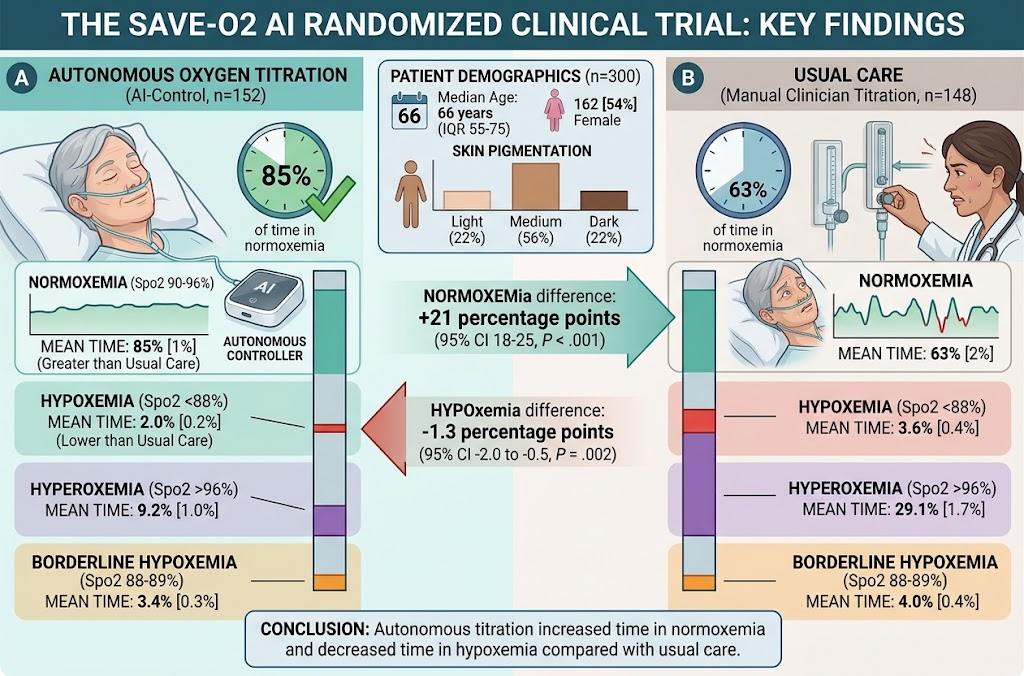
- Autonomous oxygen titration increases time spent in normoxemia (SpO2 90%-96%) from 63% to 85% in acutely ill adults compared to usual care.
- It significantly reduces hypoxemia duration (SpO2 96%).
- The randomized clinical trial enrolled 300 diverse patients across four US hospitals, demonstrating consistent efficacy across skin pigmentation groups.
- Autonomous systems can improve oxygen therapy safety and precision, addressing limitations of intermittent manual titration.
Study Background
Supplemental oxygen is a cornerstone therapy in the management of acutely ill patients with hypoxemia, including those hospitalized for respiratory illnesses, trauma, burns, or after acute care surgery. Maintaining peripheral oxygen saturation (SpO2) within a narrow normoxemic range (90%-96%) is vital to avoid the deleterious effects of both hypoxemia and hyperoxemia. However, current clinical practice involves intermittent clinician-driven titration of oxygen flow based on spot SpO2 measurements, which can result in prolonged periods of inadequate oxygenation or excess exposure to oxygen’s toxic effects. In this context, autonomous oxygen titration, leveraging artificial intelligence (AI) and real-time monitoring, offers potential to dynamically optimize oxygen delivery and enhance patient safety.
Study Design
The SAVE-O2 AI randomized clinical trial was a multicenter, unblinded, parallel-group study conducted at four US hospitals between May 6, 2024, and November 17, 2025. It enrolled 300 adults hospitalized with acute respiratory illnesses, trauma, burns, or acute care surgery who required supplemental oxygen. Patients were randomized equally to either an autonomous oxygen titration intervention or to usual care involving manual titration by clinical staff. The intervention involved AI-guided autonomous adjustments of oxygen flow to maintain SpO2 within the targeted range of 90%-96% over the first 72 hours post-randomization. The primary endpoint was the proportion of time patients spent within the targeted normoxemia range. Key secondary endpoints included time spent in hypoxemia (SpO2 96%). The trial enrolled a diverse cohort with a balance of skin pigmentation categories to assess potential effects on pulse oximetry accuracy.
Key Findings
The autonomous oxygen titration group achieved a significantly higher mean proportion of time in normoxemia—85% (SE 1%) compared to 63% (SE 2%) in the usual care group (adjusted risk difference [RD] 21 percentage points, 95% CI 18-25, P < .001). This improvement reflects markedly enhanced precision in oxygen delivery and continuous maintenance within the target saturation range.
Importantly, the autonomous group also spent significantly less time in hypoxemia (2.0% vs 3.6%; adjusted RD -1.3 percentage points, 95% CI -2.0 to -0.5, P = .002), indicating a clinically meaningful reduction in potentially dangerous desaturation episodes. Time spent in hyperoxemia was reduced from 29.1% in usual care to 9.2% in the autonomous group, dramatically lowering exposure to potentially toxic high oxygen levels. Borderline hypoxemia episodes (SpO2 88%-89%) were slightly reduced as well.
Subgroup analyses showed consistent benefits across patients with light, medium, and dark skin pigmentation, addressing a known challenge in pulse oximetry accuracy related to skin color bias. Safety data suggested no adverse events directly attributable to autonomous titration.
Expert Commentary
This landmark trial validates the use of AI-driven autonomous oxygen titration technology in diverse acutely ill populations. By continuously adjusting supplemental oxygen based on real-time SpO2 readings, the system overcomes limitations of intermittent clinician-based titration, reducing both hypoxemic and hyperoxemic exposures. These findings are particularly pertinent given increasing recognition of harm from hyperoxia in critical care settings.
While prior studies have demonstrated feasibility, the SAVE-O2 AI trial robustly quantifies time-in-target improvements and safety in a large multicenter cohort. Notably, the inclusion of pigmentation diversity strengthens the applicability given known pulse oximeter biases. Nonetheless, the unblinded design could influence clinical behaviors, and longer-term clinical outcome data (mortality, length of stay) remain to be elucidated.
Future investigations should focus on integration in varied clinical environments, cost-effectiveness, and impact on patient-centered outcomes. Real-world implementation could herald a paradigm shift in oxygen therapy management, aligning with precision medicine principles.
Conclusion
The SAVE-O2 AI randomized clinical trial provides compelling evidence that autonomous oxygen titration significantly increases the proportion of time acutely ill patients spend within normoxemic SpO2 targets, while decreasing both hypoxemia and hyperoxemia relative to standard care. This technology represents a promising innovation to optimize oxygen delivery, improving safety and possibly clinical outcomes in hospitalized patients requiring supplemental oxygen. Wider adoption and further research could transform oxygen management practices across critical care and acute medicine.
Funding and Trial Registration
This trial was registered at ClinicalTrials.gov (Identifier: NCT06374225). Funding sources are detailed in the original publication by Douin et al., 2026, in JAMA Internal Medicine.
References
Douin DJ, Rice JD, Xiao M, et al. Autonomous Oxygen Titration for Maintaining Normoxemia in Acutely Ill Adults: The SAVE-O2 AI Randomized Clinical Trial. JAMA Intern Med. 2026; PMID: 42546017. https://pubmed.ncbi.nlm.nih.gov/42546017/
Additional references relevant to oxygen therapy, pulse oximetry accuracy, and automated medical device implementation can be found in contemporary clinical guidelines and systematic reviews (e.g., Intensive Care Medicine, CHEST guidelines on oxygen therapy).