Highlight
• Lipoabdominoplasty under intravenous sedation with tumescent anesthesia and transversus abdominis plane (TAP) block effectively controls intraoperative pain and anxiety.
• Majority of patients’ preoperative concerns about pain and loss of control were significantly alleviated postoperatively.
• Early postoperative recovery milestones such as ambulation, showering, and light activities were achieved sooner than or as expected.
• Sedation-based anesthesia may provide a safe and patient-acceptable alternative to general anesthesia for lipoabdominoplasty.
Study Background
Lipoabdominoplasty is a common elective cosmetic procedure aimed at improving abdominal contour. Despite advances in anesthesia techniques enabling less invasive sedation options, it remains predominantly performed under general anesthesia. Patients’ preoperative fears—particularly regarding intraoperative pain, nausea, and loss of anesthetic control—may influence this preference. Understanding whether less invasive anesthesia strategies can adequately meet patient expectations and facilitate early recovery has meaningful implications for optimizing perioperative care and enhancing patient satisfaction.
Study Design
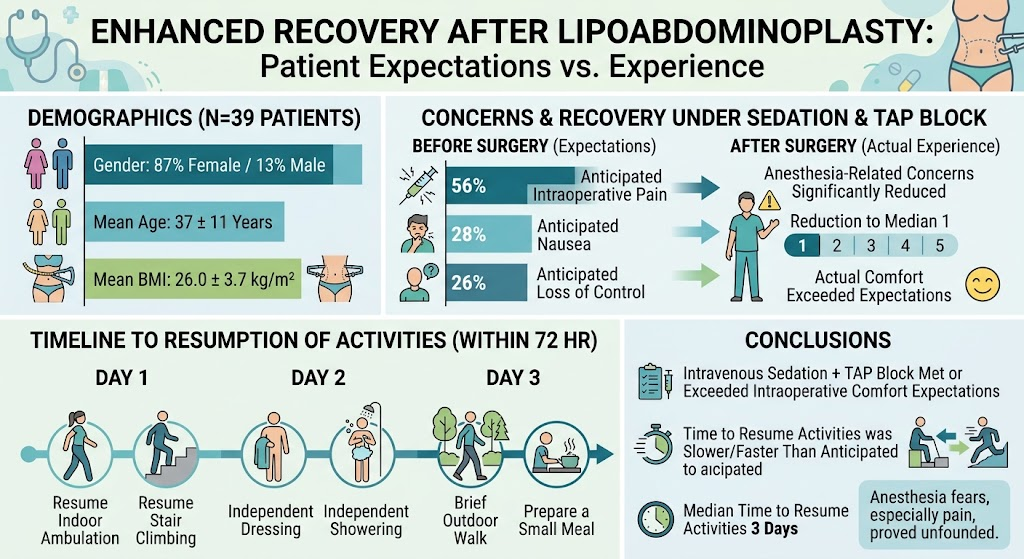
This was a single-center prospective cohort study of 39 consecutive outpatient lipoabdominoplasty patients treated from December 2020 to June 2025. The cohort was 87% female with a mean age of 37 years and mean BMI of 26.0 kg/m2. All procedures were conducted using a combination of intravenous sedation, tumescent local anesthesia, and transversus abdominis plane (TAP) nerve block. Demographic and clinical data were collected. Patient-reported outcomes on anxiety, expectations, and anesthetic experience were assessed preoperatively and within 72 hours postoperatively using validated instruments: the International Pain Outcomes (IPO) questionnaire and the BODY-Q questionnaire. Recovery milestones related to resuming daily activities were prospectively tracked and compared against patients’ preoperative expectations.
Key Findings
Among the 39 patients, preoperative expectations revealed that 56% feared intraoperative pain, 28% expected nausea, and 26% anticipated loss of control under anesthesia. Postoperatively, these anesthesia-related concerns were significantly reduced, with anxiety scores dropping from a median of 3 (interquartile range 4-2) preoperatively to 1 (1-1) on a 5-point scale. This substantial reduction illustrates that sedation combined with tumescent anesthesia and TAP block effectively alleviates patients’ fears associated with the operation.
Regarding early recovery outcomes, patients resumed key activities faster than or consistent with their expectations. Indoor ambulation and stair climbing generally resumed by postoperative day 1, independent dressing and showering by day 2, and brief outdoor walks and preparing small meals by day 3. This rapid recovery trajectory under sedation contrasts with common assumptions favoring general anesthesia for better intraoperative control but prolonged recuperation.
Safety endpoints, although not detailed in this report, were implicitly supported by patient-reported outcome improvements and early discharge suitability, suggesting the protocol’s feasibility in an outpatient setting.
Expert Commentary
This study provides valuable evidence supporting the use of multimodal anesthesia—combining sedation, tumescent local anesthesia, and TAP block—as a patient-centered approach to lipoabdominoplasty. Its strengths include prospective data collection, use of validated patient-reported outcome measures, and a focus on patient expectations, which are paramount in elective cosmetic surgery.
The reduction in anesthesia-related fears parallels outcomes reported with regional block techniques in other surgical fields. TAP blocks specifically target sensory nerves of the abdominal wall, effectively minimizing nociceptive input during and after surgery, which explains the lower reported pain and quicker functional recovery.
Limitations include the single-center design, relatively small sample size, and lack of a comparator arm with general anesthesia. While findings are promising, they should be generalized cautiously. Future randomized trials comparing sedation-based protocols with general anesthesia would clarify relative benefits and potential risks. Additionally, long-term satisfaction and functional outcomes warrant exploration given the cosmetic nature of the procedure.
Conclusion
Intravenous sedation combined with tumescent anesthesia and TAP block in lipoabdominoplasty can meet or exceed preoperative expectations regarding intraoperative comfort and facilitate early postoperative recovery. This approach challenges the prevailing preference for general anesthesia by demonstrating that sedation-based techniques may sufficiently allay intraoperative fears and support faster return to routine activities. Implementing such protocols could enhance patient satisfaction and optimize resource utilization in ambulatory cosmetic surgery contexts.
Funding and ClinicalTrials.gov
The study did not report specific funding sources. There is no available clinical trial registration identified in the source citation.
References
1. Stahl S, Prantl L, Krüger T, Feng YS, Santos Stahl A, Seabra Robalo Gomes Jorge AC. Enhanced Recovery After Lipoabdominoplasty Under Sedation, Transversus Abdominis Plane Block, and Tumescent Anesthesia: Patient Expectations and Experience in the Early Postoperative Phase. Aesthetic surgery journal. 2026 Aug 5. PMID: 42555013.
2. McDonnell JG, O’Donnell B, Curley G, Heffernan A, Power C, Laffey JG. The analgesic efficacy of transversus abdominis plane block after abdominal surgery: a randomized controlled trial. Anesth Analg. 2007 Jul;104(1):193-7.
3. Kehlet H, Wilmore DW. Multimodal strategies to improve surgical outcome. Am J Surg. 2002 Jun;183(6):630-41.
4. Sinatra R. Causes and consequences of inadequate management of acute pain. Pain Med. 2010 Dec;11(12):1859-71.