Highlight
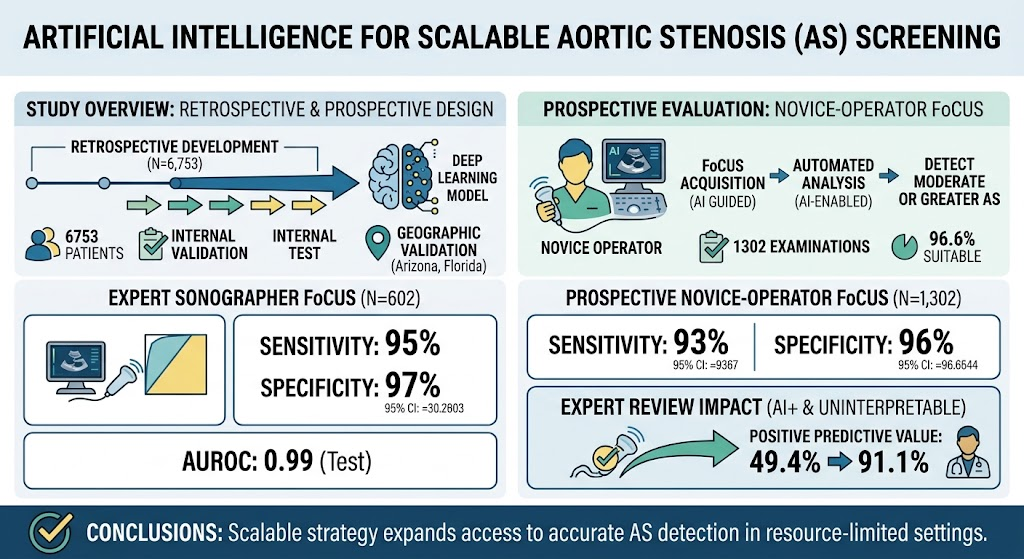
– A deep learning algorithm achieved high accuracy (AUROC ~0.99) in detecting moderate or greater aortic stenosis (AS) across multiple validation cohorts.
– AI-guided focused cardiac ultrasound (FoCUS) performed by novice operators enabled automated, accurate AS screening.
– Sensitivity and specificity remained above 90% in both expert and novice-acquired imaging.
– Expert review of AI-flagged or noninterpretable cases significantly improved diagnostic positive predictive value.
Study Background
Aortic stenosis, characterized by progressive narrowing of the aortic valve, carries significant morbidity and mortality if not diagnosed timely. It is one of the most common valvular heart diseases, especially in aging populations. Early identification of moderate or severe AS is critical for management decisions, including surveillance and timely intervention such as valve replacement, which can improve outcomes. However, current screening relies primarily on comprehensive echocardiography performed by trained sonographers and cardiologists. This requirement limits screening availability, particularly in resource-limited or remote settings.
Focused cardiac ultrasound, a simplified echocardiographic technique, offers promise for point-of-care screening but traditionally demands operator expertise for both image acquisition and interpretation. Recent advances in artificial intelligence (AI) and deep learning provide an opportunity to overcome these barriers by guiding image acquisition and automating diagnostic interpretation, potentially allowing novices to perform effective screening and expanding access.
Study Design
This diagnostic study incorporated retrospective and prospective phases across three geographically distinct Mayo Clinic sites in the Midwest, Arizona, and Florida. The retrospective phase involved training and validating a deep learning algorithm on echocardiographic datasets collected from January 2005 through September 2022, comprising 6753 patients for model development and three validation cohorts totaling 3608 patients. The algorithm was designed to detect moderate or greater aortic stenosis.
Prospectively, the AI-guided FoCUS system was used by both experienced sonographers and novice operators (nonexperts) to acquire cardiac ultrasound video clips. The prospective study included 602 exams from experts and 1302 exams from novices enrolled in two periods in 2024 and 2025. The algorithm automatically assessed the acquired images for the presence of moderate or greater AS.
Key endpoints included detection accuracy measured by area under the receiver operating characteristic curve (AUROC), sensitivity, specificity, and positive predictive value (PPV). Expert cardiologist review was also performed on AI-flagged or uninterpretable exams to evaluate the impact on diagnostic performance.
Key Findings
The deep learning model demonstrated near-perfect discriminatory power in detecting moderate or greater AS across both internal and external validation cohorts: AUROC of 0.99 (95% CI 0.98-1.00) in the internal test set, and 0.99 (95% CI 0.97-1.00 and 0.96-1.00) in Arizona and Florida validation cohorts respectively.
Among FoCUS performed by experienced sonographers, the algorithm yielded sensitivity of 95% (95% CI 82-99) and specificity of 97% (95% CI 95-98), indicating reliable detection with minimal false negatives and false positives. Notably, for FoCUS exams acquired by novice operators, 96.6% (1258/1302) were suitable for automated assessment. Sensitivity was 93% (95% CI 82-99) and specificity 96% (95% CI 95-97), confirming robust performance even when image acquisition was performed by untrained personnel guided by AI.
Expert adjudication of AI-positives and uninterpretable exams considerably enhanced diagnostic yield: PPV increased from 49.4% to 91.1% with a sensitivity of 85.4%. This hybrid approach leveraging AI screening and expert review could optimize clinical workflow by triaging cases requiring further evaluation.
Expert Commentary
These findings represent a significant advance in valvular heart disease screening technology. By demonstrating that AI can guide novices to acquire diagnostic quality cardiac ultrasound and accurately interpret aortic valve pathology, this study addresses a major limitation in AS screening accessibility.
Despite excellent reported metrics, some caution should be noted. The study was conducted at Mayo Clinic centers with specific imaging equipment and protocols; generalizability to other settings or devices may require further validation. Additionally, clinical integration would necessitate streamlined workflows for expert adjudication in ambiguous cases and appropriate follow-up pathways. The impact on clinical outcomes, healthcare costs, and patient adherence remains to be seen in real-world implementation.
Conclusion
The validated AI-enabled algorithm provides a scalable, effective method for screening moderate or greater aortic stenosis using focused cardiac ultrasound acquired by novice operators. This innovation holds potential to expand AS screening beyond specialized centers, improving early disease detection and enabling timely intervention in broader populations. Future research should explore implementation strategies, longitudinal outcomes, and economic benefits to fully realize this technology’s clinical impact.
Funding and ClinicalTrials.gov
The study was supported by the Mayo Clinic research infrastructure. Prospective studies conducted under Mayo Clinic sites complied with institutional review board approvals. No clinical trial registration number was specified in the source publication.
References
Lee E, Naser JA, Kane CJ, Kovac JL, Greason C, Killalea MM, et al. Artificial Intelligence-Enabled Acquisition and Interpretation for Screening Aortic Stenosis. JAMA Cardiology. 2026 Aug 28. PMID: 42661496.
Otto CM, Nishimura RA, Bonow RO, et al. 2020 ACC/AHA Guideline for the Management of Patients With Valvular Heart Disease. Circulation. 2021;143(5):e72-e227.
Thaden JJ, Nkomo VT, Enriquez-Sarano M. The global burden of aortic stenosis. Prog Cardiovasc Dis. 2014;56(6):565-571.
Davenport A, Slomka PJ, Leung S, et al. Artificial intelligence-assisted focused cardiac ultrasound for evaluation of aortic valve disease: a review. Eur Heart J Cardiovasc Imaging. 2023;24(2):115-124.