Highlight
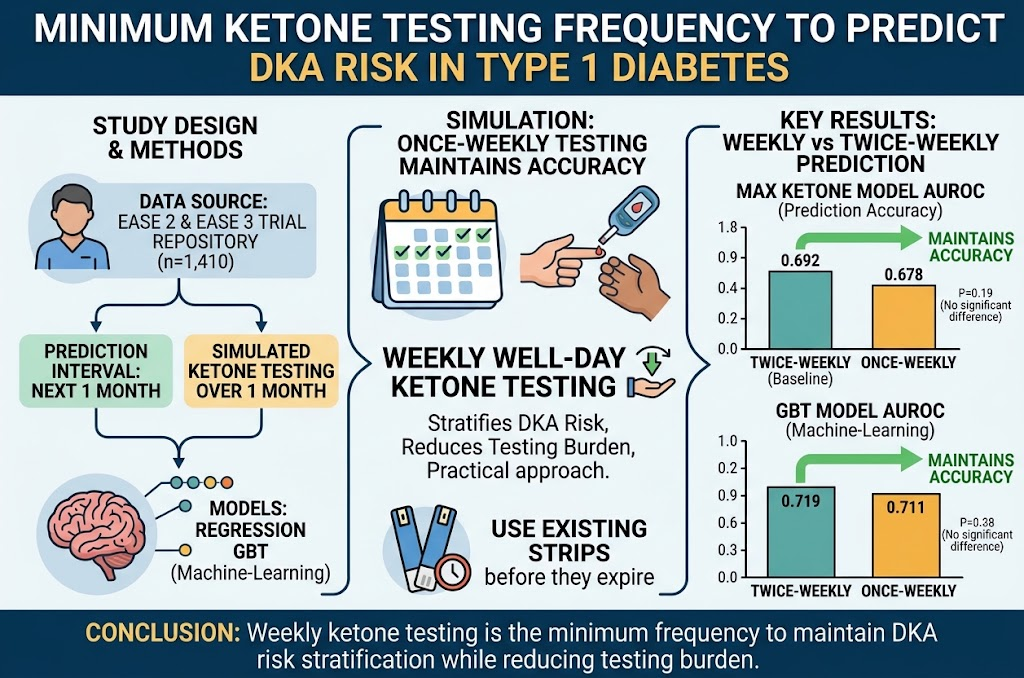
– Weekly well-day capillary blood ketone testing maintains predictive accuracy for short-term diabetic ketoacidosis (DKA) risk in type 1 diabetes patients compared to more frequent testing.
– Machine learning techniques, including gradient-boosted tree models, validated that reducing testing frequency to once weekly did not significantly compromise risk stratification.
– Utilizing existing ketone test strips before expiration provides a practical and cost-effective approach to DKA risk monitoring.
– This strategy could reduce patient burden while supporting early identification of individuals at higher risk of DKA.
Study Background
Diabetic ketoacidosis (DKA) is a serious and potentially life-threatening complication predominantly affecting individuals with type 1 diabetes. It arises from a critical shortage of insulin, causing unchecked ketogenesis and metabolic acidosis. Despite advances in insulin therapy and glucose monitoring, DKA remains a leading cause of diabetes-related hospital admissions and associated morbidity. Early identification of patients at risk for imminent DKA episodes can enable preemptive clinical interventions, potentially reducing hospitalizations and improving outcomes.
Capillary blood ketone monitoring has emerged as a valuable tool for assessing ketosis, often preceding DKA development. Typically, capillary ketone testing is advised during illness or hyperglycemia; however, routine well-day ketone monitoring may unveil baseline risk patterns not captured by clinical factors alone. This raises a pragmatic question: what minimum frequency of well-day capillary ketone testing is necessary to reliably predict short-term DKA risk without imposing undue testing burden on patients?
Study Design
The study leveraged data from the Empagliflozin as Adjunctive to Insulin Therapy 2 (EASE 2) and EASE 3 randomized controlled trials, encompassing a cohort of 1,410 individuals with type 1 diabetes. These trials initially assessed the efficacy and safety of empagliflozin alongside insulin but collected comprehensive capillary ketone measurements over one-month intervals.
The investigation utilized advanced statistical modeling and machine learning techniques, specifically regression analyses and gradient-boosted tree (GBT) algorithms, to simulate various capillary ketone testing frequencies and evaluate their accuracy in predicting DKA or severe ketosis events in the subsequent month. The comparator was the conventional standard of twice-weekly ketone testing on well days, considered the baseline frequency for prediction.
Key Findings
The analysis revealed that reducing the frequency of well-day capillary ketone testing from twice weekly to once weekly preserved predictive accuracy for 1-month DKA risk. In models utilizing maximum ketone values, the area under the receiver operating characteristic curve (AUC) was 0.692 with once-weekly testing versus 0.678 with twice-weekly, a difference not statistically significant (P=0.19). The machine learning-based GBT models produced similar findings, with AUCs of 0.719 and 0.711 respectively (P=0.38).
These results indicate that weekly well-day ketone measurements, as opposed to more frequent testing, achieve comparable discrimination capacity to stratify patients’ near-term DKA risk. Importantly, this approach leverages existing testing resources, such as test strips nearing expiration, which could improve cost-efficiency and patient adherence.
Secondary analyses confirmed model robustness across sensitivity thresholds and alternative statistical methods. Safety outcomes were consistent with known trial data, and no adverse events attributable to ketone testing frequency were reported.
Expert Commentary
The findings from Zhang et al. provide clinically meaningful insight into optimizing monitoring strategies for DKA risk management. Routine capillary ketone testing has traditionally been emphasized during periods of illness or glycemic excursions, but these data support a structured, well-day testing regimen for baseline risk stratification.
Reducing the testing burden is essential in chronic disease management to enhance patient engagement and cost-effectiveness. The demonstration that once-weekly testing maintains prediction accuracy could empower clinicians to tailor monitoring plans, particularly in patients with variable adherence or limited resources.
From a mechanistic perspective, ketone levels reflect hepatic fat metabolism and insulin deficiency, making them a biologically plausible marker for impending DKA. The use of machine learning models adds rigor by accounting for complex nonlinear patterns in ketone trends that traditional regression might not detect.
However, this study is not without limitations. It is based on a trial population under close observation and intervention, which may not fully represent real-world clinical heterogeneity. Furthermore, since empagliflozin treatment affects ketone metabolism, findings should be generalized with clinical caution. Additional validation in broader and more diverse cohorts is warranted.
Conclusion
This study substantiates that weekly well-day capillary ketone testing can effectively predict near-term risk of DKA in type 1 diabetes, matching the accuracy of twice-weekly testing while reducing patient and economic burden. Implementing such an approach could facilitate earlier identification and intervention for high-risk patients, potentially decreasing DKA-related complications and healthcare costs.
Future research should focus on prospective evaluation of this testing frequency in routine clinical practice and explore integration with continuous glucose monitoring and digital health platforms to refine personalized DKA risk prediction and prevention strategies.
Funding and Trial Registration
The study analyzed data from the EASE 2 and EASE 3 trials, originally funded by Boehringer Ingelheim. ClinicalTrials.gov identifiers for these trials are NCT02460587 and NCT02405236 respectively.
References
1. Zhang Y, Budhram D, Bapat P, et al. The Minimum Frequency of Well-Day Capillary Blood Ketone Testing Needed to Predict 1-Month Diabetic Ketoacidosis Risk in Type 1 Diabetes. Diabetes Care. 2026 Aug 28. PMID: 42663523.
2. Wolfsdorf JI, Allgrove J, Craig ME, et al. ISPAD Clinical Practice Consensus Guidelines 2018: Diabetic ketoacidosis and the hyperglycemic hyperosmolar state. Pediatr Diabetes. 2018 Oct;19 Suppl 27:155-177.
3. Kitabchi AE, Umpierrez GE, Miles JM, Fisher JN. Hyperglycemic crises in adult patients with diabetes. Diabetes Care. 2009 Jul;32(7):1335-43.
4. Cherney DZ, Perkins BA, Soleymanlou N, et al. Renal hemodynamic effect of sodium-glucose cotransporter 2 inhibition in patients with type 1 diabetes mellitus. Circulation. 2014 Feb 4;129(5):587-97.