Highlight
- Long-term seizure recurrence after temporal lobe epilepsy surgery is linked to disruption in brain network hubs, notably the hippocampi and dorsal attention network.
- Combining structural and functional MRI-derived connectomes enhances the accuracy of predicting seizure recurrence over clinical variables alone.
- Machine learning models using normative hub disruption metrics demonstrate high specificity and have potential for clinical risk stratification post-surgery.
- Identified biomarkers indicate seizure recurrence drivers may extend beyond resected temporal regions, suggesting broader network involvement.
Study Background
Temporal lobe epilepsy (TLE) is the most common focal epilepsy in adults and often resistant to pharmacotherapy. Surgical interventions, including resective and laser ablative procedures, provide substantial seizure freedom rates in the short term. However, approximately 50% of patients experience seizure recurrence over long-term follow-up, significantly affecting quality of life and increasing morbidity. While several clinical and imaging predictors have been proposed, reliable biomarkers for long-term postoperative seizure recurrence remain limited.
Recent advances have implicated brain network dysfunction, especially in highly connected regions or “hubs,” in epilepsy pathophysiology. Disruption of these hubs may underlie persistent epileptogenicity and recurrence despite resection. This study aimed to evaluate whether normative brain hub disruptions, measured by advanced MRI connectomic analysis, can predict long-term seizure outcomes in TLE patients undergoing surgery.
Study Design
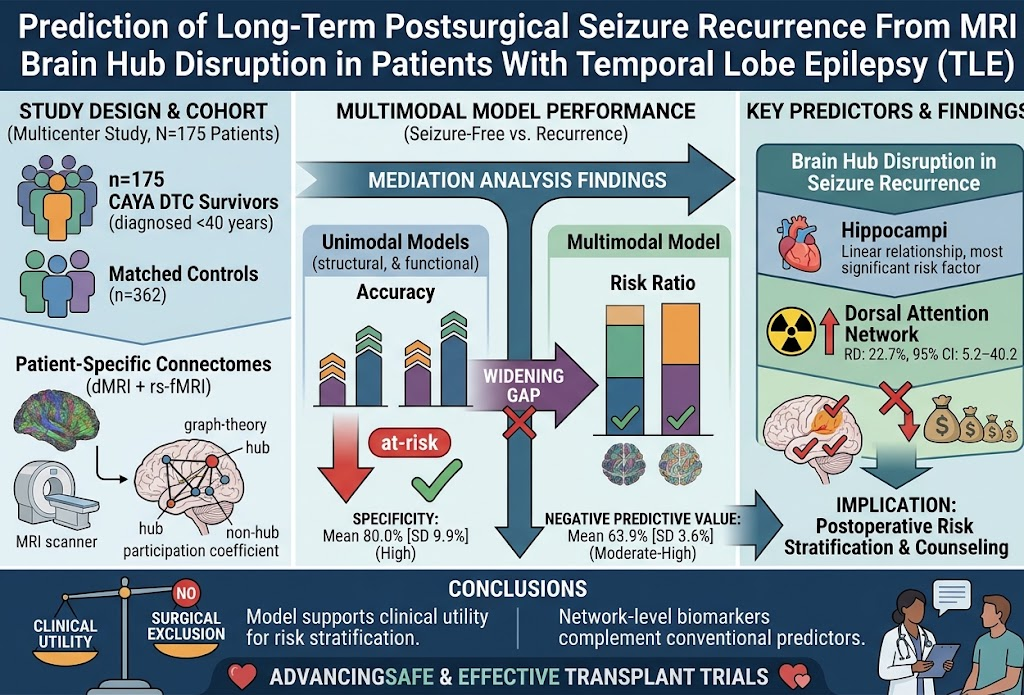
This prospective multicenter cohort study included 175 patients with drug-resistant TLE from six epilepsy centers who underwent resective or laser ablative surgery. Inclusion required at least two years of postoperative follow-up, with a mean of 5.4 years. Preoperative imaging encompassed diffusion-weighted MRI for structural connectomics and resting-state functional MRI for functional connectivity.
Normative hub definitions were derived from 362 healthy controls across multiple centers. Brain network hubs were identified using graph theory, focusing on the participation coefficient to assess cross-network integration. Patient-specific disruption of these normative hubs was quantified. Three machine learning models were trained to classify seizure outcomes: structural connectome disruption, functional connectome disruption, and a multimodal model combining both. Models also incorporated demographic and clinical variables, as well as gray and white matter volumes.
Model performance was validated using an independent patient cohort. Shapley Additive Explanation (SHAP) analyses were employed to interpret the contribution of specific brain regions to model predictions.
Key Findings
The multimodal model using combined structural and functional hub disruption significantly outperformed models using clinical variables alone and unimodal imaging data. This integrated approach achieved a mean specificity of 80.0% (SD 9.9%) and a moderate-to-high negative predictive value of 63.9% (SD 3.6%) for distinguishing seizure-free from seizure-recurring patients.
SHAP analyses highlighted the hippocampi and connector hubs within the dorsal attention network as most predictive of long-term seizure recurrence. This is notable as the dorsal attention network areas are typically not the direct targets of TLE surgery. Disruptions were observed in both gray and white matter regions tied to these hubs.
Patients with less disruption in these normative hubs were more likely to maintain long-term seizure freedom, suggesting preservation of brain-wide network integrity is crucial for sustained surgical success. Conversely, hub disruptions indicated residual epileptogenic networks beyond the surgical field.
Safety outcomes were not the primary focus but no adverse effects related to imaging or model implementation were reported. No deterioration of predictive accuracy was noted across centers, reflecting good generalizability.
Expert Commentary
This study advances the field by integrating novel network neuroscience principles with clinical epileptology. The large multicenter design and inclusion of an independent validation cohort strengthen the credibility of findings. Using normative networks as a scaffold for patient-specific disruption adds biological interpretability, moving beyond black-box models.
The identification of unexpected hubs, such as those in the dorsal attention network, challenges traditional paradigms focusing solely on the epileptogenic temporal lobe. This aligns with evolving evidence that epilepsy is a network disorder involving distributed circuits.
Some limitations include potential heterogeneity across imaging protocols among centers, although this was mitigated by the large control cohort and robust harmonization. Remaining confounding factors like medication effects or comorbidities require further exploration.
Clinically, the model’s high specificity for seizure recurrence supports its use for postoperative counseling and risk stratification rather than exclusionary surgical decision-making. Implementation in routine care could inform personalized follow-up intensity and adjunctive therapy decisions.
Future research might expand on integrating electrophysiological data and exploring dynamic network changes over time. Prospective interventional studies are needed to determine if modifying network disruption can improve outcomes.
Conclusion
Disruption of normative brain hub architecture, as assessed by multimodal MRI connectomics, provides a robust biomarker for predicting long-term postsurgical seizure recurrence in temporal lobe epilepsy. This approach enhances risk stratification beyond conventional clinical factors, offering biologically interpretable insights into the network basis of seizure relapse. These findings pave the way for integrating network-level biomarkers into precision epilepsy surgery and postoperative management strategies.
Funding and ClinicalTrials.gov
Details on specific funding sources and clinical trial registration were not provided in the source material. Future publications may elaborate on these aspects.
References
Karpychev V, Roth RW, Yun W, Davis KA, Drane DL, Bagić AI, Dugan PC, Stein JM, Pardoe HR, Parashos A, Kuzniecky R, Laxpati NG, Bonilha L, Gleichgerrcht E. Prediction of Long-Term Postsurgical Seizure Recurrence From MRI Brain Hub Disruption in Patients With Temporal Lobe Epilepsy. Neurology. 2026 Aug 12;107(5):e218416. PMID: 42585607.
Additional relevant references on MRI connectomics, epilepsy network models, and surgical outcomes can be sourced from PubMed-indexed literature.