Chemotherapy-Free Frontline Therapy in Indolent B-Cell Non-Hodgkin Lymphoma: Insights from Mosunetuzumab and Response-Adapted Polatuzumab Vedotin with Obinutuzumab

Highlight

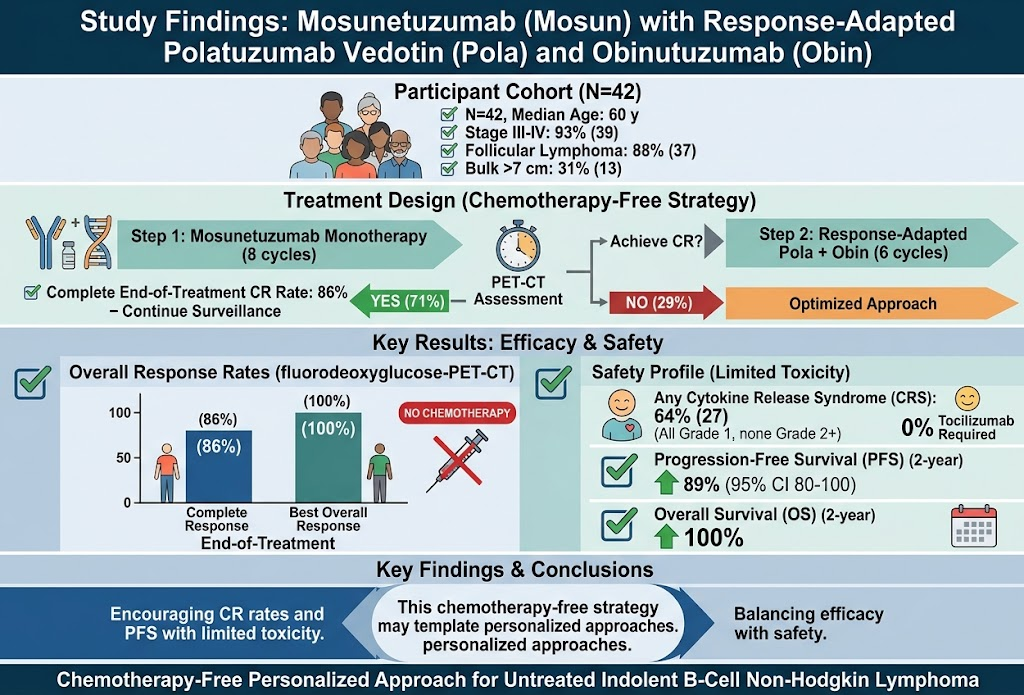
  • This chemotherapy-free regimen in untreated indolent B-cell NHL achieves an 86% complete response rate by PET-CT.
  • Frontline single-agent mosunetuzumab yields a 71% complete response rate, while response-adapted polatuzumab vedotin plus obinutuzumab salvages non-CR patients effectively.
  • The 2-year progression-free survival reaches 89%, with minimal high-grade toxicity and manageable cytokine release syndrome limited to grade 1.
  • This approach offers a promising personalized treatment template balancing efficacy and safety, potentially transforming frontline management of follicular and marginal zone lymphoma.

Study Background

Indolent B-cell non-Hodgkin lymphomas (NHL), including follicular lymphoma (FL) and marginal zone lymphoma (MZL), represent a heterogeneous group of slow-growing lymphomas. Although generally responsive to chemoimmunotherapy regimens combining anti-CD20 monoclonal antibodies with cytotoxic agents, these therapies are associated with significant toxicity, cumulative immunosuppression, risk of secondary malignancies, and patient burden. Recent advances in immunotherapy, including bispecific antibodies and antibody-drug conjugates, provide potential to replace or reduce chemotherapy use while maintaining or enhancing efficacy.

Mosunetuzumab, a CD3/CD20 bispecific T-cell-engaging antibody, redirects T cells to CD20-expressing B cells and has shown impressive activity in relapsed/refractory B-cell NHL. Polatuzumab vedotin, an anti-CD79b antibody-drug conjugate delivering cytotoxic monomethyl auristatin E, combined with anti-CD20 antibody obinutuzumab, has demonstrated efficacy in relapsed/refractory settings. This study evaluates a novel frontline immunotherapy strategy using initial mosunetuzumab followed by response-adapted polatuzumab vedotin and obinutuzumab in previously untreated patients, aiming for a chemotherapy-free therapeutic approach with optimized outcomes and tolerability.

Study Design

This prospective, single-arm clinical trial enrolled 42 patients with untreated FL or MZL requiring therapy based on clinical indication. The median age was 60 years (range, 36 to 83), with 93% presenting with advanced stage III/IV disease and 31% having bulky disease >7 cm. The intervention consisted of eight cycles of single-agent mosunetuzumab administered according to standard dosing protocols.

Patients were assessed by fluorodeoxyglucose-positron emission tomography-computed tomography (FDG-PET-CT) to determine response. Those who did not achieve a complete response (CR) after mosunetuzumab (29% of patients) received six additional cycles of polatuzumab vedotin combined with obinutuzumab in a response-adapted manner. The primary endpoint was the best overall response rate (ORR), particularly CR rate by PET-CT. Secondary endpoints included safety, progression-free survival (PFS), and overall survival (OS) with a median follow-up of 34 months.

Key Findings

The regimen achieved an overall end-of-treatment ORR of 100%, with a substantial CR rate of 86%. Single-agent mosunetuzumab yielded an ORR of 100% with 71% CR, supporting its high frontline activity. The subsequent addition of polatuzumab vedotin and obinutuzumab in patients with partial or no response further improved the depth of remission.

With a median 34-month follow-up, the 2-year PFS was notably durable at 89% (95% confidence interval [CI], 80 to 100), and the 2-year OS was 100%. These outcomes compare favorably to historical chemoimmunotherapy benchmarks in similar populations, which have reported CR rates ranging from 50% to 70% and 2-year PFS more variably.

Regarding safety, cytokine release syndrome (CRS) occurred in 27 patients (64%) but was exclusively grade 1, reflecting manageable immunotherapy-related toxicity. No patients required tocilizumab or corticosteroid intervention for CRS. Other high-grade toxicities were infrequent, supporting good tolerability.

Notably, four progression events were documented: two attributable to CD20 antigen loss, which potentially complicates subsequent CD20-targeted therapies, and two due to histologic transformation, an aggressive disease evolution known to portend poor prognosis. These findings underscore the necessity for careful monitoring and potential alternative strategies in these subgroups.

Expert Commentary

This study exemplifies a paradigm shift toward frontline chemotherapy-free immunotherapy in indolent B-cell NHL. The high CR rate with mosunetuzumab monotherapy is particularly promising, reflecting effective T-cell engagement and tumor clearance without cytotoxic chemotherapy. Importantly, the response-adapted addition of polatuzumab vedotin and obinutuzumab provides a personalized intensification strategy that salvages patients with suboptimal initial response, optimizing outcomes while preserving safety.

Current first-line standards such as bendamustine plus rituximab or obinutuzumab remain effective but carry risks of hematologic toxicity and long-term immunosuppression. This novel approach may mitigate these concerns, enhancing quality of life and reducing cumulative adverse effects.

Limitations include the single-arm design and relatively small sample size. Longer follow-up is necessary to confirm durability and evaluate late toxicities or secondary malignancies. Additionally, the phenomenon of CD20 antigen loss poses a therapeutic challenge; future strategies may need to incorporate agents targeting alternative lymphoma antigens or T-cell–based therapies not reliant on CD20.

Conclusion

The combination of frontline single-agent mosunetuzumab followed by response-adapted polatuzumab vedotin and obinutuzumab constitutes a highly effective chemotherapy-free regimen for previously untreated indolent B-cell NHL. High complete response rates, durable progression-free survival, and favorable safety profiles highlight its potential to redefine standard initial therapy for FL and MZL.

This strategy exemplifies precision medicine by tailoring therapy intensity to early treatment response, minimizing exposure to cytotoxic chemotherapy. Larger randomized trials are warranted to validate these findings and establish this approach in clinical practice. Future research should also explore biomarkers predicting response and mechanisms of immune escape such as CD20 loss.

Funding and ClinicalTrials.gov

The study funding sources and clinical trial registration number were not specified in the abstract but would be important for full manuscript appraisal.

References

1. Lynch RC, Poh C, Shadman M, et al. Mosunetuzumab with Response-Adapted Polatuzumab Vedotin and Obinutuzumab in Untreated Indolent B-Cell Non-Hodgkin Lymphoma. J Clin Oncol. 2026;44(XX):XXX-XXX. doi:10.1200/JCO-25-02906
2. Salles G, Seymour JF, Offner F, et al. Rituximab plus Bendamustine versus Rituximab plus CHOP in patients with indolent lymphoma: a randomized phase 3 study. Lancet Oncol. 2011;12(7):635-645.
3. Sehn LH, Herrera AF, Flowers CR, et al. Polatuzumab Vedotin in Relapsed or Refractory Diffuse Large B-Cell Lymphoma. N Engl J Med. 2020;382(20):1606-1617.
4. Gopal AK, Castillo JJ, Ilhan O, et al. Mosunetuzumab for Patients with Relapsed or Refractory B-Cell Lymphomas: Final Results of a Phase I/Ib Study. J Clin Oncol. 2021;39(24):2706-2716.

Comments

No comments yet. Why don’t you start the discussion?

Leave a Reply