Highlight
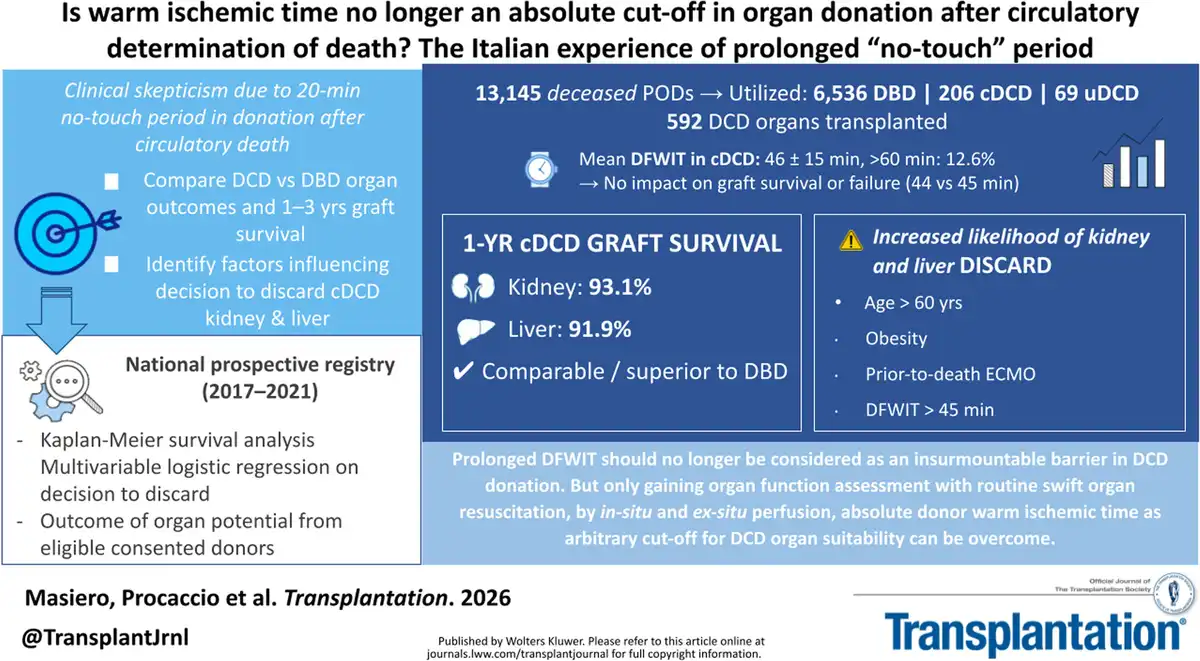
– In Italy, controlled and uncontrolled donation after circulatory death (DCD) programs have matured despite a traditionally long 20-minute no-touch period, using mandatory in situ normothermic regional perfusion (nRP) and often ex situ machine perfusion.
– A national registry analysis from 2017 to 2021 revealed excellent 1-year kidney and liver graft survival rates (~93% and ~92%) from cDCD donors, comparable to donation after brain death (DBD) on similar warm ischemic times.
– Functional warm ischemic time (FWIT) in controlled DCD frequently exceeded conventional thresholds (mean ~46 minutes, >60 minutes in 12.6%), yet did not adversely affect graft survival.
– Donor factors such as age >60, obesity, prior ECMO use, and warm ischemic time >45 minutes independently increased organ discard risk, suggesting integrated assessment beyond ischemic duration alone.
– This experience advocates abandoning fixed warm ischemic time cutoffs in favor of swift organ resuscitation and function assessment enabled by combined in situ and ex situ perfusion technologies, to safely expand the donor pool.
Background
Organ transplantation remains limited by donor availability and organ quality. Donation after circulatory determination of death (DCD) has emerged as a vital strategy to augment organ supply beyond donation after brain death (DBD). However, warm ischemic time (WIT) following circulatory arrest until organ preservation remains a major determinant of graft viability. Traditionally, particularly in Italy, the “no-touch” period—which mandates waiting approximately 20 minutes after circulatory arrest before procurement—has raised concerns about ischemic injury, limiting the acceptance of DCD organs. This has created skepticism around the safety and outcomes of organs exposed to prolonged WIT, resulting in potential underutilization of DCD donors, especially controlled DCD (cDCD) donors, where withdrawal of life-sustaining therapies occurs predictably.
Emerging technologies, including normothermic regional perfusion (nRP) and ex situ machine perfusion, have been introduced to mitigate ischemic damage by restoring organ perfusion and allowing viability assessment prior to transplantation. Despite this, reluctance to accept organs from donors with prolonged WIT has persisted due to classical dogma considering specific time limits as absolute safety thresholds.
Study Design
This prospective observational study utilized data extracted from the Italian national deceased donor and transplant registry spanning 2017 to 2021. Both controlled (cDCD) and uncontrolled (uDCD) DCD donor candidates were included along with conventional DBD donors for comparative purposes. Key definitions included mean functional warm ischemic time (FWIT) measuring ischemia from circulatory arrest to organ perfusion initiation.
The primary endpoints were graft survival at one to three years post-transplant and rates of kidney and liver discard among cDCD donors. Secondary analyses explored clinical factors related to organ discard via multivariable logistic regression. Survival analyses employed Kaplan-Meier estimates. The study’s unique context was the Italian prolonged “no-touch” period (approximately 20 minutes), considerably extending warm ischemic intervals beyond international DCD norms.
Key Findings
The study encompassed 12,663 DBD, 262 cDCD, and 220 uDCD potential donors (PODs). Among these, 73.4% of DBD, 82.1% of cDCD, and 40.3% of uDCD donors proceeded to organ utilization, attesting to the programmatic success of DCD in Italy despite the prolonged no-touch period.
The mean FWIT for cDCD donors was 46 ± 15 minutes, and notably, 12.6% exceeded 60 minutes. This duration is substantially longer than commonly accepted upper limits in other DCD protocols worldwide where warm ischemic times usually do not exceed 30 minutes. A total of 592 organs from DCD donors were transplanted, encompassing kidneys and livers.
The 1-year graft survival rates for kidneys (93.1%) and livers (91.9%) from cDCD donors mirrored those of DBD transplants, despite identical mean donor functional warm ischemic times between grafts that survived and those that failed (around 44-45 minutes). This finding directly challenges the paradigm that strict warm ischemic cutoff times are predictive or exclusionary.
Multivariable analysis demonstrated that donor age above 60 years, obesity, pre-death extracorporeal membrane oxygenation (ECMO), and a functional warm ischemic time >45 minutes independently increased the likelihood of organ discard for kidneys and livers. These factors underline the necessity of multifactorial donor evaluation rather than reliance on ischemic time alone.
Crucially, the routine adoption of in situ normothermic regional perfusion and ex situ machine perfusion was instrumental in enabling the practical extension of acceptable warm ischemic periods while maintaining organ viability and transplant outcomes. These techniques resuscitate organs and allow real-time functional assessment, reducing inappropriate discards due to ischemic time concerns.
Expert Commentary
The Italian national experience significantly broadens the traditional transplant community’s understanding of warm ischemic tolerance in DCD donors. While preclinical studies have long demonstrated ischemia-induced organ injury, this clinical dataset endorses technological advances that effectively offset these risks. Leading transplant experts now increasingly advocate for flexible ischemic thresholds, especially when combined with normothermic perfusion, which allows selective organ resuscitation and functional viability testing before committing to transplantation.
Nonetheless, it is vital to recognize that prolonged warm ischemia remains a risk factor warranting enhanced monitoring and selection rigor. The association of donor age, obesity, and ECMO usage with discard likelihood highlights a complex interplay of factors influencing organ quality beyond ischemic time. Delineation of optimal cutoff values or composite risk models incorporating these variables may further improve selection and outcomes.
While these findings are compelling, the generalizability beyond Italy’s healthcare infrastructure, regulatory environment, and perfusion expertise should be assessed cautiously. Prospective multicenter studies and randomized trials are warranted to reinforce these conclusions and guide international guidelines.
Conclusion
The Italian experience challenges the dogma that warm ischemic time constitutes an absolute contraindication for DCD organ donation. Prolonged functional warm ischemic times, facilitated by a lengthy no-touch period, did not compromise 1-year kidney and liver graft survival compared to DBD transplants. Integration of mandatory in situ normothermic regional perfusion and prevalent ex situ machine perfusion technologies allows for organ resuscitation and function assessment, enabling confident expansion of donor criteria.
These results encourage a paradigm shift toward individualized donor evaluation, reducing inappropriate discard of potentially viable DCD organs. Greater flexibility in warm ischemic time cutoffs, combined with strategic use of advanced perfusion techniques, represents a pragmatic pathway to enhance organ availability without sacrificing transplant outcomes. Future research should focus on refining donor assessment algorithms incorporating ischemic time within a multifactorial framework and optimizing perfusion protocols for widespread application.
Funding and ClinicalTrials.gov
The study was supported by institutional and national transplant program funding; no specific clinical trial registration was reported.
References
1. Masiero L, Procaccio F, Vespasiano F, et al. Is Warm Ischemic Time no Longer an Absolute Cutoff in Organ Donation After Circulatory Determination of Death? The Italian Experience of Prolonged “No-touch” Period. Transplantation. 2026 Jun 17;110(10):e2113-e2121. PMID: 42302729.
2. Nasralla D, Coussios CC, Mergental H, et al. A randomized trial of normothermic preservation in liver transplantation. Nature. 2018;557(7703):50-56.
3. Patel MS, Cooper DK. Donation after circulatory death: Current practice and future directions. Transplantation. 2019;103(6):1019-1027.
4. Summers DM, Allen J, Collett D, et al. Impact of donor age and warm ischemia time on liver transplant outcome in DCD donors. Am J Transplant. 2014;14(5):1133-1140.