Highlights
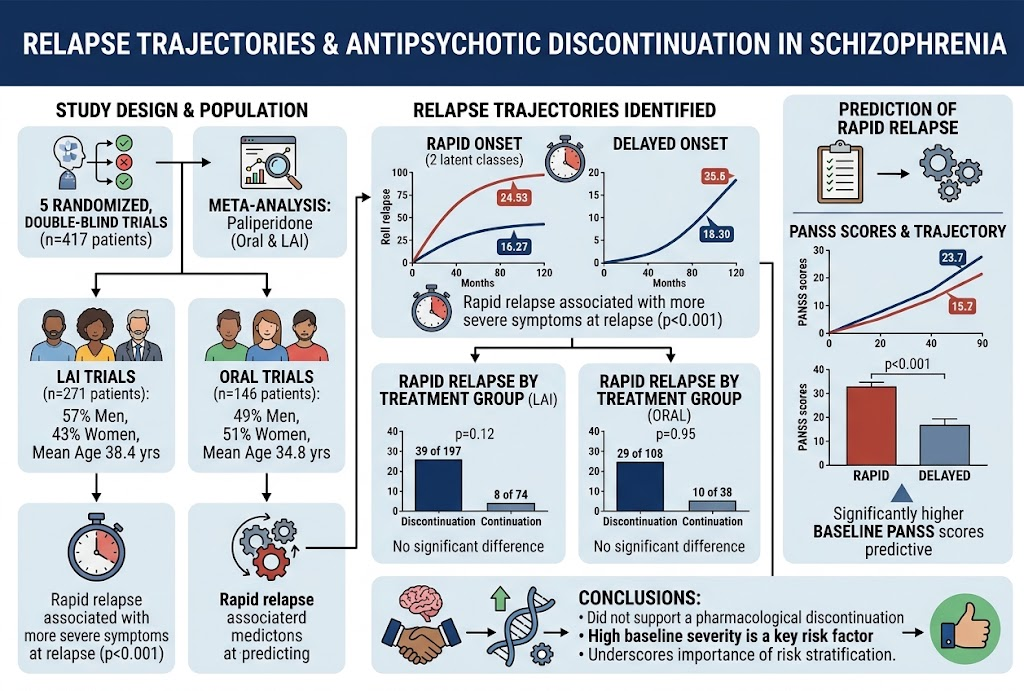
- Relapse after paliperidone discontinuation occurs via two distinct symptom trajectories: rapid and delayed onset, with rapid relapse linked to higher baseline symptom severity.
- Rapid relapse is not significantly more frequent in patients who discontinue treatment than in those who continue, suggesting relapse reflects underlying illness rather than pharmacological withdrawal effects.
- Long-acting injectable (LAI) formulations, especially paliperidone palmitate, delay relapse significantly compared to oral antipsychotics, supporting early and sustained maintenance treatment.
- Gradual, supervised antipsychotic reduction strategies show no social functioning benefit but carry increased relapse risk; personalized monitoring during de-prescribing is critical.
Background
Schizophrenia is a chronic, severe psychiatric disorder characterized by episodic psychosis with high relapse rates. Maintenance antipsychotic treatment effectively reduces relapse risk but is associated with cumulative adverse effects, prompting clinical consideration of dose reduction or discontinuation. Antipsychotic discontinuation, while increasing relapse risk, presents a heterogeneous clinical picture: some patients relapse rapidly, others more gradually. Understanding the clinical trajectories of relapse and their association with treatment status is vital for optimizing management strategies that balance efficacy and tolerability. This review synthesizes a recent individual participant data meta-analysis of five randomized, double-blind, placebo-controlled trials from the Yale Open Data Access database on relapse trajectories after paliperidone discontinuation, integrated with contemporary evidence on antipsychotic maintenance, discontinuation, and formulations.
Key Content
Relapse Trajectories Following Paliperidone Discontinuation: Meta-Analytic Insights
Louie et al. (2026) conducted a meta-analysis of five randomized, double-blind, placebo-controlled trials on oral and LAI paliperidone in schizophrenia and schizoaffective disorder, including 417 patients with relapse events (271 LAI, 146 oral). Participants were stabilized on antipsychotic treatment for >3 months prior to randomization to either placebo (discontinuation) or continued active treatment, and symptom trajectories preceding relapse were derived via latent class mixed modeling of longitudinal Positive and Negative Syndrome Scale (PANSS) data.
Two distinct relapse trajectories were identified: rapid-onset and delayed-onset relapse. Rapid relapse cases exhibited higher PANSS scores at baseline and at relapse than delayed relapse cases, regardless of treatment arm. Importantly, the proportion of rapid relapsers did not significantly differ between discontinuation and continuation groups in either LAI or oral formulations. Symptom profiles at relapse were comparable between discontinuation and continuation groups, arguing against a predominant pharmacological withdrawal effect as the cause of rapid relapse. The rapid relapse trajectory was more closely associated with baseline illness severity or potential measurement ceiling effects at screening. These findings support individualized risk stratification and vigilant monitoring during antipsychotic de-prescribing.
Comparative Efficacy of Paliperidone Formulations and Long-Acting Injectables
Risperidone and paliperidone LAIs, including the novel subcutaneous formulation TV-46000, have demonstrated robust relapse prevention.
– The RISE phase 3 RCT of subcutaneous TV-46000 showed a 5-fold and 2.7-fold prolongation of time to impending relapse with monthly and bimonthly dosing, respectively, versus placebo, with a favorable safety profile (Lancet Psychiatry 2023).
– A post hoc analysis integrating PRIDE, PROSIPAL, and DREaM trial data found paliperidone palmitate (PP) LAIs reduced treatment failure and relapse rates more effectively than oral antipsychotics (J Clin Psychiatry 2023).
– Comparative effectiveness trials such as EULAST (Lancet Psychiatry 2023) found no significant difference between LAI and oral antipsychotics regarding all-cause discontinuation in early-phase schizophrenia, underscoring the importance of individualized formulation choice based on adherence potential and patient preference.
– Economic analyses of the DREaM study support early continuous use of PP LAI, resulting in reduced psychiatric hospitalizations and healthcare costs, particularly among patients with shorter prior antipsychotic exposure.
– Network meta-analyses confirm paliperidone LAI among the top-ranked agents for relapse prevention and acceptability among various LAIs (Am J Psychiatry 2021).
Antipsychotic Discontinuation and Dose Reduction Strategies: Clinical Trials and Outcomes
Discontinuation of antipsychotic medication is frequently motivated by adverse effects but entails relapse risk.
– The RADAR trial (Lancet Psychiatry 2023) investigated gradual dose reduction versus maintenance treatment in recurrent psychotic disorder (including schizophrenia) over 2 years. Although dose reduction increased short-term relapse risk, no improvement in social functioning was observed, highlighting complexity in balancing benefits and harms.
– The TAILOR study protocol aims to assess closely monitored tapering/discontinuation versus maintenance in newly diagnosed schizophrenia or persistent delusional disorder, involving app-based relapse monitoring; results will further inform de-prescribing approaches.
– Data from first-episode psychosis cohorts underscore that negative symptom severity and number of relapses predict functional outcomes; maintenance treatment reduces relapse risk, especially in those with higher baseline symptoms (Schizophr Res 2020).
– Observational and randomized studies confirm higher relapse rates after antipsychotic discontinuation, with poorer outcomes and increased suicidality in the long term (Lancet Psychiatry 2018; J Clin Psychiatry 2016).
– Post hoc analyses suggest relapse upon discontinuation largely represents illness recurrence rather than withdrawal phenomena, mitigating concerns of rebound psychosis after stopping medications (J Clin Psychiatry 2018).
Predictive Factors for Relapse and Discontinuation Outcomes
Individual factors influence relapse risk following antipsychotic discontinuation.
– A machine learning analysis of pooled discontinuation trials (Lancet Psychiatry 2023) found general prognostic factors for relapse include positive drug screen, younger age, higher CGI severity, and antipsychotic discontinuation; specific predictors of relapse after discontinuation include elevated prolactin, multiple hospitalizations, smoking, and oral (vs LAI) antipsychotic use.
– Predictors of successful discontinuation from EUFEST data include better baseline prognosis and social integration, as well as geographic region (Schizophr Res 2016).
– In first-episode patients, enduring remission and lower PANSS positive scores predict lower risk of symptom re-exacerbation after discontinuation (Schizophr Res 2016).
Expert Commentary
This comprehensive synthesis underscores the heterogeneity of relapse trajectories following antipsychotic discontinuation in schizophrenia. The meta-analytic identification of rapid versus delayed relapse trajectories, irrespective of continuation status, challenges the notion that rapid relapse is primarily a pharmacological withdrawal effect. Instead, it aligns with the conceptualization of relapse as multifactorial, with baseline illness severity as a major determinant.
The evidence supports the early use and continuation of long-acting paliperidone formulations for relapse prevention, especially in patients with early-phase schizophrenia or those at higher risk of treatment nonadherence. While LAIs may not always reduce discontinuation rates compared to oral agents, the extended half-life and steady plasma levels yield longer relapse-free intervals post-discontinuation, valuable for managing unplanned treatment interruptions.
Dose-reduction and discontinuation strategies remain complex. Short-term increases in relapse risk after gradual dose reduction, as observed in RADAR and other trials, contrast with patient preferences to minimize medication burden and side effects. These data highlight a critical need for individualized de-prescribing protocols integrating close monitoring, risk stratification using clinical predictors (e.g., baseline severity, prolactin levels, prior hospitalizations), and patient-informed decision making.
Mechanistically, these clinical observations align with dopaminergic dysregulation in schizophrenia pathophysiology. The lack of withdrawal-associated biomarkers or dyskinesia in relapsing patients argues against supersensitivity psychosis as a dominant factor, advocating illness recurrence as the primary driver.
Current schizophrenia management guidelines favor continuous maintenance therapy for at least 1-3 years post-remission, as supported by long-term outcome data. Future research should focus on refining biomarker-driven risk stratification for relapse, optimizing tapering schedules, and developing novel agents with improved safety profiles to balance relapse prevention and adverse effects.
Conclusion
Antipsychotic discontinuation in schizophrenia results in relapse trajectories that are heterogeneous, comprising rapid and delayed onset, with rapid relapse linked to baseline clinical severity rather than treatment withdrawal per se. Long-acting paliperidone formulations offer significant advantages in prolonging relapse-free intervals and reducing healthcare utilization. Gradual dose reduction requires careful individualized risk assessment and monitoring to mitigate relapse risk without compromising social functioning. These findings emphasize the importance of integrating clinical, biological, and patient-centered factors in designing maintenance and de-prescribing strategies for schizophrenia.
References
- Louie K et al. Relapse trajectories and antipsychotic discontinuation in schizophrenia from individual participant data of five trials from the Yale Open Data Access database: a meta-analysis. Lancet Psychiatry. 2026 Aug 24; PMID:42636852.
- Janssen Branded Pharmaceutical Products R&D. Efficacy and safety of TV-46000, a long-acting, subcutaneous injectable risperidone formulation. Lancet Psychiatry. 2023;10(12):934-43. PMID:37924833.
- Jauhar S et al. Antipsychotic dose reduction and discontinuation versus maintenance treatment in schizophrenia (RADAR trial). Lancet Psychiatry. 2023;10(11):848-859. PMID:37778356.
- Pillinger T et al. Earlier use of long-acting injectable paliperidone palmitate versus oral antipsychotics in schizophrenia: integrated patient-level post hoc analysis. J Clin Psychiatry. 2023;84(6):23m14788. PMID:37756123.
- NICE guidelines on schizophrenia management; available at https://www.nice.org.uk/guidance/cg178.
- Taipale H et al. Maintenance treatment with long-acting injectable antipsychotics for nonaffective psychoses: network meta-analysis. Am J Psychiatry. 2021 May 1;178(5):424-436. PMID:33596679.