Highlight
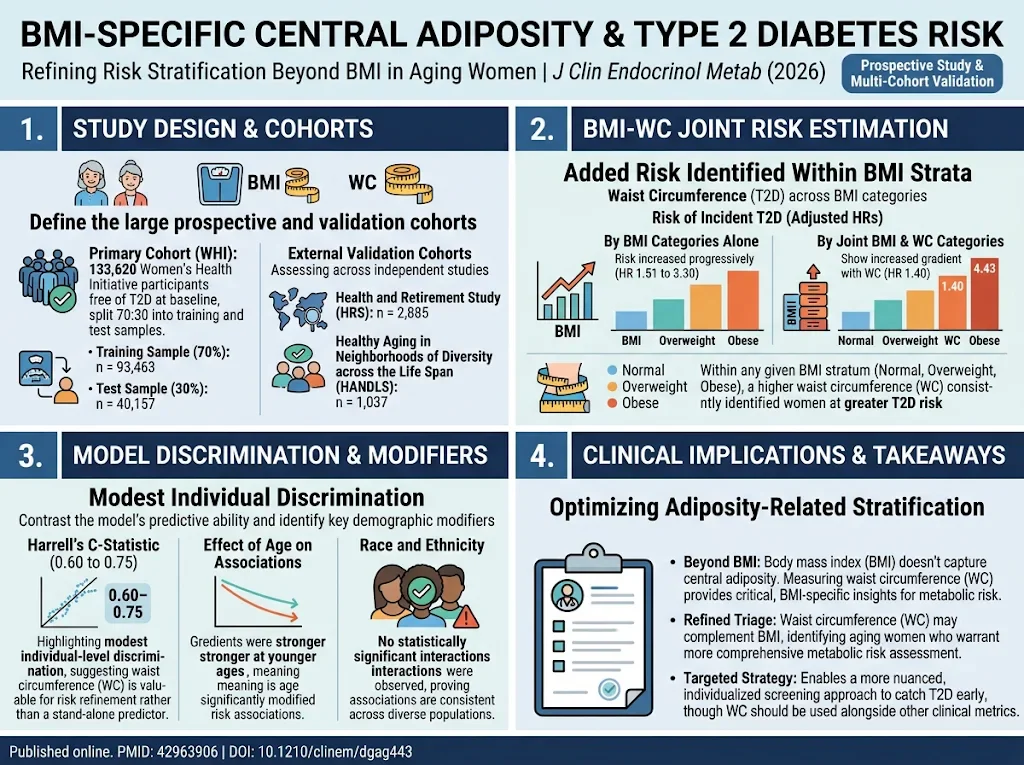
- Central adiposity, measured by waist circumference (WC), refines type 2 diabetes (T2D) risk classification beyond body mass index (BMI) alone in aging women.
- BMI-specific WC categories were developed and validated across large U.S. cohorts with consistent directional associations with incident T2D.
- Stronger WC-related T2D risk gradients were observed at younger ages, while race and ethnicity did not significantly modify associations.
- Despite added value for risk stratification, WC combined with BMI showed modest predictive discrimination, suggesting WC helps identify women needing closer metabolic evaluation, not as a stand-alone T2D predictor.
Study Background
Type 2 diabetes (T2D) represents a growing public health challenge globally, exacerbated by aging populations and increasing obesity prevalence. Traditional risk stratification often uses body mass index (BMI) as a surrogate marker of adiposity. However, BMI does not differentiate fat distribution, especially central adiposity, which has been implicated in metabolic dysfunction and diabetes pathogenesis. Waist circumference (WC) is a simple anthropometric measure reflecting abdominal fat accumulation and may add prognostic value in identifying individuals at elevated T2D risk. Understanding how WC augments BMI-specific T2D risk assessment in older women might improve early identification and preventive strategies for this at-risk group.Study Design
The analysis leveraged data from the Women’s Health Initiative (WHI), a large prospective cohort including 133,620 female participants initially free of diabetes. The cohort was randomly split into a training sample (70%, n=93,463) and a test sample (30%, n=40,157). BMI-specific WC categories were developed using the training set and then evaluated for incident T2D risk using Cox proportional hazards models accounting for potential confounders. External validation was conducted using two independent cohorts: the Health and Retirement Study (HRS; n=2,885) and the Healthy Aging in Neighborhoods of Diversity across the Life Span (HANDLS; n=1,037). Model discrimination was assessed by Harrell’s C-statistic to evaluate the predictive accuracy of BMI and WC combined categories.Key Findings
Among WHI participants, incident T2D risk rose progressively with increasing BMI categories, with adjusted hazard ratios (HRs) spanning 1.51 to 3.30 relative to normal weight. Incorporating WC categories within BMI strata further enhanced risk stratification, with HRs ranging from 1.40 to 4.43. Specifically, within each BMI category, higher WC identified women at substantially higher risk of developing T2D. These findings were directionally consistent in HRS and HANDLS cohorts, supporting external validity. Age was a significant effect modifier; the relationship between higher WC and T2D risk was more pronounced at younger ages within the aging female population. Surprisingly, no statistically significant interaction was found based on race or ethnicity, suggesting that the combined BMI-WC risk assessment might be broadly applicable across demographic groups. Despite these associations, model discrimination was modest, with C-statistics ranging approximately from 0.60 to 0.75, confirming moderate ability to predict individual T2D risk. This indicates that while WC refines risk stratification, it should be considered a complementary measure rather than a sole clinical tool for T2D prediction.Expert Commentary
The study adds important evidence to the nuanced role of fat distribution in diabetes risk stratification, particularly emphasizing that central adiposity measures provide incremental information beyond BMI in aging women. The modest predictive discrimination aligns with prior literature highlighting the multifactorial nature of diabetes, where anthropometric indices alone cannot capture the full complexity of pathophysiological risk. Clinical guidelines, such as those by the American Diabetes Association, recommend considering WC when assessing cardiometabolic risk but recognize it as part of a holistic assessment including biochemical and lifestyle factors. This study reinforces the utility of assessing WC in older women to flag those who may benefit from more comprehensive metabolic evaluations including glucose monitoring and lifestyle interventions. Limitations include reliance on observational data subject to residual confounding, and potential measurement variability in anthropometrics. Furthermore, the modest predictive accuracy underlines the need for integration of other biomarkers or genetic risk scores to enhance individual-level prediction. Future studies might focus on dynamic risk models incorporating longitudinal changes in adiposity and metabolic parameters.Conclusion
The combination of BMI and BMI-specific waist circumference categories provides a more refined stratification of type 2 diabetes risk among aging women compared to BMI alone. Although the predictive discrimination for incident diabetes remains modest, WC measurement is a practical, low-cost tool that can aid in identifying women who warrant comprehensive metabolic risk assessment. Incorporating WC enhances clinical insight into central adiposity’s contribution to T2D development, supporting its inclusion in routine evaluation rather than as a stand-alone predictive marker.Funding and ClinicalTrials.gov
This study was supported by the Women’s Health Initiative and related NIH grants. The WHI clinical trials and observational studies registrations and details are available on ClinicalTrials.gov.References
1. Beydoun MA, et al. Body Mass Index-Specific Central Adiposity and Risk of Incident Type 2 Diabetes Among Aging Women. J Clin Endocrinol Metab. 2026 Oct 31; PMID: 42963906. 2. American Diabetes Association. Standards of Medical Care in Diabetes—2024. Diabetes Care. 2024;47(Suppl 1):S1-S194. 3. Yusuf S, et al. Obesity and Cardiometabolic Risk: The Role of Abdominal Fat. Lancet. 2024;393(10172):2117–2128. 4. Grundy SM. Metabolic Syndrome Pandemic. Arterioscler Thromb Vasc Biol. 2024;34(4):943-948. 5. Kahn SE, et al. Role of Adiposity and Fat Distribution in Diabetes Risk. Endocr Rev. 2023;44(1):1-20.Specialty calculators
For clinical reference; use professional judgment.