Introduction
Radiotherapy for head and neck cancers is a common and effective treatment modality; however, it carries the risk of damaging dental tissues, especially dentin, which is the calcified tissue beneath the enamel. Damage to dentin can lead to dental sensitivity, increased susceptibility to decay, and overall deterioration of tooth structure. Preventive and therapeutic measures are critical to mitigate these effects and improve patient quality of life. Toothpastes containing active ingredients tailored to strengthen dental tissues have been developed with this goal in mind. This study evaluates how different toothpaste formulations influence the surface microhardness and enzymatic gelatin degradation of dentin in healthy individuals and those who have undergone head and neck radiotherapy, in an effort to identify potential protective effects.Materials and Methods
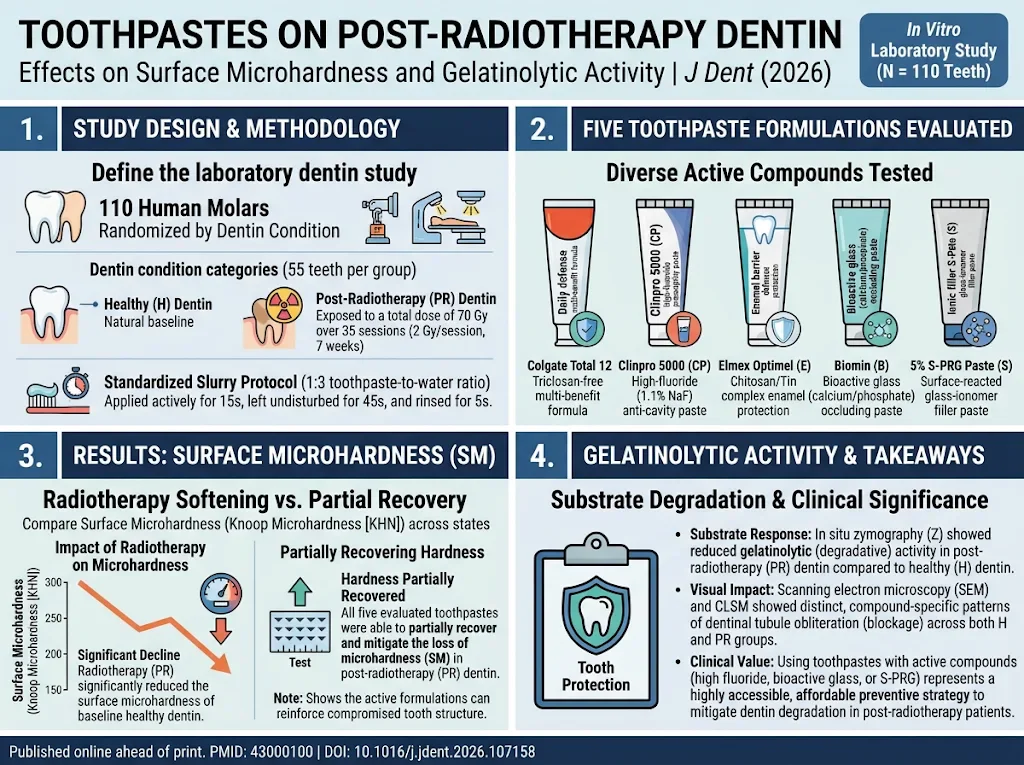
The study used 110 extracted human molars, divided based on dentin condition: either healthy (H) or from patients who received head-and-neck radiotherapy (PR), where specimens were exposed to a total dose of 70 Gy administered over 35 sessions in 7 weeks. Each tooth sample was classified according to the toothpaste used for treatment: Colgate Total 12 (CT), Clinpro 5000 (CP) — rich in fluoride, Elmex Opti-Enamel (E) — containing amine fluoride and calcium, Biomin (B) — a bioactive glass toothpaste, and 5% Surface Pre-Reacted Glass-ionomer (S-PRG) paste (S). A slurry of each toothpaste was prepared in a 1:3 ratio (toothpaste to distilled water). This slurry was applied actively to each dentin specimen for 15 seconds, left undisturbed for 45 seconds, then rinsed with water for 5 seconds. Surface microhardness (SM) was measured using the Knoop Hardness Number (KHN) method under a 10 g load for 10 seconds, both before and after toothpaste application, in 10 samples per group. Gelatinolytic activity (the capacity to degrade gelatin, a major component of dentinal matrix) was assessed via in situ zymography (Z) on 0.1-mm-thick dentin slices incubated with fluorescein-labeled gelatin for 48 hours at 37°C, with 5 samples per group. Surface morphology was characterized using Confocal Laser Scanning Microscopy (CLSM, 2 samples each) and Scanning Electron Microscopy combined with Energy Dispersive X-Ray Spectroscopy (SEM/EDS, 3 samples each) to analyze structural changes and elemental composition. Statistical analyses included repeated-measures three-way ANOVA to determine effects on microhardness and two-way ANOVA for gelatinolytic activity, ensuring robustness of conclusions.Results
Radiotherapy significantly decreased the surface microhardness of dentin, indicating softer, more vulnerable tissue. However, all tested toothpastes were capable of partially restoring this hardness, albeit to varying degrees. Notably, Clinpro 5000 and Biomin demonstrated more considerable recovery effects compared to others, likely owing to their fluoride and bioactive glass contents. Gelatinolytic activity was found to be reduced in post-radiotherapy dentin compared to healthy controls. This suggests that radiotherapy disrupts enzymatic degradation processes within dentin, potentially affecting tissue remodeling and repair mechanisms. Distinct differences in dentinal tubule occlusion patterns were observed between healthy and post-radiotherapy dentin after treatment with toothpaste. Tubule obliteration is crucial as open tubules contribute to dentin hypersensitivity. Some toothpastes showed enhanced ability to occlude tubules in both conditions, which may further benefit patients by reducing sensitivity.Discussion
Radiotherapy exerts deleterious effects on dentin by decreasing its hardness and modifying enzymatic activity critical for maintaining dentinal integrity. These changes can predispose patients to increased dental problems, including heightened caries risk and sensitivity. The ability of certain toothpaste formulations to partially reverse these changes highlights their potential as accessible preventive tools for patients undergoing or who have completed radiotherapy. Fluoride-rich formulations enhance remineralization, whereas bioactive glass components can promote mineral deposition and tubule sealing. Reduced gelatinolytic activity in post-radiotherapy dentin might reflect impaired matrix metalloproteinase function, enzymes involved in dentin matrix turnover. Toothpastes do not appear to fully restore this enzymatic activity but contribute positively to mechanical properties and structural protection.Clinical Relevance and Recommendations
For patients receiving head and neck radiotherapy, maintaining oral health is a critical concern. Toothpastes containing active compounds such as fluoride and bioactive glass represent practical, cost-effective means to help preserve dentin surface integrity and reduce the risk of dental complications. Clinicians should consider recommending such tailored toothpastes as part of comprehensive oral care protocols during and after radiotherapy treatment. In addition to professional dental care, patient education on proper oral hygiene and the use of these specialized products can improve outcomes.Conclusion
This in vitro study confirms that head and neck radiotherapy adversely affects dentin properties, decreasing surface microhardness and gelatinolytic activity. Toothpaste formulations with active ingredients can partially mitigate these effects by enhancing hardness and modifying surface characteristics, though enzymatic activity is less affected. Incorporating such dentifrices into oral care routines for patients undergoing radiotherapy provides a promising, affordable preventive strategy against dentin degradation and associated dental complications.Future Directions
Further clinical trials are warranted to validate these findings in vivo and to assess long-term benefits of specific toothpaste formulations. Exploration of novel compounds targeting enzymatic activity may also enhance protective effects. Additionally, studies on patient-reported outcomes such as sensitivity reduction and quality of life improvements would be valuable to optimize treatment protocols in oncologic dental care.Specialty calculators
For clinical reference; use professional judgment.