Highlight
- The retensionable inlay/onlay hybrid double-bundle medial collateral ligament (MCL) reconstruction significantly improves restoration of native knee laxity compared to single-bundle reconstruction.
- An anterior-posterior distal tibial fixation in double-bundle constructs outperforms proximal-distal fixation in replicating native knee kinematics.
- The use of retensionable variable-loop devices allows adjustment post cycling, enhancing graft tension and biomechanical stability.
- Biomechanical robotic testing validates that double-bundle constructs better resist valgus and external rotation laxity, potentially supporting earlier postoperative mobilization.
Study Background
The superficial medial collateral ligament (sMCL) is a primary stabilizer of the medial knee, preventing valgus stress and contributing to rotational stability. Injuries to the sMCL are common in sports and trauma and often require surgical reconstruction when conservative management fails or in combined ligament injuries. Traditional single-bundle sMCL reconstruction techniques have had variable success, with incomplete restoration of native joint laxity, often leading to residual instability or compromised function. This underscores an unmet clinical need for improved reconstruction methods that closely restore native knee biomechanics, reduce postoperative laxity, and facilitate early rehabilitation.Study Design
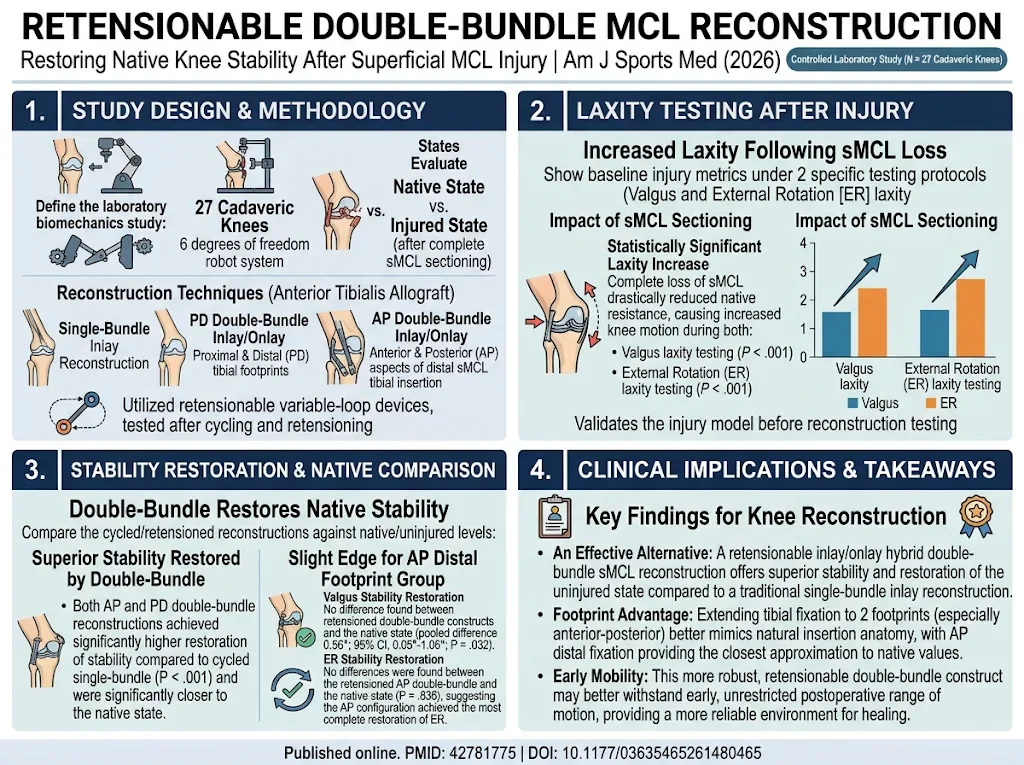
This controlled laboratory study utilized 27 fresh-frozen human cadaveric knees tested on a six degrees of freedom robotic system equipped for precise biomechanical analysis. Each knee underwent sequential testing in three states: native intact, injured (after sMCL sectioning), and reconstructed. Reconstruction was performed using anterior tibialis tendon allografts allocated into three groups: 1. Single-bundle inlay reconstruction representing traditional methods. 2. Double-bundle inlay/onlay hybrid reconstruction with tibial fixation at proximal and distal (PD) sMCL insertion sites. 3. Double-bundle inlay/onlay hybrid reconstruction with tibial fixation at anterior and posterior (AP) aspects of the distal sMCL insertion. Retensionable variable-loop devices facilitated adjustment of graft tension after knee cycling to mimic postoperative conditions. Valgus and external rotation (ER) laxity tests were conducted across knee flexion-extension cycles to assess restoration of biomechanical stability.Key Findings
Following sectioning of the sMCL, both valgus and ER laxities increased significantly compared to the native state (P < .001), confirming biomechanical instability due to ligament disruption. Post reconstruction and knee flexion cycling with retensioning: – Both double-bundle reconstructions (PD and AP tibial fixation) showed significantly greater restoration of stability than the single-bundle technique (P < .001). – For valgus rotation, double-bundle reconstructions approached native laxity values closely, exhibiting a pooled difference of 0.56° (95% CI, 0.05°-1.06°; P = .032), indicating negligible biomechanical deviation. – ER testing demonstrated that only the AP double-bundle hybrid reconstruction achieved parity with native states (P = .836), suggesting superior restoration of rotational stability. Comparing PD and AP tibial fixation in double-bundle constructs revealed that AP fixation better replicated natural joint kinematics under valgus and ER loading. The biomechanical superiority of double-bundle constructs suggests improved resistance to forces that typically challenge medial knee stability.Expert Commentary
Medial collateral ligament reconstruction techniques traditionally faced limitations in replicating the complex multi-directional restraint function of the native sMCL, often attributed to single-bundle constructs with limited footprint coverage. This study’s use of a retensionable inlay/onlay hybrid approach expands the reconstructed footprint with dual bundles, enhancing graft fixation biomechanics and functional length-tension dynamics. The innovative use of retensionable variable-loop suspensory fixation devices allows real-time tension adjustment post-cycling, mitigating graft elongation or slackening during early motion. These biomechanical advantages address critical challenges in postoperative rehabilitation, potentially enabling early joint movement without risking graft integrity. Limitations include the controlled laboratory environment using cadaveric specimens without biological healing responses, which may influence clinical translation. Further clinical outcome studies should investigate long-term graft integration, functional recovery, and re-injury rates. However, this study establishes a rational biomechanical foundation encouraging the adoption of double-bundle retensionable reconstructions in complex or high-demand patients.Conclusion
This biomechanical investigation demonstrates that retensionable inlay/onlay hybrid double-bundle medial collateral ligament reconstruction more effectively restores native knee laxity than conventional single-bundle methods. Notably, anterior-posterior distal tibial fixation within the double-bundle construct yields superior kinematic normalization under valgus and rotational stresses. These findings support the clinical consideration of double-bundle retensionable reconstructive techniques to enhance medial knee stability and potentially facilitate accelerated rehabilitation protocols without compromising graft performance. Clinicians managing medial knee instability should weigh the benefits of advanced double-bundle reconstruction against traditional approaches, especially in cases requiring robust resistance to complex loading patterns. Future research is warranted to correlate these biomechanical advantages with patient-oriented functional outcomes and long-term joint preservation.Funding and Clinical Trials
The referenced study did not explicitly disclose funding sources or clinical trial registration. Further updates from the authors or sponsoring institutions are awaited to clarify financial support and ongoing clinical evaluations.References
1. Anz AW, Waller G, Carroll J, et al. A Retensionable Inlay/Onlay Hybrid Double-Bundle Medial Collateral Ligament Reconstruction Produces Superior Restoration of the Uninjured State When Compared to a Single-Bundle Inlay Reconstruction. Am J Sports Med. 2026;54(13):3199-3210. doi:10.1177/03635465231112220 2. LaPrade RF, Geeslin AG, Griffith CJ, Johansen S. Patterns of medial knee injury. Diagnosis and treatment. Sports Med Arthrosc Rev. 2010;18(4):166-174. 3. Wijdicks CA, Griffith CJ, Johansen S, Engebretsen L, LaPrade RF. Injuries to the medial collateral ligament and associated medial structures of the knee. J Bone Joint Surg Am. 2010;92(5):1266-1280. 4. Jakob RP, Staubli HU. Medial collateral ligament injuries of the knee: diagnosis and treatment. Orthopade. 1995;24(3):196-204.Specialty calculators
For clinical reference; use professional judgment.