Highlight
The LATENT (Leveraging AI-ECG Technology for Early Notification and Tracking of AF Development) trial demonstrates that AI-enabled electrocardiogram (AI-ECG) analysis can modestly increase detection of new atrial fibrillation (AF), atrial flutter (AFl), or pre-AF atrial abnormalities through targeted rhythm monitoring. This randomized controlled trial introduces a novel precision surveillance strategy but also reveals that the improvement in detection is statistically fragile and requires further validation in larger studies focused on clinical outcomes.
Study Background
Atrial fibrillation and atrial flutter are common cardiac arrhythmias associated with increased risk of stroke, heart failure, and mortality. Early detection and treatment of these arrhythmias can reduce adverse outcomes but remains challenging due to their often paroxysmal and asymptomatic nature. Conventional interval-based ECG screening or opportunistic rhythm assessment frequently misses earlier or subtle electrical changes indicative of atrial vulnerability.
Recent advances in artificial intelligence (AI) have enabled analysis of sinus rhythm ECGs to predict latent atrial electrical abnormalities and future risk of AF. The hypothesis underpinning LATENT was that AI-ECG could identify patients at high risk of developing atrial arrhythmias who would benefit from targeted, intensified rhythm monitoring with ambulatory devices such as Holter monitors.
Study Design
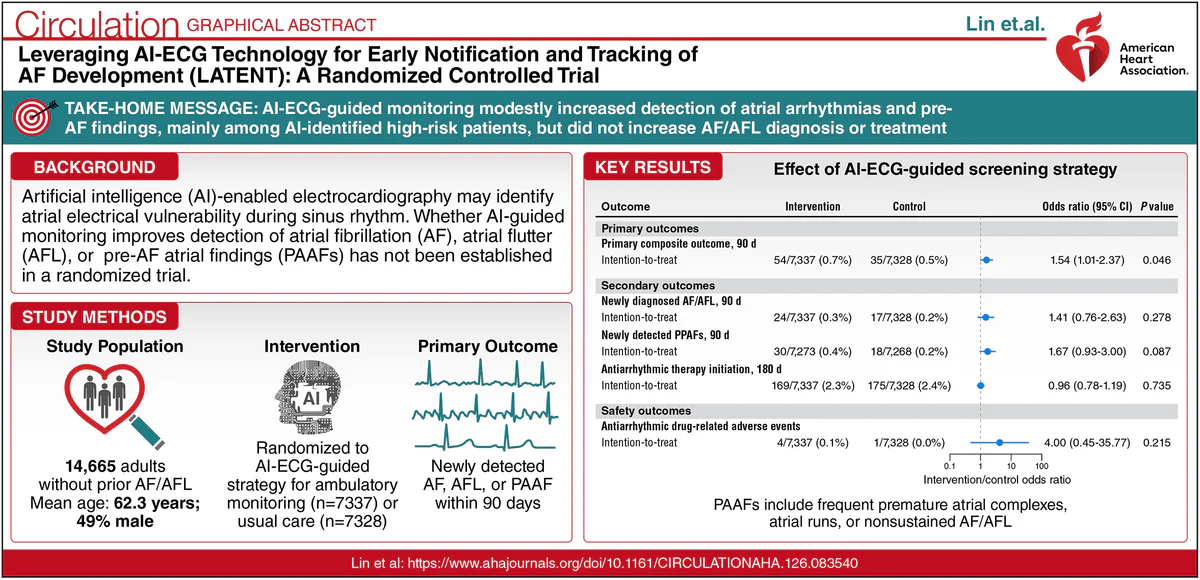
LATENT was a prospective, single-center, open-label, randomized controlled trial involving 14,665 adults aged 40 to 85 years without prior history of AF or AFl. Participants were randomized to either an AI-ECG-guided strategy or usual care (control).
In the intervention arm, participants with sinus-rhythm ECGs in the previous year were analyzed by AI algorithms to classify them as high-risk or low-risk for developing atrial arrhythmias. High-risk individuals were offered up to 7 days of Holter monitoring. Each high-risk intervention participant who underwent monitoring was paired with an age- and sex-matched control participant who also received the same monitoring to reduce ascertainment bias. Reporting cardiologists interpreting the Holter data were blinded to both AI classification and randomization assignment.
The primary outcome was a composite endpoint of newly detected AF, AFl, or pre-AF atrial findings (including frequent premature atrial complexes [PACs], short runs of PACs, or nonsustained AF/AFl episodes) within 90 days of randomization. Secondary outcomes included rates of overt AF/AFl detection, initiation of antiarrhythmic therapy within 180 days, and safety endpoints, including monitoring-related adverse events.
Key Findings
From 7,337 intervention and 7,328 control participants, 84 (1.1%) and 78 (1.1%) were classified as high risk by the AI algorithm, respectively. Of these, 57.1% of high-risk intervention participants and matched controls underwent Holter monitoring.
The primary composite outcome occurred in 0.74% of all intervention participants versus 0.48% of controls (odds ratio 1.54; 95% confidence interval [CI], 1.01–2.37; P=0.046). This indicates a modest relative increase in detection of atrial arrhythmia-related events in the AI-guided group. However, the statistical significance was fragile as hypothetically reclassifying one intervention event to a nonevent rendered the P value nonsignificant (P=0.057).
Subgroup analysis revealed a marked difference according to baseline AI-ECG risk status. Among high-risk participants, the primary outcome was detected in 32.1% of the intervention group compared to 2.6% of controls, signifying a substantial yield of the targeted monitoring strategy in this subgroup. In contrast, there was no significant difference in low-risk participants.
Regarding actual clinically overt AF/AFl detection, the rates were low and did not significantly differ between groups (0.3% intervention vs 0.2% control). Similarly, initiation of antiarrhythmic therapies at 180 days was comparable (2.3% intervention vs 2.4% control).
Safety data showed that 22.9% of monitored intervention participants reported minor monitoring-related adverse events such as skin reactions and discomfort, compared to 18.8% in matched controls.
Expert Commentary
The LATENT trial is a pioneering investigation integrating AI prediction with guided arrhythmia surveillance to enhance early detection of AF and atrial vulnerabilities. While the approach is biologically plausible given AI’s ability to identify subtle electrical signals and atrial substrate abnormalities in sinus rhythm ECGs, the clinical benefit demonstrated was modest and statistically fragile.
From a translational perspective, the modest increase in atrial arrhythmia detection must be weighed against the logistical, patient burden, and costs associated with expanded Holter monitoring programs. The lack of increase in clinically meaningful endpoints such as overt AF diagnosis or antiarrhythmic therapy initiation indicates that detected pre-AF findings may represent subclinical or lower-risk phenomena needing further characterization.
Limitations of LATENT include single-center design, limited monitoring duration, and relatively low recruitment into the high-risk monitored subgroup. Additionally, the open-label design and small number of events limit robustness. Larger multicenter trials with extended monitoring and long-term clinical outcomes such as stroke, systemic embolism, or heart failure hospitalization are necessary to validate the clinical utility and cost-effectiveness of AI-guided ECG monitoring strategies.
Conclusion
The LATENT randomized controlled trial provides proof-of-concept that AI-ECG-guided rhythm monitoring modestly increases detection of atrial arrhythmias and pre-AF electrical abnormalities in a high-risk population. However, the fragile statistical significance and modest clinical impact highlight the need for further large-scale studies to elucidate how best to integrate AI tools into routine cardiovascular preventive care and determine their effect on downstream clinical events and patient outcomes.
Despite its limitations, LATENT establishes a foundation for implementing AI-based risk stratification and personalized monitoring pathways, marking a step forward in precision cardiology and early arrhythmia detection strategies.
Funding and ClinicalTrials.gov Registration
The LATENT trial was registered at ClinicalTrials.gov with identifier NCT06847932. Details on funding sources were not specified in the abstract but are integral for assessing potential conflicts and trial support.
References
Lee CC, Lin WY, Liu WT, et al. Leveraging AI-ECG Technology for Early Notification and Tracking of AF Development (LATENT): A Randomized Controlled Trial. Circulation. 2026 Nov 7. PMID: 42998297. Available from: https://pubmed.ncbi.nlm.nih.gov/42998297/
Kirchhof P, Benussi S, Kotecha D, et al. 2020 ESC Guidelines for the diagnosis and management of atrial fibrillation developed in collaboration with the European Association of Cardio-Thoracic Surgery (EACTS). Eur Heart J. 2020;41(2): 245– 321.
Attia ZI, Noseworthy PA, Lopez-Jimenez F, et al. An artificial intelligence-enabled ECG algorithm for the identification of patients with atrial fibrillation during sinus rhythm: a retrospective analysis of outcome prediction. Lancet. 2019;394(10201):861-867.
Specialty calculators
For clinical reference; use professional judgment.