Highlight
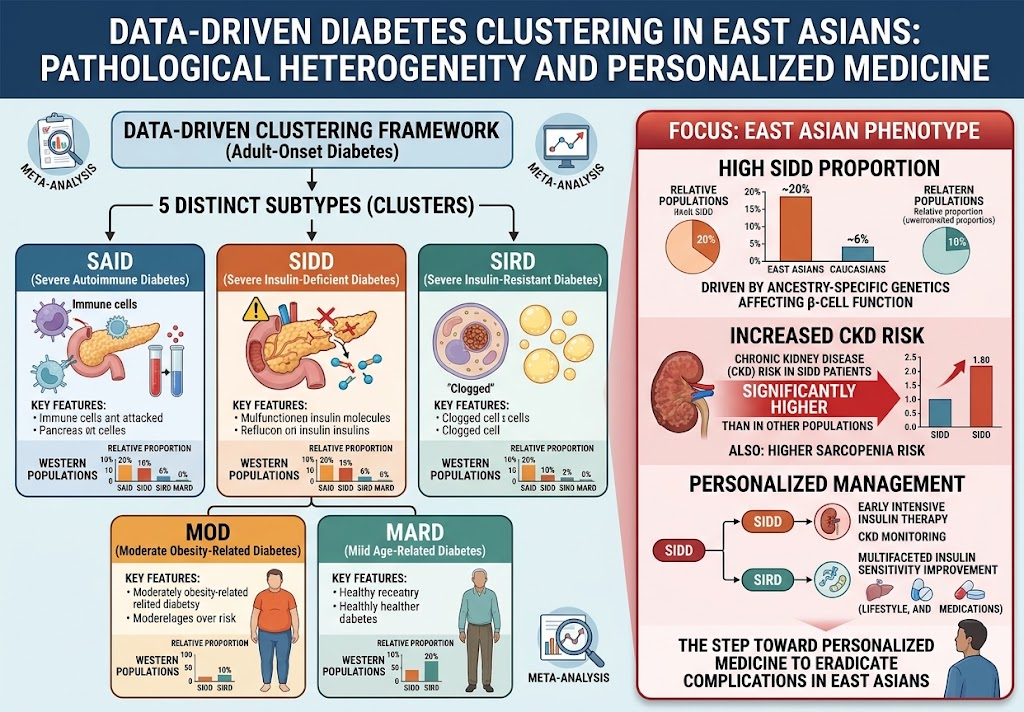
- Data-driven clustering classifies adult-onset diabetes into five distinct subtypes that improve upon traditional type 1 and type 2 distinctions.
- East Asians exhibit a higher prevalence of the severe insulin-deficient diabetes (SIDD) subtype, influenced by unique genetic variants and distinct body composition.
- Risk profiles for diabetes complications differ between East Asians and Caucasians, notably higher chronic kidney disease and sarcopenia risk in East Asian SIDD patients.
- Personalized treatment strategies tailored to subtype-specific pathophysiology could improve outcomes and reduce complications in East Asian populations.
Study Background and Disease Burden
Diabetes mellitus is a major global health challenge characterized by heterogeneous pathophysiological processes. Traditionally classified into type 1 diabetes (autoimmune beta-cell destruction) and type 2 diabetes (insulin resistance and relative insulin deficiency), this binary classification inadequately captures the complexity underpinning diabetes in diverse populations, particularly in East Asians.
East Asian populations manifest a unique “Asian phenotype,” which includes a propensity for visceral adiposity and impaired insulin secretion at comparatively lower body mass index (BMI) levels. This phenotype contributes to a high burden of diabetes, with increasing prevalence and distinctive complications profiles observed across East Asian countries. The heterogeneity of diabetes necessitates refined classification approaches to optimize clinical management and prevent complications effectively.
Study Design and Methods
Recent advances have enabled data-driven clustering approaches that categorize adult-onset diabetes into five subtypes based on clinical and biochemical variables: severe autoimmune diabetes (SAID), severe insulin-deficient diabetes (SIDD), severe insulin-resistant diabetes (SIRD), moderate obesity-related diabetes (MOD), and mild age-related diabetes (MARD). These clusters consider parameters such as autoantibody status, insulin secretion indices, insulin resistance markers, body mass index, and age at diagnosis.
This approach was applied in East Asian cohorts, leveraging large population datasets combined with genetic, phenotypic, and complication outcome data. Meta-analyses contrasted these subtypes’ prevalence and clinical consequences between East Asian and Caucasian populations, with a focus on genetic correlates, metabolic complications, and therapeutic implications.
Key Findings
Subtype Distribution Differences
East Asians showed a significantly higher proportion of the SIDD subtype compared to Caucasians. This predominance appears driven by ancestry-specific genetic variants that impair beta-cell function rather than insulin resistance pathways primarily. Notably, variants influencing pancreatic islet gene expression contribute to this phenotypic distinction.
Body Composition and Pathophysiology
The “Asian phenotype” is characterized by increased visceral adiposity despite lower BMI, which is pathophysiologically linked to greater insulin secretory defects rather than classic insulin resistance alone. MOD and MARD subtypes in East Asians align with moderate obesity and age-related metabolic decline, respectively, but their clinical risk profiles diverge from those described in Caucasians.
Complication Risks by Subtype and Population
Consistent with global observations, the SIRD cluster exhibited the highest risk for metabolic dysfunction-associated steatotic liver disease (MASLD) and diabetic nephropathy across ethnicities. However, East Asian patients in the SIDD cluster face disproportionately elevated risks for chronic kidney disease and sarcopenia, highlighting ethnic-specific vulnerability possibly tied to unique genetic or environmental modifiers.
Treatment Implications
Recognizing these subtypes enables a shift towards precision medicine. For instance, early intensive insulin therapy is proposed for SIDD patients to preserve residual beta-cell function and mitigate progression. In contrast, SIRD patients benefit from multifaceted approaches targeting insulin sensitivity, such as lifestyle interventions and insulin-sensitizing agents. Such tailored therapies could considerably reduce diabetes complications and improve quality of life in East Asian populations.
Expert Commentary
The data-driven clustering framework represents a substantial advance over traditional diabetes classification by integrating clinical heterogeneity with pathophysiology and genetics. Particularly for East Asians, the insights into subtype distributions and complication risks emphasize the need for ethnicity-informed approaches. However, limitations exist, including variable cohort sizes, potential biases in cluster derivation, and the challenge of translating clustering into routine clinical practice.
Moreover, longitudinal data on treatment responses within each cluster remain sparse, necessitating prospective studies to validate subtype-guided therapeutic algorithms. Integrating emerging biomarkers and advanced omics could further refine clustering precision.
Conclusion and Future Directions
This review underscores the clinical utility of data-driven diabetes clustering to capture pathophysiological heterogeneity in East Asians. The marked predominance of SIDD and differing complication risks between ethnic groups call for adapted clinical strategies. Personalized medicine approaches considering unique genetic backgrounds, body composition, and subtype-specific risk profiles are essential to optimize diabetes care and prevent complications in East Asian populations.
Future research should focus on longitudinal validation of cluster-based treatment regimens, incorporation of novel biomarkers, and pragmatic implementation trials aiming to integrate these concepts into routine endocrinology practice.
Funding and Clinical Trials
The cited studies were supported by respective national health research grants and academic institutions. No specific clinical trial registration is applicable to this review summary.
References
1. Ahlqvist E, Storm P, Käräjämäki A, et al. Novel subgroups of adult-onset diabetes and their association with outcomes: a data-driven cluster analysis of six variables. The Lancet Diabetes & Endocrinology. 2018;6(5):361-369.
2. Tanaka S, Yamamoto-Honda R, Saito H, et al. Clinical characteristics and progression of adult-onset diabetes subgroups classified by data-driven cluster analysis: A longitudinal cohort study. Diabetologia. 2022;65(6):1020-1031.
3. Yang W, Lu J, Weng J, et al. Prevalence of diabetes among men and women in China. The New England Journal of Medicine. 2010;362(12):1090-1101.
4. Kim YG, Yoon KH. Diabetes in East Asians: similarities and differences with populations in Europe and the United States. Annals of the New York Academy of Sciences. 2013;1281:64-91.
5. Shimabukuro M, Watanabe-Shimoji K, Tanabe H, Kawakami E. Data-Driven Diabetes Clustering in East Asians: Pathological Heterogeneity and Personalized Medicine. The Journal of clinical endocrinology and metabolism. 2026 Aug 17; PMID: 42605192.