Highlight
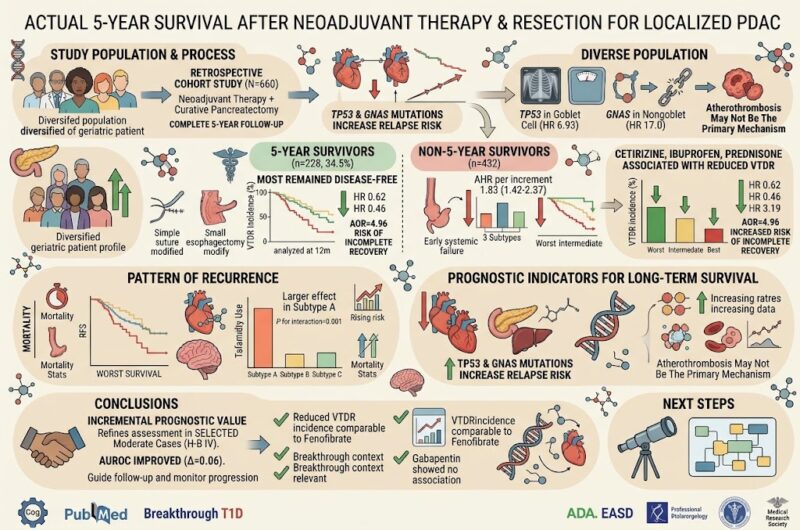
This large multicenter retrospective study demonstrates that 34.5% of patients with localized pancreatic ductal adenocarcinoma (PDAC) who undergo neoadjuvant therapy followed by curative-intent surgery survive at least five years. Early systemic recurrence within the first year after surgery is the primary barrier to long-term survival. Patients who remain recurrence-free at 1 and 2 years have substantially higher survival probabilities, up to 82%. Independent predictors of favorable long-term outcomes include lower baseline CA19-9 levels, less comorbidity, resectable baseline staging, ypT0-1 pathological stage, and complete (R0) resection.
Study Background
Pancreatic ductal adenocarcinoma (PDAC) remains one of the deadliest solid tumors, with a historically dismal prognosis even after surgical resection. Neoadjuvant therapy—chemotherapy and/or chemoradiotherapy administered before surgery—has emerged as a strategy to improve outcomes by downstaging tumors, eradicating micrometastatic disease early, and selecting patients more likely to benefit from surgery. However, despite its increasing application, accurate actual five-year survival rates following neoadjuvant therapy and curative resection have remained poorly characterized. Prior reports often rely on actuarial (Kaplan-Meier) estimates that do not reflect the true percentage of patients alive at five years. Precise data are crucial for informing patients, guiding surveillance strategies, and optimizing treatment paradigms.
Study Design
This was a retrospective cohort study conducted at two high-volume centers enrolling consecutive patients with localized PDAC who underwent neoadjuvant therapy followed by curative-intent pancreatectomy between January 2015 and February 2021. Crucially, only patients with complete follow-up—either documented death or at least five years of survival—were included to calculate actual survival rates rather than actuarial estimates. Baseline clinical and tumor characteristics were recorded, including disease stage categorized as resectable, borderline resectable, or locally advanced. The primary endpoint was actual five-year survival measured from the date of surgery. Secondary outcomes included recurrence rates, timing and patterns of recurrence, and predictors of long-term survival. Multivariable analysis identified independent clinical and pathological factors associated with five-year survival.
Key Findings
Among 660 patients studied, the actual five-year survival after neoadjuvant therapy and surgery was 34.5%. This demonstrates that more than one-third of this high-risk population ultimately achieved long-term survival. However, the majority—74.1%—experienced disease recurrence, predominantly within the first year following surgery, illustrating the challenge of early systemic failure despite aggressive neoadjuvant treatment.
Strikingly, nearly two-thirds of recurrences in patients who did not survive five years occurred within 12 months after resection, underscoring the aggressive biology of early relapse. Long-term survivors (those alive beyond five years) showed a markedly lower overall recurrence rate (40.4%) and tended to develop later-onset recurrences (>2 years) characterized by locoregional or pulmonary oligometastatic patterns rather than diffuse systemic spread. This suggests a biologically distinct trajectory with potentially more indolent disease or more effective initial systemic control.
Survival probability increased dramatically when patients reached disease-free milestones: among those recurrence-free at 1 year, the probability of five-year survival rose to 62.0% (95% CI 56–67), and for those recurrence-free at 2 years, it further increased to 81.9% (95% CI 76–86). This affirms the prognostic importance of early recurrence and provides practical guidance on counseling and surveillance intensity.
The study further stratified five-year survival by initial disease stage: 42.5% for resectable, 29.0% for borderline resectable, and 17.5% for locally advanced PDAC. These substantial differences highlight the continuing importance of baseline disease burden assessment in prognostication and treatment planning.
In multivariable analysis, independent predictors of five-year survival included low comorbidity burden, baseline serum carbohydrate antigen 19-9 (CA19-9) levels below 200 U/mL, initial resectable disease stage, pathological tumor stage ypT0-1 indicating limited residual tumor, and R0 resection status (microscopically margin-negative). These factors can guide selection and risk stratification before and after surgery.
Expert Commentary
This robust analysis provides the clearest quantification to date of actual long-term survival after neoadjuvant therapy and resection for localized PDAC, moving beyond actuarial estimates that tend to overestimate survival probabilities. Importantly, the work demonstrates that while early systemic recurrence remains the major hurdle, a significant subset of patients achieves durable remission. Identifying those at risk for early relapse versus those suited for intensified surveillance or adjunctive therapies remains a clinical priority.
The finding that delayed recurrences are often oligometastatic and anatomically limited suggests opportunities for salvage interventions, such as metastasectomy or stereotactic radiotherapy, which merit further prospective evaluation.
Limitations include the retrospective design, potential selection bias, and being conducted at high-volume centers which may limit generalizability. Nevertheless, it offers vital real-world insight that complements ongoing clinical trials of novel neoadjuvant and adjuvant regimens.
Conclusion
In summary, this study confirms that over one-third of patients with localized PDAC who undergo neoadjuvant therapy and curative-intent surgery achieve actual five-year survival, with most long-term survivors remaining disease-free. Early systemic recurrence within the first year is the predominant obstacle to improved long-term outcomes. Patients who remain recurrence-free at 1 and 2 years have substantially higher probabilities of surviving five years. Key prognostic indicators including tumor burden, CA19-9, surgical margins, and pathological staging provide actionable information to optimize patient counseling and management. These findings emphasize the importance of early detection and systemic control of microscopic disease for improving survival in this aggressive malignancy. Future research should focus on refining neoadjuvant regimens, improving biomarkers for early relapse prediction, and exploring strategies for managing late oligometastatic recurrences to further extend patient survival and quality of life.
Reference
De Stefano F, Belfiori G, Wu NF, Allen JN, Crn LC, Clark JW, Arcidiacono PG, Ferrone C, Hong TS, Tamburrino D, Partelli S, Qadan M, Reni M, Ryan DP, Lena MS, Capurso G, Weekes CD, Wo JY, Lillemoe KD, Crippa S, Falconi M, Castillo CF. Actual Five-year Survival After Neoadjuvant Therapy and Resection for Localized Pancreatic Ductal Adenocarcinoma. Ann Surg. 2026 Sep 10. doi: 10.1097/SLA.0000000000007214. Epub ahead of print. PMID: 42717278.