Highlight
This phase 2 proof-of-concept study provides the first clinical evidence that selective inhibition of interleukin-4 receptor alpha (IL-4Rα) with dupilumab arrests progression in localised scleroderma (LS). Key highlights include significant clinical improvement of sclerotic lesions, marked attenuation of local inflammation, and specific downregulation of IL-4/IL-13-dependent fibrosis gene signatures after six months of therapy compared to placebo. These findings support the translational promise of targeting IL-4/IL-13 signalling in fibrosing diseases beyond LS.
Study Background
Fibrotic diseases such as localised scleroderma and systemic sclerosis represent a major therapeutic challenge with limited approved treatments. LS is characterised by localized skin inflammation and excessive extracellular matrix deposition resulting in sclerosis, which can cause functional impairment and cosmetic disfigurement. Preclinical studies in murine models implicate the IL-4/STAT6 axis as critical to fibrosis development; however, the role of IL-4 and IL-13 in human fibrotic diseases remains incompletely understood. Given the IL-4/TH2 cytokine profile association with fibrosis, targeting IL-4 receptor α – a shared receptor subunit mediating IL-4 and IL-13 signals – is a rational therapeutic approach. A deeper understanding of the immunopathogenesis in LS is essential to developing effective and mechanism-based therapies.
Study Design
This randomized, double-blind, placebo-controlled clinical trial enrolled patients with active localised scleroderma (ClinicalTrials.gov ID: NCT04200755). Participants received either dupilumab, a monoclonal antibody targeting IL-4Rα, or placebo for six months. The primary objective was to assess safety and clinical efficacy in LS, measured by changes in sclerosis severity and disease activity. Secondary endpoints included histologic evaluation of inflammation, molecular interrogation of gene expression profiles associated with IL-4/IL-13 signalling, and evaluation of fibrosis-related genes. The study was adequately powered to detect meaningful clinical and molecular differences between groups.
Key Findings
After six months of treatment with dupilumab, patients exhibited significant clinical improvement in sclerosis compared to placebo, with reduction in induration and improved skin pliability. Objective assessments demonstrated a significant attenuation of local inflammatory infiltrates on histology. Molecular analyses revealed a targeted suppression of the IL-4/IL-13-dependent gene signature, confirming pharmacodynamic engagement of the pathway. Notably, genes encoding fibrosis-promoting proteins showed partial but significant downregulation, highlighting the potential to modify underlying fibrotic processes. The intervention was well tolerated with no unexpected safety signals, consistent with prior dupilumab experience in atopic diseases.
Effect Size and Clinical Significance
The study demonstrated statistically significant differences favoring dupilumab over placebo in both clinical scores and molecular biomarkers. While longer-term outcomes remain to be explored, the observed improvements within six months establish proof-of-concept efficacy in a disease that previously lacked targeted pharmacotherapy. The partial normalization of fibrosis gene expression suggests meaningful biological impact that could translate to sustained disease control.
Expert Commentary
The study adds important human evidence to the preclinical data supporting the IL-4/IL-13 axis as a driver of fibrosis. By directly blocking IL-4Rα, dupilumab uniquely dampens both IL-4 and IL-13 signalling, key cytokines implicated in fibrotic pathobiology. This dual inhibition contrasts with more nonspecific approaches and may offer superior efficacy and a favorable safety profile. However, limitations include the relatively short duration, modest sample size, and focus on cutaneous manifestations without exploration of systemic involvement. Larger, longer trials are warranted to confirm clinical durability and to explore utility in other fibrosing conditions such as systemic sclerosis or idiopathic pulmonary fibrosis.
Mechanistically, the study supports targeting type 2 cytokines as a strategy to reverse or stabilize fibrosis by reducing profibrotic immune activation and fibroblast stimulation. This is a promising paradigm shift from primarily symptomatic management to disease-modifying immunotherapy in fibrotic diseases.
Conclusion
This phase 2 trial establishes that IL-4Rα blockade with dupilumab effectively suppresses inflammation and fibrosis-associated gene expression, resulting in significant clinical improvement in localised scleroderma. These findings pave the way for larger clinical studies and highlight IL-4/IL-13 signalling as a viable therapeutic target in fibrosing diseases. Early intervention with selective cytokine blockade has the potential to transform management of scleroderma and related conditions, reducing morbidity and improving patient quality of life.
Funding and ClinicalTrials.gov
The study was registered under ClinicalTrials.gov identifier NCT04200755. Funding sources were not described in the abstract but can be referenced in full publication.
References
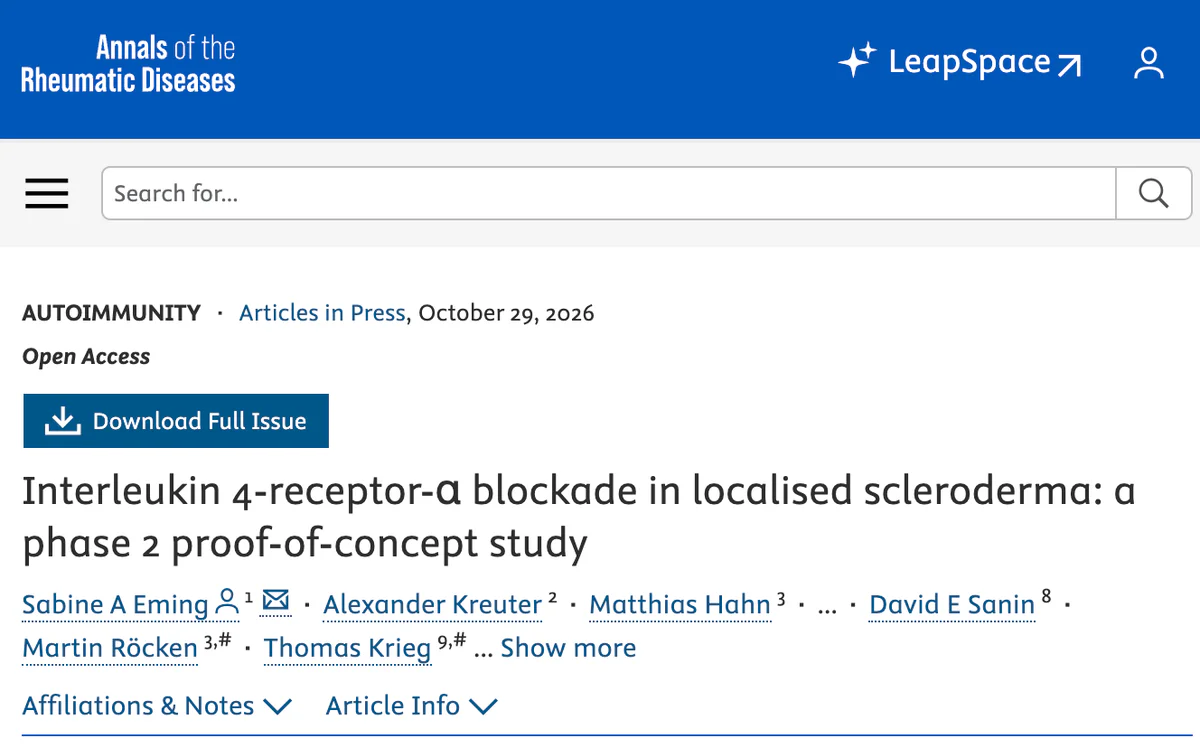
Eming SA, Kreuter A, Hahn M, et al. Interleukin 4-receptor-α blockade in localised scleroderma: a phase 2 proof-of-concept study. Ann Rheum Dis. 2026 Oct 29. PMID: 42957460.
Additional background literature on IL-4/IL-13 and fibrosis pathogenesis may include:
- Sterling JC, et al. The role of type 2 immunity in skin fibrosis. Clin Exp Immunol. 2022;208(3):277-288.
- Harrison DA, et al. Signal transducer and activator of transcription 6 (STAT6) and fibrosis: therapeutic implications. Fibrogenesis Tissue Repair. 2020;13:12.
Specialty calculators
For clinical reference; use professional judgment.