Introduction
Since the first successful live birth following uterus transplantation (UTx) in 2014, this cutting-edge procedure has developed into a promising fertility-restoration option for women with absolute uterine factor infertility (AUFI). While the field has focused extensively on recipient and newborn outcomes, comprehensive evaluation and selection processes for living donors remain relatively understudied yet are crucial for ensuring optimal transplant success and safety.Background: The Burden of Absolute Uterine Factor Infertility and the Emergence of UTx
AUFI affects women who either lack a uterus congenitally or have lost it due to disease or surgery, rendering them infertile. Until recently, options to achieve biological motherhood included surrogacy or adoption, each with legal, ethical, or personal limitations. Uterus transplantation offers the potential for gestation and genetic offspring in this population, marking a significant advance in reproductive medicine. Since 2017, the Dallas UTx program has been a leading center in the United States with a living-donor-predominant approach, having completed 40 transplants with impressive clinical outcomes.Study Design and Methods
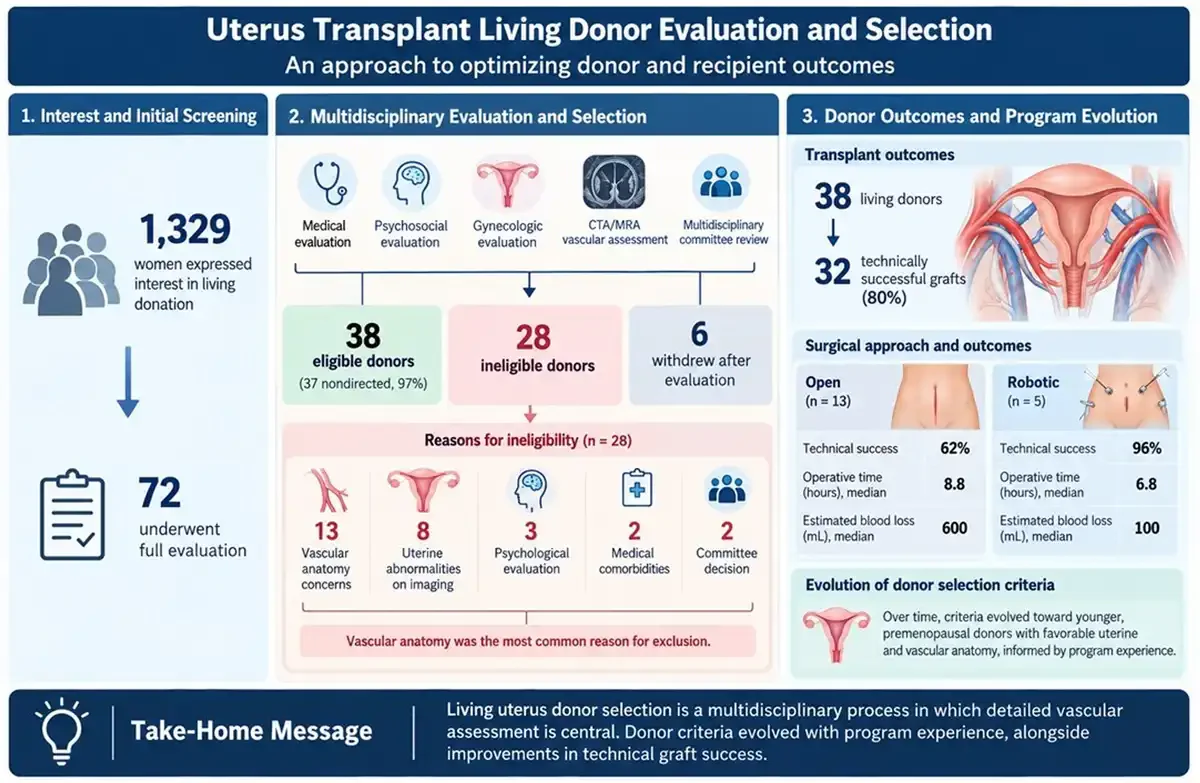
This review article details the Dallas UTx program’s methodology and evolution in living donor evaluation over a 9-year period. The program assessed a large cohort of volunteers—1329 women—who engaged in a multi-step evaluation process aimed at meticulously identifying suitable uterus donors. The evaluations encompassed medical, psychological, and imaging assessments alongside multidisciplinary committee review to address donor safety and predict successful transplant outcomes. The study emphasizes exclusion criteria such as vascular anatomy adequacy and medical comorbidities, which are central to donor eligibility.Key Findings
Out of 1329 volunteers, only 72 progressed to full evaluation, reflecting the program’s rigorous screening. Thirty-eight donors (approximately 3% of initial volunteers) were deemed eligible; notably, a high portion (97%) of these were nondirected donations. Donor exclusions were primarily driven by concerns regarding vasculature anatomy (13 women), highlighting the critical importance of pelvic vascular supply compatibility for successful graft perfusion and viability. Other exclusion factors included imaging-detected abnormalities (8 women), medical comorbidities (2 women), psychological concerns (3 women), and decisions reached during committee review (2 women). Clinical outcomes in recipients demonstrated encouraging results: 27 recipients have delivered one child, four have had two children, and six are currently pregnant at the time of reporting. These data underscore that rigorous donor selection contributes to favorable recipient and newborn outcomes.Discussion and Expert Commentary
The Dallas experience reaffirms that living donor UTx requires an exceptionally comprehensive evaluation protocol that integrates anatomical, medical, and psychological dimensions. The predominance of vasculature concerns as reasons for exclusion supports the importance of advanced imaging modalities and vascular assessment in donor selection. Minimizing donor risk while maximizing recipient success is paramount given the complex nature and ethical considerations associated with living donation for a non-life-saving transplant. This evaluation strategy balances donor safety and recipient benefit, avoiding transplantation attempts on unsuitable donors that could precipitate graft loss or serious complications. Expert consensus increasingly advocates for standardized donor assessment protocols to facilitate comparison across centers and improve regulatory oversight. Limitations of the report include its single-center design and potential selection biases inherent in a volunteer donor population. Future multicenter studies and consensus guidelines are necessary to validate and optimize donor criteria universally.Conclusion
The Dallas UTx program’s living donor evaluation and selection process exemplifies a rigorous and evolving model that prioritizes donor safety and optimizes recipient outcomes. Their experience highlights the indispensable role of a comprehensive, multidisciplinary approach focusing on vascular integrity and medical fitness. As uterus transplantation continues to gain traction globally, adoption of such robust evaluation protocols will be critical for advancing this transformative reproductive technology responsibly and ethically.Funding and Clinical Trials
Details regarding funding sources and clinical trial registrations for the Dallas UTx program were not delineated in the primary publication. Interested readers should consult clinical trial registries and program disclosures for updated research sponsorship information.References
1. Jacques A, Fischbach C, Warren AM, Testa G, Johannesson L. Uterus Transplant Living Donor Evaluation and Selection: An Approach to Optimizing Donor and Recipient Outcomes. Transplantation. 2026 Oct 30. doi:10.1097/TP.0000000000004401. PubMed PMID: 42957616. 2. Brännström M, Johannesson L, Dahm-Kähler P, et al. First livebirth after uterus transplantation. Lancet. 2015 Apr 11;385(9968):607-16. 3. Fageeh W, Raffa H, Mansi M, et al. Uterine transplantation: a historical perspective and future outlook. Obstet Gynecol Sci. 2018 Apr;61(2):137-148.Specialty calculators
For clinical reference; use professional judgment.