Highlight
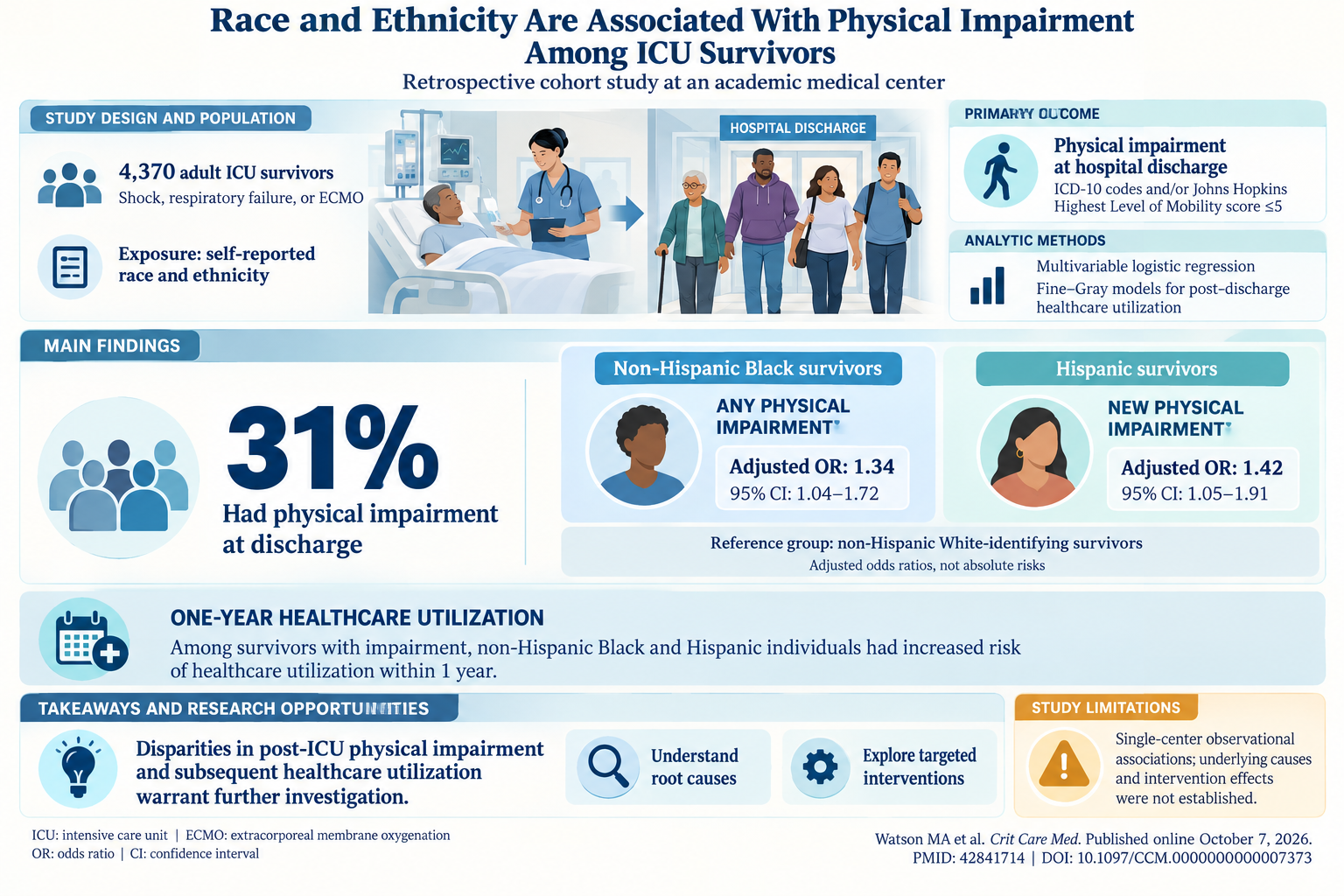
- Non-Hispanic Black and Hispanic adult ICU survivors have significantly increased odds of physical impairment at hospital discharge compared to non-Hispanic White survivors.
- Physical impairment affects nearly one-third of ICU survivors who experienced shock, respiratory failure, or extracorporeal membrane oxygenation.
- Among those with impairment, non-Hispanic Black and Hispanic patients demonstrate an elevated risk of increased healthcare utilization within one year post-discharge.
- Findings emphasize the urgent need to understand underlying causes and develop tailored interventions to address racial and ethnic disparities in ICU recovery.
Study Background
The global burden of critical illness often results in prolonged physical impairment among survivors, contributing to long-term disability, decreased quality of life, and increased healthcare demands. Critical illness-related physical impairment—encompassing muscle weakness, reduced mobility, and functional limitations—is commonly observed after intensive care unit (ICU) stays involving shock, respiratory failure, or advanced life support modalities such as extracorporeal membrane oxygenation (ECMO). Early physical recovery is a key determinant of long-term outcomes, but disparities in post-ICU recovery remain poorly characterized across racial and ethnic groups.
Emerging evidence suggests that social determinants of health and systemic inequities contribute to disparities in critical care outcomes. Understanding differences in physical impairment among ICU survivors by race and ethnicity is essential to optimize rehabilitation pathways and allocate resources equitably. This study aimed to evaluate whether self-reported race and ethnicity are associated with increased odds of physical impairment at hospital discharge in ICU survivors and to assess how such impairment impacts subsequent healthcare utilization.
Study Design
A retrospective cohort study was conducted at an academic medical center, involving 4,370 adult ICU survivors who had experienced shock, respiratory failure, or were treated with ECMO. Data were extracted from electronic health records, including demographic information, clinical characteristics, and post-discharge health service utilization.
The primary exposure variable was self-reported race and ethnicity, categorized as non-Hispanic White, non-Hispanic Black, Hispanic, or other groups. The primary outcome was physical impairment at hospital discharge, operationalized as the presence of relevant International Classification of Diseases, 10th Revision (ICD-10) codes indicative of mobility or functional limitations or a Johns Hopkins Highest Level of Mobility (HLM) score ≤5, reflecting limited functional mobility.
Multivariable logistic regression models adjusted for confounding variables including age, sex, comorbidities, severity of illness, and ICU length of stay were used to assess the association between race/ethnicity and impairment. Additionally, Fine-Gray competing risk models examined healthcare utilization within one year after discharge, adjusting for mortality as a competing risk.
Key Findings
Physical impairment at hospital discharge was identified in 31% of the ICU survivor cohort. After adjustment, non-Hispanic Black patients had a 34% higher odds of any physical impairment compared with non-Hispanic White patients (adjusted odds ratio [aOR], 1.34; 95% confidence interval [CI], 1.04–1.72).
Hispanic patients demonstrated a 42% higher odds of new physical impairment at discharge (aOR, 1.42; 95% CI, 1.05–1.91) relative to non-Hispanic White counterparts.
Regarding post-discharge healthcare utilization among those with physical impairment, non-Hispanic Black and Hispanic patients had increased risk of healthcare encounters within one year, including hospital readmissions, emergency visits, and outpatient rehabilitation services. These elevated risks persisted after accounting for demographic and clinical factors.
These findings highlight significant racial and ethnic disparities not only in initial physical recovery following critical illness but also in healthcare resource use during the vulnerable post-discharge period.
Expert Commentary
The study by Watson et al. compellingly quantifies disparities in physical impairment among ICU survivors, underscoring that non-Hispanic Black and Hispanic populations face higher burdens beyond their initial critical illness. This disparity may be driven by a complex interplay of factors including pre-existing health inequities, social determinants such as access to outpatient rehabilitation, socioeconomic status, implicit biases in care delivery, and differential support systems post-hospitalization.
The use of validated mobility scores alongside ICD-10 data strengthens the assessment of functional impairment. However, limitations inherent to retrospective design, such as potential misclassification and unmeasured confounding (e.g., socioeconomic variables, detailed rehabilitation access), should be acknowledged. Moreover, the single-center nature may affect generalizability, and further multi-institutional studies are warranted.
Mechanistically, early physical impairment post-ICU often reflects critical illness myopathy and neuropathy, compounded by prolonged immobilization, malnutrition, inflammation, and comorbidity burden. Racial and ethnic disparities may exacerbate these biological insults due to differential exposure to stressors and healthcare quality.
The heightened healthcare utilization observed suggests that impaired survivors require ongoing support but may face barriers in effective outpatient management, which can contribute to preventable readmissions.
Conclusion
This study reveals that approximately one-third of ICU survivors experience physical impairment at hospital discharge, with non-Hispanic Black and Hispanic patients disproportionately affected. These impairments correlate with increased healthcare utilization in the subsequent year, emphasizing an urgent need to address racial and ethnic disparities in post-ICU rehabilitation and care coordination.
Future research should identify modifiable factors contributing to these disparities and evaluate targeted interventions—such as culturally tailored rehabilitation programs, enhanced access to multidisciplinary support, and social determinants-informed care models—to improve outcomes equitably among ICU survivors. Clinicians and health systems must be aware of these disparities to ensure comprehensive assessments and optimize discharge planning for vulnerable populations.
Funding and Trial Registration
The original study did not report specific funding sources or clinical trial registration.
References
1. Watson MA, Fuchita M, Burnham EL, Jolley SE. Race and Ethnicity Are Associated With Physical Impairment Among ICU Survivors. Crit Care Med. 2026 Oct 7. PMID: 42841714.
2. Herridge MS, Cheung AM, Tansey CM, et al. One-year outcomes in survivors of the acute respiratory distress syndrome. N Engl J Med. 2003;348(8):683-93.
3. Needham DM, Davidson J, Cohen H, et al. Improving long-term outcomes after discharge from intensive care unit: Report from a stakeholders’ conference. Crit Care Med. 2012;40(2):502-9.
4. Blackstock AJ, Effken JA, Kon AA, et al. Racial disparities in post-acute care for critically ill patients: A systematic review. Am J Respir Crit Care Med. 2015;192(6):717-25.