Highlight
- Integrating primary colorectal tumor location with RAS and BRAF mutational status identifies distinct post-hepatectomy recurrence and survival trajectories.
- BRAF-mutant and right-sided RAS-mutant colorectal liver metastases (CRLM) are associated with the highest mortality risk after liver resection.
- Rectal RAS-mutant tumors show a stronger tendency for lung-only and disseminated recurrence patterns, impacting surveillance strategies.
- Integrated tumor biology can enhance preoperative counseling, postoperative monitoring, and clinical trial stratification.
Study Background
Colorectal cancer (CRC) remains a major global health challenge, and liver metastases (CRLM) represent the principal cause of death in affected patients. Liver resection offers the best chance of long-term survival and potential cure in selected patients with CRLM. However, recurrence after hepatectomy is common, and traditionally, patient selection and prognostication have relied heavily on morphology-based criteria such as tumor size, number, and resection margins. Emerging evidence underscores the critical role of tumor biology in determining recurrence risk and survival outcomes after liver resection for CRLM. In particular, primary tumor site (right colon, left colon, rectum) and the mutational status of key oncogenes—RAS and BRAF—have demonstrated individual prognostic significance. Right-sided primary tumors and BRAF mutations are associated with more aggressive disease and poorer outcomes, yet the integrated impact of tumor location combined with RAS/BRAF status on post-resection disease behavior remains incompletely characterized. The BIO-CRLM study aimed to fill this knowledge gap by evaluating whether a pre-defined integrated model of primary tumor biology could define recurrence phenotypes and survival trajectories in an international cohort undergoing liver resection for CRLM.Study Design
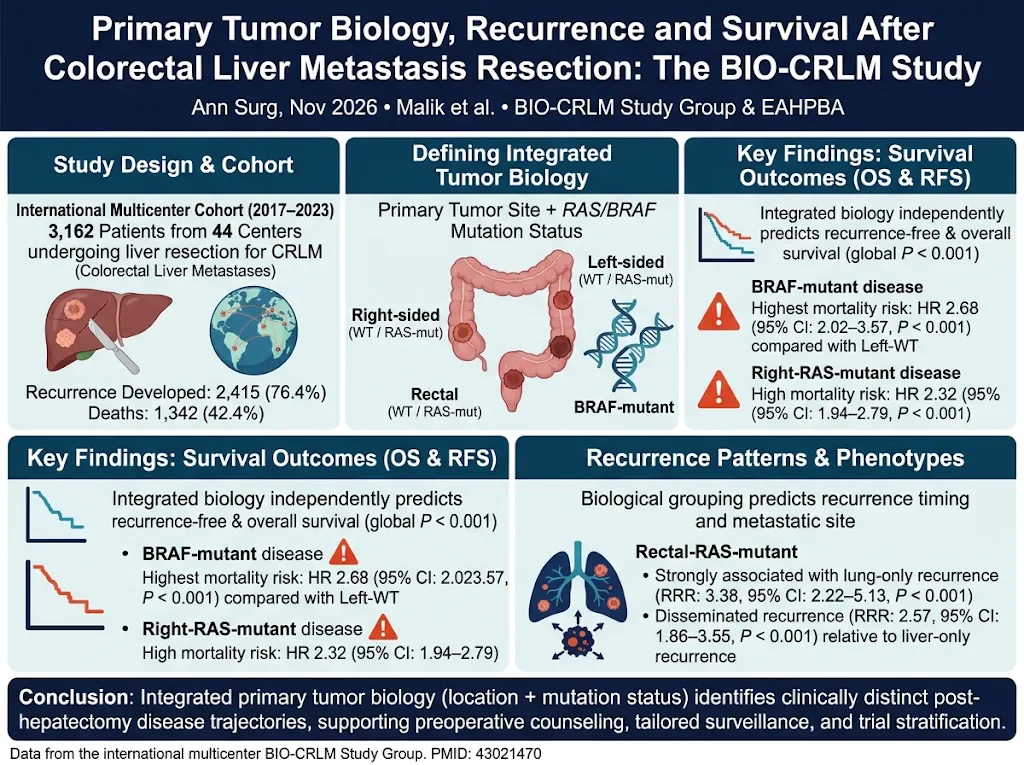
This multinational cohort study analyzed data from 3162 patients across 44 centers who underwent liver resection for CRLM between 2017 and 2023. The integrated biology classification was defined a priori, combining primary tumor location (left colon, right colon, or rectum) and mutation status into seven groups: left-sided wild-type, right-sided wild-type, rectal wild-type, left-sided RAS-mutant, right-sided RAS-mutant, rectal RAS-mutant, and BRAF-mutant disease. Primary outcomes included recurrence-free survival (RFS) and overall survival (OS). Secondary outcomes investigated were early recurrence (timing post-surgery), disseminated first recurrence (multiple distant sites), and patterns of first recurrence (organ-specific phenotypes such as liver-only, lung-only, or disseminated). Appropriate multivariable statistical models adjusted for confounders were implemented to establish the independent prognostic contribution of integrated tumor biology.Key Findings
Among the large cohort, 76.4% (2415) developed disease recurrence, and 42.4% (1342) died during follow-up, illustrating the high recurrence burden after CRLM resection. Integrated primary tumor biology was significantly and independently associated with both RFS and OS (global P<0.001), confirming its strong prognostic value beyond conventional factors. Mortality risk was highest in patients with BRAF-mutant tumors (hazard ratio [HR]: 2.68; 95% confidence interval [CI]: 2.02-3.57; P<0.001) and right-sided RAS-mutant tumors (HR: 2.32; 95% CI: 1.94-2.79; P<0.001) compared with left-sided wild-type tumors. This establishes BRAF mutation and right-sided RAS mutation as markers of particularly aggressive biology leading to worse survival after liver resection. Integrated biology classification was significantly correlated with recurrence phenotypes. Notably, rectal RAS-mutant tumors exhibited the strongest association with lung-only recurrence (relative risk ratio [RRR]: 3.38; 95% CI: 2.22-5.13; P<0.001) and disseminated recurrence (RRR: 2.57; 95% CI: 1.86-3.55; P<0.001) relative to liver-only recurrence. This suggests site-specific biological behaviors influencing metastatic tropism. Early recurrence and disseminated first recurrence were also linked to integrated biology subgroups, highlighting potential differences in tumor aggressiveness and systemic dissemination patterns.Expert Commentary
This expansive international study robustly confirms that integrating primary tumor sidedness with RAS/BRAF mutation profiling provides a refined biological stratification tool with clinically actionable prognostic implications after CRLM resection. The pronounced poor prognosis of BRAF-mutant and right-sided RAS-mutant subtypes aligns with prior molecular research indicating these tumors harbor distinct oncogenic pathways, immune microenvironments, and therapeutic vulnerabilities. The observed association of rectal RAS-mutant tumors with lung metastases underscores how anatomical origin influences metastatic spread and may inform surveillance protocols emphasizing pulmonary imaging. While the study’s large sample size and comprehensive mutation and clinical data represent major strengths, limitations include potential variability in mutation testing across centers and lack of detailed data on systemic therapy regimens, which can influence survival outcomes. Moreover, these biological classifications should be integrated with morphologic and clinical features to optimize personalized treatment decisions. Future prospective investigations could evaluate how preoperative knowledge of integrated biology impacts surgical candidacy decisions, neoadjuvant therapy choices, and follow-up intensity.Conclusion
The BIO-CRLM study establishes an integrated biological classification model combining primary colorectal tumor site and RAS/BRAF mutational status as a powerful predictor of recurrence patterns and survival outcomes after resection of colorectal liver metastases. This approach enables identification of clinically distinct disease trajectories, thereby enhancing patient counseling, individualized surveillance strategies, and rational stratification for therapeutic trials. Incorporation of tumor biology into standard preoperative evaluation represents a critical step toward precision oncology in metastatic colorectal cancer management, with the potential to improve long-term outcomes and resource utilization.Funding and Trial Registration
The study was conducted under the auspices of the BIO-CRLM Study Group and the European-African Hepato-Pancreato-Biliary Association (EAHPBA) Scientific and Research Committee. Funding sources and trial registration details were not specified in the reference abstract.References
1. Malik AK, et al. Primary Tumor Biology, Recurrence and Survival After Colorectal Liver Metastasis Resection: The BIO-CRLM Study. Ann Surg. 2026 Nov 13. PMID: 43021470. 2. Vauthey JN, et al. Impact of RAS mutations on surgical outcomes in colorectal liver metastases. J Clin Oncol. 2013;31(15):1931-1938. 3. Kopetz S, et al. Impact of BRAF mutation on colorectal cancer survival: systematic review and meta-analysis. J Natl Cancer Inst. 2015;107(3):dju427. 4. Jones RP, et al. Site-specific metastases and prognosis in colorectal cancer. Surg Oncol. 2016;25(1):26-30.Specialty calculators
For clinical reference; use professional judgment.