Highlights
- Silent atherosclerosis is detectable as early as the third decade of life in both sexes, increasing in prevalence exponentially with advancing age.
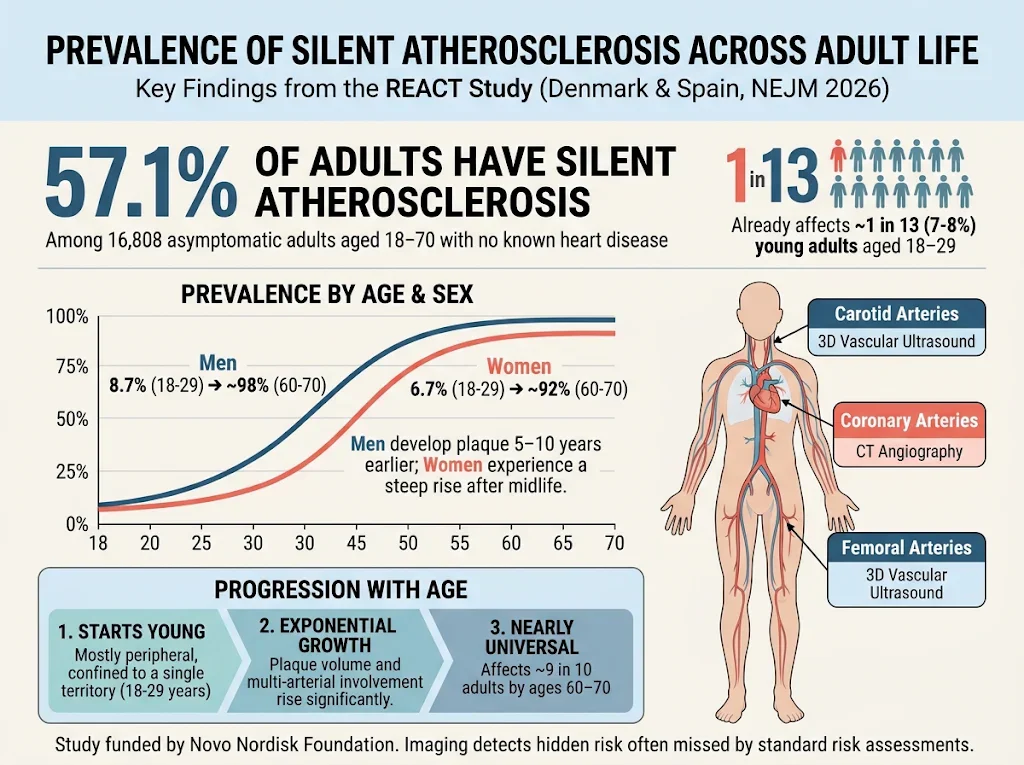
- Atherosclerotic burden predominately involves peripheral arteries (carotid and femoral) in younger adults before extending to multi-territory and coronary involvement with aging.
- Sex differences manifest with men showing earlier and higher prevalence; however, women experience a steeper midlife rise, highlighting the impact of hormonal and biological changes.
- Novel imaging modalities such as three-dimensional vascular ultrasonography and coronary CT angiography enable sensitive detection and volumetric assessment, improving risk stratification beyond traditional risk factors.
Background
Atherosclerosis is the primary pathological substrate underlying cardiovascular diseases (CVD), a leading cause of morbidity and mortality worldwide. Typically, atherogenesis initiates silently, years to decades before clinical manifestations such as myocardial infarction or stroke. Understanding the prevalence, distribution, and burden of silent (subclinical) atherosclerosis across adult life stages is critical for implementing early prevention strategies. Traditional cardiovascular risk factors such as dyslipidemia, hypertension, diabetes mellitus, smoking, and obesity are well-established contributors. However, emerging evidence highlights residual risks linked to parameters like hypertriglyceridemia, glycemic markers below diabetes thresholds, inflammatory phenotypes, and lifestyle factors including diet and sleep patterns. Despite recognition of silent atherosclerosis as a harbinger of future cardiovascular events, its age- and sex-specific prevalence, arterial distribution, and quantitative burden have not been fully delineated, especially across broad adult age ranges.Key Content
Population-Based Prevalence and Age-Sex Trends
Bundgaard et al. (2026) conducted a landmark prospective cohort study involving 16,808 asymptomatic adults aged 18 to 70 years from Denmark and Spain. Utilizing three-dimensional ultrasonography (3DUS) of the carotid and femoral arteries alongside coronary computed tomographic angiography (CCTA), they revealed that 57.1% harbored silent atherosclerosis. Notably, even in the youngest adults (18-29 years), prevalence existed at 8.7% in men and 6.7% in women, underscoring early disease onset. Prevalence increased with age, with men showing earlier increases and women a delayed but steeper midlife rise, likely reflecting hormonal influences and the menopausal transition. Early disease localized predominantly to peripheral arteries and often confined to single vascular territories. With aging, plaque volume grew exponentially, and multiarterial involvement became frequent. Isolated coronary artery disease remained uncommon across age strata (≤9.3% men, ≤5.0% women). This large-scale evidence confirms that silent atherosclerosis is ubiquitous by mid-adulthood and advances in plaque burden and territorial spread with aging.Imaging Advances in Quantification and Risk Estimation
Three-dimensional vascular ultrasound has emerged as a powerful tool for volumetric quantification of plaque burden, enhancing risk prediction beyond simple plaque detection. The Progression of Early Subclinical Atherosclerosis (PESA) study demonstrated that plaque volumes are higher in men and growth is more pronounced in femoral compared to carotid arteries, with age-related increases correlating strongly with estimated cardiovascular risk (Sánchez-González et al., 2017). Additionally, carotid intima-media thickness (cIMT) progression models have defined normative values distinguishing faster atherosclerosis progression, correlated with increased cardiovascular risk (Stefenelli et al., 2019). Multimodality imaging combining vascular ultrasound, coronary artery calcium scoring, and molecular imaging (e.g., vascular inflammation via FDG-PET) permits comprehensive assessment, elucidating phenotype and activity of subclinical plaques.Metabolic and Inflammatory Contributors Beyond Traditional Risk Factors
Emerging data implicate triglycerides, glycation markers, and chronic inflammation as crucial modifiers of subclinical atherosclerosis. Serum triglycerides ≥150 mg/dL associate independently with noncoronary atherosclerosis and vascular inflammation, even in individuals with guideline-recommended LDL cholesterol levels (Fernández-Ortiz et al., 2021). Similarly, glycated hemoglobin (HbA1c) within non-diabetic ranges correlates with multiterritorial subclinical atherosclerosis extent, influencing risk stratification beyond conventional factors (Fernández-Friera et al., 2021). Inflammatory biomarkers such as high-sensitivity C-reactive protein (hsCRP) discern high-risk obesity phenotypes with increased carotid intima-media thickness particularly in nonobese men, highlighting sex-specific inflammatory contributions (Wang et al., 2016). In CKD populations, biomarkers like soluble TWEAK and circulating ACE2 activity predict silent atherosclerosis burden and progression independently, underscoring kidney-cardiovascular interplay (Torres et al., 2017; Ruiz Herrera et al., 2016).Additional Modifiable Lifestyle Factors and Atherosclerosis
Dietary patterns rich in red meats, processed foods, and sugar-sweetened beverages — indicative of the so-called “social-business” eating pattern — are linked with increased prevalence and multisite presence of subclinical atherosclerosis compared to healthier Mediterranean diets (López-Miranda et al., 2016). Sleep disturbances, quantified objectively by actigraphy, including short duration (<6 hours) and fragmentation, correlate independently with increased subclinical atherosclerosis burden across multiple vascular territories (Lozano-Escobar et al., 2019). Physical activity, especially vigorous levels, may modulate cardiac morphology and function, including associations with left ventricular noncompaction phenotypes, although its direct link to atherosclerosis requires further study (Kofoed et al., 2020).Sex Differences in Plaque Vulnerability and Vascular Biology
Quantitative contrast-enhanced ultrasound studies demonstrate that females with subclinical atherosclerosis exhibit greater intraplaque neovascularization densities, a marker of plaque vulnerability, relative to males (Ersström et al., 2014). This may contribute to sex differences in clinical event rates and response to therapies. Serum phosphate levels also exhibit sex-dependent associations with atherosclerosis progression in CKD patients, suggesting varying pathophysiological mechanisms by sex (Bermúdez-López et al., 2015).Expert Commentary
The comprehensive data from Bundgaard et al.’s study and corroborating literature underscore that silent atherosclerosis initiates early and progresses with age in a sex-dimorphic fashion. Peripheral vascular beds appear as sentinel sites before coronary involvement, emphasizing the need for vascular imaging to assess multiarterial territories, particularly in midlife risk evaluation. Conventional risk scoring systems may underestimate risk by neglecting subclinical disease and emerging biomarkers. Integrating advanced vascular imaging alongside biomarkers of lipid metabolism, glycemic control, and inflammation enables refined risk stratification and early intervention potential. Lifestyle factors remain paramount, with diet quality and sleep health emerging as modifiable determinants of silent atherosclerosis progression. Limitations in the literature include variability in imaging modalities, criteria definitions, and population heterogeneity. Prospective longitudinal studies are warranted to evaluate incident cardiovascular events relative to silent plaque characteristics and to assess the impact of targeted preventive strategies. Biological mechanisms underlying sex differences merit further exploration, including hormonal influences on vascular biology and plaque microenvironment.Conclusion
Silent atherosclerosis is highly prevalent across adulthood, detectable from early adult life with increasing burden and vascular territory involvement with age. Peripheral arteries bear early disease, with coronary artery involvement emerging later but remaining less frequently isolated. Advanced imaging modalities have revolutionized detection and quantification, which when combined with novel biomarkers and lifestyle assessment, can improve early risk stratification and prevention strategies. Recognizing sex-specific patterns in prevalence and plaque vulnerability is critical to tailoring interventions. Future research should focus on longitudinal natural history, integration of multimodal risk markers, and effective precision prevention in asymptomatic individuals to reduce cardiovascular event incidence.References
- Bundgaard H et al. Prevalence of Silent Atherosclerosis across Adult Life. N Engl J Med. 2026;395(18):1818-1829. PMID:42670946.
- Fernández-Ortiz A, Varela-Roman A, et al. Triglycerides and Residual Atherosclerotic Risk. J Am Coll Cardiol. 2021;77(24):3031-3041. PMID:34140107.
- Fernández-Friera L, et al. Glycated Hemoglobin and Subclinical Atherosclerosis in People Without Diabetes. J Am Coll Cardiol. 2021;77(22):2777-2791. PMID:34082907.
- Sánchez-González J, et al. Subclinical Atherosclerosis Burden by 3D Ultrasound in Mid-Life: The PESA Study. J Am Coll Cardiol. 2017;70(3):301-313. PMID:28705310.
- Lozano-Escobar A, et al. Association of Sleep Duration and Quality With Subclinical Atherosclerosis. J Am Coll Cardiol. 2019;73(2):134-144. PMID:30654884.
- López-Miranda J, et al. Association Between a Social-Business Eating Pattern and Early Asymptomatic Atherosclerosis. J Am Coll Cardiol. 2016;68(8):805-814. PMID:27539172.
- Wang H, et al. Inflammatory Obesity Phenotypes, Gender Effects, and Subclinical Atherosclerosis in African Americans: The Jackson Heart Study. Arterioscler Thromb Vasc Biol. 2016;36(12):2431-2438. PMID:27856456.
- Torres A, et al. Soluble TWEAK and atheromatosis progression in patients with chronic kidney disease. Atherosclerosis. 2017;260:130-137. PMID:28390291.
- Ruiz Herrera C, et al. Circulating angiotensin converting enzyme 2 activity as a biomarker of silent atherosclerosis in patients with chronic kidney disease. Atherosclerosis. 2016;253:135-143. PMID:27615597.
- Ersström A, et al. Impact of gender on the density of intraplaque neovascularization: a quantitative contrast-enhanced ultrasound study. Atherosclerosis. 2014;233(2):461-466. PMID:24530780.
Specialty calculators
For clinical reference; use professional judgment.