Highlight
– Copeptin serves as a stable surrogate marker for arginine vasopressin (AVP) secretion, enabling reliable assessment of water homeostasis regulation.
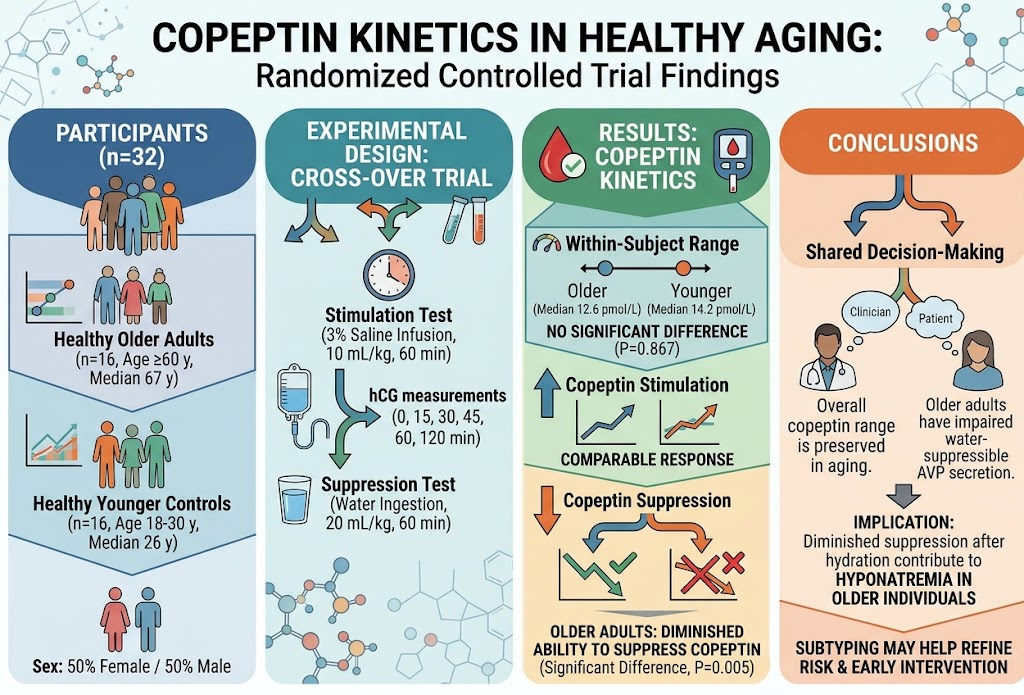
– Healthy older adults have a preserved copeptin response to stimulation with hypertonic saline but show reduced suppression of copeptin after water loading.
– The diminished ability to suppress copeptin in older adults may contribute to the higher incidence of hyponatremia in the elderly population.
– These findings underscore the need to tailor hydration guidelines considering altered copeptin kinetics in aging.
Study Background
Maintaining water homeostasis is critical for physiological balance and involves complex neuroendocrine mechanisms regulated notably by arginine vasopressin (AVP). AVP controls renal water reabsorption to maintain plasma osmolality and volume. In aging, disturbances in water balance, including hypo- and hypernatremia, become increasingly prevalent and are associated with increased morbidity and mortality. Although prior research suggested possible alterations in AVP secretion or action with age, the direct assessment of AVP has been challenging due to its short half-life and instability in plasma. The emergence of copeptin as a reliable, stable surrogate marker for AVP secretion has facilitated objective evaluation of AVP kinetics in health and disease. However, data on copeptin kinetics and their modulation with aging remain sparse, limiting understanding of how age-related changes may contribute to sodium disturbances and risks such as hyponatremia.
Study Design
This randomized controlled cross-over trial enrolled 32 healthy adults, divided equally into an older group (≥ 60 years; median age 67) and a younger group (18–30 years; median age 26). Both groups were sex matched (50% female). Participants underwent two experimental interventions in randomized order: a copeptin stimulation test involving infusion of hypertonic saline (3% NaCl, 10 mL/kg over 60 minutes) to provoke AVP/copeptin release, and a copeptin suppression test involving ingestion of tap water (20 mL/kg over 60 minutes) to suppress AVP/copeptin secretion. Serial plasma copeptin concentrations were measured at baseline and at 15, 30, 45, 60, and 120 minutes after intervention. The primary endpoint was the within-subject range of copeptin levels (difference between peak and nadir) comparing older adults to younger controls. Secondary endpoints included the magnitude of copeptin response to stimulation and suppression.
Key Findings
The study demonstrated that the median copeptin within-subject range was not significantly different between older adults (12.6 pmol/L [IQR 8.5–18.7]) and younger adults (14.2 pmol/L [IQR 8.5–16.6]; P = 0.867), indicating largely preserved copeptin kinetic variability with age. Responses to hypertonic saline stimulation were qualitatively similar, with older adults showing a mean copeptin increment comparable to younger controls (β = +3.9 pmol·h/L; 95% CI: -2.9 to +10.7; P = 0.020). However, during water loading, older adults displayed a significantly smaller decrease in copeptin levels (β = +0.8 pmol·h/L; 95% CI: +0.3 to +1.3; P = .005), suggesting impaired ability to suppress AVP secretion upon hydration. This impaired suppression may partially explain the propensity for water retention and hyponatremia observed in the elderly.
These findings align with the known increased risk of hypo-osmolar states and electrolyte disturbances with aging. Although the overall range and stimulation capacity remain intact, the blunted shutdown of vasopressin secretion under hypo-osmolar conditions implies altered water handling regulatory mechanisms.
Expert Commentary
This study provides novel insights into neuroendocrine regulation of water balance by analyzing copeptin kinetics in healthy aging using a robust experimental design. The use of both stimulation and suppression tests allows comprehensive characterization of copeptin dynamics. The comparable stimulation responses indicate preserved osmoreceptor sensitivity and AVP secretory capacity in elderly individuals, contrary to earlier suggestions of diminished AVP release with age. Conversely, the diminished suppression after water loading may reflect altered renal or hypothalamic feedback mechanisms, potentially contributing to vulnerability to hyponatremia in older populations.
Limitations include the relatively small sample size and the exclusion of individuals with comorbidities or frailty, limiting generalizability to the broader elderly population, often burdened by chronic illness and polypharmacy. Future studies should expand to include such groups and explore longitudinal changes and clinical correlations with hydration status and sodium disturbances.
Clinicians should consider these findings when counseling older adults on fluid intake and monitor serum sodium proactively, particularly in clinical contexts predisposed to impaired water excretion (e.g., heart failure, diuretics use). Further research could investigate targeted interventions to mitigate hyponatremia risk by modulating vasopressin activity or enhancing renal water clearance.
Conclusion
Healthy aging is associated with largely preserved copeptin secretion dynamics in response to osmotic stimulation but impaired suppression following hydration. This decreased ability to adequately downregulate AVP release may contribute to the heightened susceptibility of older adults to hyponatremia and related adverse outcomes. These findings underscore the importance of tailored hydration and monitoring strategies in the elderly population and provide a pathophysiological basis for optimizing fluid management guidelines to reduce water balance disorders in aging.
Funding and ClinicalTrials.gov
The study was supported by institutional research funds. No clinical trial registration number was provided in the original publication.
References
1. Lustenberger S, Riehle F, Blattmann L, et al. Copeptin kinetics in healthy aging. J Clin Endocrinol Metab. 2026;111(9):2436-2444. doi:10.1210/jc.41964423
2. Verbalis JG. Hyponatremia. Ann Intern Med. 2017;167(3):ITC17-ITC32.
3. Christ-Crain M, Fenske W, Haap M, et al. Copeptin: a biomarker of individual water balance. Nephrol Dial Transplant. 2010;25(5):1523-1529.
4. Nigro N, Hannan FM, Moritz ML, et al. The aging kidney and water homeostasis: mechanisms and clinical consequences. Nat Rev Nephrol. 2022;18(9):583-598.