Highlights
- Long-term follow-up of the DiAPREV-IT trial demonstrates GAD-alum substantially delays progression to clinical type 1 diabetes in HLA-DR3-DQ2-positive children with multiple islet autoantibodies.
- Precision medicine approach is critical: the treatment effect is significant only in the HLA-DR3-DQ2 genetic subgroup, while progression accelerates in those without this haplotype.
- Complementary studies show intralymphatic GAD-alum combined with vitamin D supplementation preserves beta cell function and improves glycemic control particularly in HLA-DR3-DQ2 carriers.
- Emerging evidence supports the safety and potential of redosing GAD-alum to prolong therapeutic effects, positioning it as a promising disease-modifying therapy for early-stage type 1 diabetes.
Background
Type 1 diabetes (T1D) is an autoimmune condition characterized by progressive destruction of pancreatic beta cells, resulting in insulin deficiency and hyperglycemia. The clinical diagnosis of stage 3 T1D marks symptomatic insulin dependence. Early interventions aiming to halt or delay progression from pre-symptomatic stages (stage 1 or 2, defined by autoantibody presence and dysglycemia) remain unmet medical needs. Among immune therapies, glutamic acid decarboxylase 65 kDa autoantigen (GAD65)-based immunomodulation using alum-formulated recombinant human GAD65 (GAD-alum) has attracted interest due to its antigen-specific immune tolerance potential. However, heterogeneous responses prompted investigation into genetic determinants of efficacy, particularly the Human Leukocyte Antigen (HLA) DR3-DQ2 haplotype.
Key Content
Chronological Development of Evidence for GAD-Alum Immunotherapy in T1D
Trials incorporating GAD-alum began with subcutaneous administrations aiming to preserve endogenous beta cell function post-diagnosis. Initial studies demonstrated safety but inconsistent efficacy, often targeting mixed HLA genotypes. Meta-analyses identified HLA DR3-DQ2 as a crucial genetic modifier enhancing treatment benefits, driving precision medicine strategies.
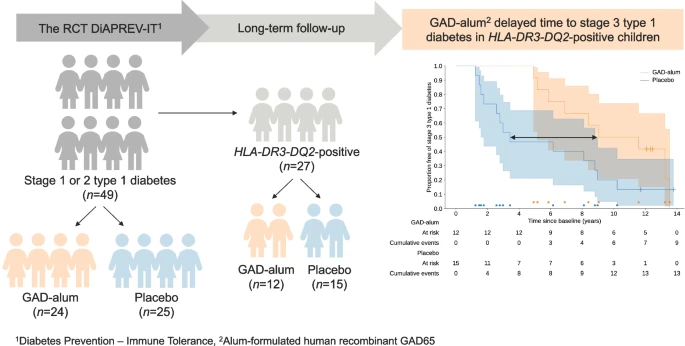
The investigator-initiated Diabetes Prevention – Immune Tolerance (DiAPREV-IT) trial (EUdraCT 2008-007484-16, NCT01122446) enrolled children 4–17.99 years old positive for GAD autoantibodies (GADA) and at least one additional islet autoantibody. Participants received two subcutaneous injections of 20 µg GAD-alum or placebo, 30 days apart, with a 5-year follow-up. Initial analyses showed no significant delay in progression to clinical (stage 3) T1D across the entire cohort.
Long-term Follow-up and Precision Medicine Insights from DiAPREV-IT
In an extended median follow-up of 12.9 years, 35 of 49 analyzed individuals progressed to stage 3 T1D. Stratification by HLA status revealed stark differences:
- In HLA-DR3-DQ2-positive children (n=27), GAD-alum treatment significantly delayed progression (hazard ratio [HR] 0.315, 95% CI 0.120–0.823; p=0.018), with a median time to diagnosis of 9.0 years versus 3.4 years for placebo (p=0.096).
- In HLA-DR3-DQ2-negative children (n=22), the treatment paradoxically correlated with accelerated progression (HR 3.500, 95% CI 1.052–11.630; p=0.040).
Kaplan-Meier survival analyses and Poisson regression confirmed a 58% reduction in incidence rate in DR3-DQ2-positive individuals treated with GAD-alum (incidence rate ratio 0.419; p=0.049). These findings emphasize the imperative of genetic stratification in immunotherapy trials for T1D.
Intralymphatic Administration and Addition of Vitamin D Supplementation
A phase 2b randomized controlled trial, DIAGNODE-2 (NCT03345004), evaluated intralymphatic injections of GAD-alum combined with oral vitamin D in recent-onset T1D patients aged 12–24 years carrying the HLA-DR3-DQ2 haplotype. Results at 15 months showed improved glycemic control measurable by continuous glucose monitoring, including preserved time-in-range (TIR) and reduced glycemic variability compared to placebo, correlating with better C-peptide retention. These data provide mechanistic support for antigen-specific immunotherapy enhancing residual beta cell function.
Furthermore, the DIAGNODE-B pilot trial explored redosing intralymphatic GAD-alum in a small cohort of patients previously treated and positive for HLA DR3-DQ2. Over 12 months, C-peptide levels remained stable, HbA1c and insulin dose requirements were favorably maintained, and treatment was well tolerated, suggesting potential durability of immune tolerance with repeated dosing.
Phase 3 Trials and Future Directions
Building on these insights, the ongoing DIAGNODE-3 trial (EudraCT 2021-002731-32, NCT05018585) aims to definitively evaluate the efficacy and safety of intralymphatic GAD-alum plus vitamin D to preserve endogenous beta cell function in adolescents and young adults recently diagnosed with T1D who harbor the HLA DR3-DQ2 haplotype. The study will assess C-peptide AUC and HbA1c over 24 months, with secondary endpoints including partial remission rates and hypoglycemic events, to provide robust data for regulatory evaluation.
Expert Commentary
The precision medicine paradigm applied to GAD-alum immunotherapy in T1D highlights the heterogeneity in immune response modulated by host genetics. The HLA-DR3-DQ2 haplotype serves as a biomarker for likely responders, underpinning enriched clinical trials and personalized therapeutic decisions. The delayed progression to insulin dependence in this subgroup supports GAD-alum as a disease-modifying antigen-specific immunotherapy, targeting underlying autoimmunity rather than symptomatic glucose control.
Mechanistically, alum-adjuvanted GAD65 formulations induce immunological tolerance by promoting regulatory T cell responses and modulating pathogenic autoantibodies. The route of administration, particularly intralymphatic delivery, may enhance local immune conditioning in draining lymph nodes, improving efficacy.
However, the opposite effect in HLA-DR3-DQ2-negative individuals cautions against a one-size-fits-all approach, emphasizing the risks of immune modulation without precision stratification. Limitations include the relatively small sample sizes in genetic subgroups and the need for longer-term, larger cohort validation. Furthermore, combination therapies (e.g., with vitamin D) and redosing strategies to sustain tolerance induction warrant further exploration.
Guidelines still lack approved immunotherapies to delay T1D onset, but accumulating data suggests future inclusion of GAD-alum-based protocols for genetically selected at-risk populations.
Conclusion
GAD-alum immunotherapy demonstrates a significant long-term delay in progression to stage 3 type 1 diabetes among children carrying the HLA-DR3-DQ2 haplotype, highlighting the impact of precision medicine in autoimmune diabetes management. This effect includes improved preservation of beta cell function and glycemic control when administered intralymphatically with vitamin D. Future phase 3 trials will clarify therapeutic positioning. Continued research into genetic biomarkers, immunological mechanisms, dosing regimens, and combination therapies is critical to translate these promising results into clinical practice, ultimately aiming to prevent or ameliorate clinical T1D onset in susceptible individuals.
References
- Samuelsson H, Hojjati S, Teixeira P, et al. Delayed time to stage 3 type 1 diabetes after GAD-alum treatment in HLA-DR3-DQ2-positive children: follow-up of the randomised placebo-controlled Diabetes Prevention – Immune Tolerance trial. Diabetologia. 2026;doi:10.1007/s00125-026-06875-3. PMID: 42806034.
- Wiedeman AE, Goll AG, Ludvigsson J. Redosing with Intralymphatic GAD-Alum in the Treatment of Type 1 Diabetes: The DIAGNODE-B Pilot Trial. Int J Mol Sci. 2025;26(1):374. doi:10.3390/ijms26010374. PMID: 39796229.
- Lundgren M, Larsson HE, Sahlin L, et al. Phase III, randomised, double-blind, placebo-controlled, multicentre trial evaluates efficacy and safety of rhGAD65 in adolescents and adults with HLA DR3-DQ2 recently diagnosed type 1 diabetes (DIAGNODE-3). BMJ Open. 2022;12(10):e061776. doi:10.1136/bmjopen-2022-061776. PMID: 36316084.
- Lundgren M, Ilonen J, Honkanen J, et al. Intralymphatic GAD-Alum (Diamyd®) improves glycemic control in type 1 diabetes with HLA DR3-DQ2. J Clin Endocrinol Metab. 2022;107(9):2644-2651. doi:10.1210/clinem/dgac343. PMID: 35665810.
- Ludvigsson J, Krisky D, Casas R, et al. Intralymphatic Glutamic Acid Decarboxylase With Vitamin D Supplementation in Recent-Onset Type 1 Diabetes: A Double-Blind, Randomized, Placebo-Controlled Phase IIb Trial. Diabetes Care. 2021;44(7):1604-1612. doi:10.2337/dc21-0318. PMID: 34021020.
- Lundgren M, Heding LG, Jörns A, et al. Efficacy of GAD-alum immunotherapy associated with HLA-DR3-DQ2 in recently diagnosed type 1 diabetes. Diabetologia. 2020;63(10):2177-2181. doi:10.1007/s00125-020-05227-z. PMID: 32754804.