Background: The Clinical Context of Incidental Thyroid Nodules
Incidental thyroid nodules (ITNs) are common findings on imaging studies performed for nonthyroid-related indications, including CT scans, MRIs, and ultrasounds of adjacent anatomical regions. Increasing utilization of these imaging modalities has led to a rise in detected ITNs, contributing substantially to thyroid cancer overdiagnosis and overtreatment, often by triggering a cascade of diagnostic procedures. Despite widespread recognition of this phenomenon, the patterns of thyroid ultrasound (TUS) follow-up after incidental detection and the factors influencing clinical decision-making are poorly characterized in routine practice. Understanding these patterns is essential to refine guidelines, improve resource utilization, and minimize patient harm from unnecessary investigations and interventions.
Study Design
This retrospective cohort study was conducted at Mayo Clinic sites from 2017 to 2023. It included adults without prior known thyroid disease who underwent imaging studies that incidentally captured the thyroid gland. A validated natural language processing (NLP) pipeline was applied to radiology reports across multiple imaging modalities to identify and characterize ITNs, enabling a large-scale, unbiased assessment. The primary outcome evaluated was the rate of thyroid ultrasound performed within 180 days after ITN detection. Secondary outcomes included rates of thyroid biopsy, partial and total thyroidectomy, and thyroid cancer diagnosis. Multivariable logistic regression with penalized variable selection was used to identify patient and nodule characteristics, as well as radiologist recommendations, associated with subsequent TUS utilization.
Key Findings
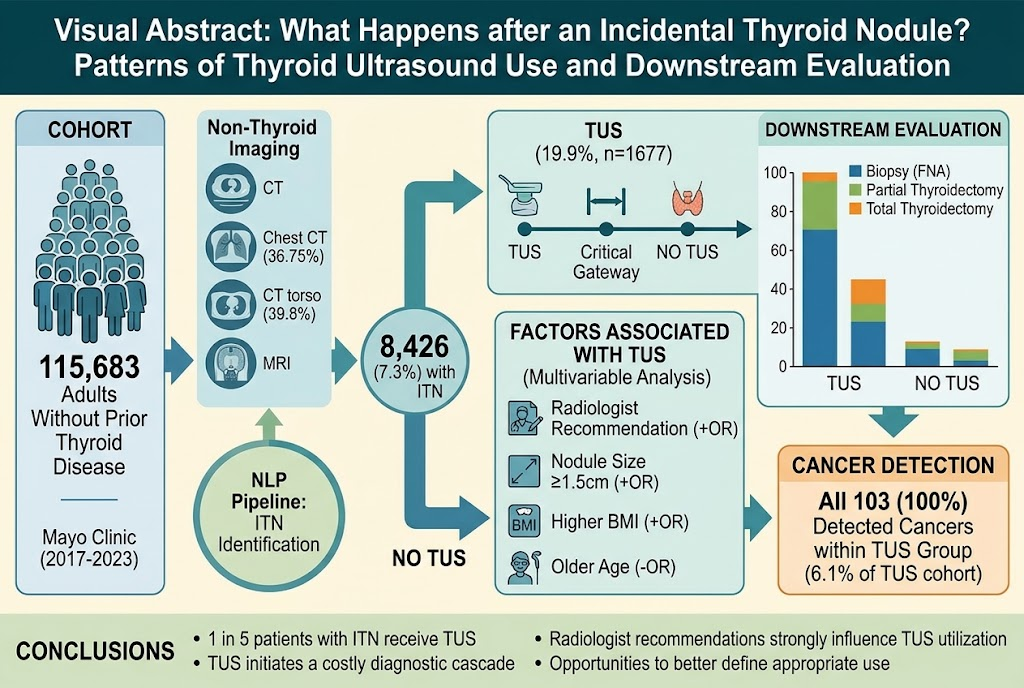
Out of 115,683 patients undergoing imaging that captured the thyroid, 7.3% (8426 patients) were found to have an ITN. The majority of these patients were women (64.6%) and of White race (89.7%), with a mean age of 61.7 years. Most ITNs were initially identified on computed tomography (80.8%), predominantly during chest imaging (52.3%). Notably, only 19.9% (1677 patients) underwent subsequent thyroid ultrasound within 180 days, marking TUS as a critical juncture in the diagnostic evaluation pathway.
Multivariable analysis revealed significant independent predictors of TUS use: higher body mass index (OR 1.20 per 10-unit increase), nodule size ≥1.5 cm (OR 1.79), and the presence of a radiologist recommendation for ultrasound (OR 2.51). Increasing patient age was inversely associated with TUS utilization (OR 0.89 per 10-year increment). This suggests clinicians weigh multiple factors, including clinical and radiological features, when deciding on further evaluation.
Patients undergoing TUS had significantly higher rates of thyroid biopsy, partial thyroidectomy, and total thyroidectomy compared to those who did not undergo TUS. Importantly, all thyroid cancers diagnosed during the study (103 cases) were among the TUS group, reflecting a 6.1% cancer detection rate within those evaluated by ultrasound.
These data underscore TUS as a pivotal gateway leading to downstream invasive diagnostic and therapeutic procedures. However, with only one-fifth of ITN patients receiving TUS, there is evidence of variable clinical practice influenced by patient factors and radiologist communication.
Expert Commentary
This study provides valuable real-world evidence on the management trajectory of incidentally detected thyroid nodules and the complex decision-making around thyroid ultrasound. The findings reinforce concerns about potential overdiagnosis driven by incidentalomas but also demonstrate selective ultrasound use, likely tailored to clinical context and nodule characteristics.
The strong influence of radiologist recommendations on ultrasound utilization highlights the critical role of communication in shaping clinical pathways. Standardizing reporting language and incorporating evidence-based guidelines may help optimize patient selection, reducing unnecessary interventions without compromising cancer detection.
The inverse association of age with TUS may reflect clinician judgment balancing cancer risk against procedural risks and patient life expectancy, aligning with contemporary patient-centered approaches.
Limitations include the retrospective design and reliance on NLP from radiology reports, which, while validated, may be subject to misclassification or incomplete data capture. Additionally, the single health system setting may limit generalizability, though the large cohort enhances robustness.
Conclusion
Incidental thyroid nodules are frequent findings with substantial potential to initiate diagnostic cascades culminating in biopsies, surgeries, and cancer diagnoses. Thyroid ultrasound emerges as the pivotal step directing patient management following incidental detection. Patient BMI, nodule size, age, and radiologist recommendation strongly influence ultrasound use, revealing targets for intervention to optimize appropriateness of care.
Future efforts should focus on refining criteria for ultrasound after incidental nodule detection, improving radiology report clarity, and educating clinicians to balance cancer detection benefits with harms of overdiagnosis. Such interventions may reduce unnecessary testing and treatment, enhancing value-based thyroid nodule management.
Reference
Larios F, Vilatuna Andrango L, Borras-Osorio M, Branda ME, Toro-Tobon D, Wu Y, Cabezas E, Loor-Torres R, Mateo Chavez M, Claros AG, Lizarazo Jimenez M, Alzamora IM, Montero M, Gomez-Alvarez E, Al Zahidy M, Soto Jacome C, Fan JW, Ponce-Ponte OJ, Singh Ospina NM, Brito JP. What Happens after an Incidental Thyroid Nodule? Patterns of Thyroid Ultrasound Use and Downstream Evaluation. Thyroid. 2026 Sep 30:10507256261493769. doi: 10.1177/10507256261493769. Epub ahead of print. PMID: 42813606.