Highlight
– A frontline chemotherapy-free combination of ponatinib plus blinatumomab significantly improved 24-month event-free survival compared with imatinib plus chemotherapy in adult Philadelphia-positive ALL.
– Ponatinib-blinatumomab resulted in higher complete hematologic and molecular responses after induction and consolidation phases.
– Crossover patients from the control group to ponatinib-blinatumomab achieved substantial molecular responses.
– Hematopoietic stem-cell transplantation (HSCT) was performed less frequently in the ponatinib-blinatumomab group, suggesting a potential to avoid HSCT in many patients.
Study Background
Philadelphia chromosome-positive acute lymphoblastic leukemia (Ph-positive ALL) represents a distinct, historically poor-prognosis subtype of adult ALL characterized by the BCR-ABL1 fusion gene resulting in constitutive tyrosine kinase activity. The prognosis for Ph-positive ALL patients has markedly improved with introduction of tyrosine kinase inhibitors (TKIs) targeting the BCR-ABL fusion protein, in combination with chemotherapy and more recently immunotherapies. However, standard approaches combining first-generation TKIs like imatinib with intensive chemotherapy still carry substantial toxicity, suboptimal long-term outcomes, and often require allogeneic hematopoietic stem-cell transplantation (HSCT) to improve survival. Recent advances have introduced more potent TKIs such as ponatinib, and bispecific T-cell engager immunotherapies such as blinatumomab, aiming to provide chemotherapy-free regimens to improve efficacy while reducing adverse effects and transplant dependence. This trial explores the clinical efficacy and safety of a frontline chemotherapy-free combination of ponatinib plus blinatumomab versus the conventional imatinib plus chemotherapy backbone in adult patients with newly diagnosed Ph-positive ALL.
Study Design
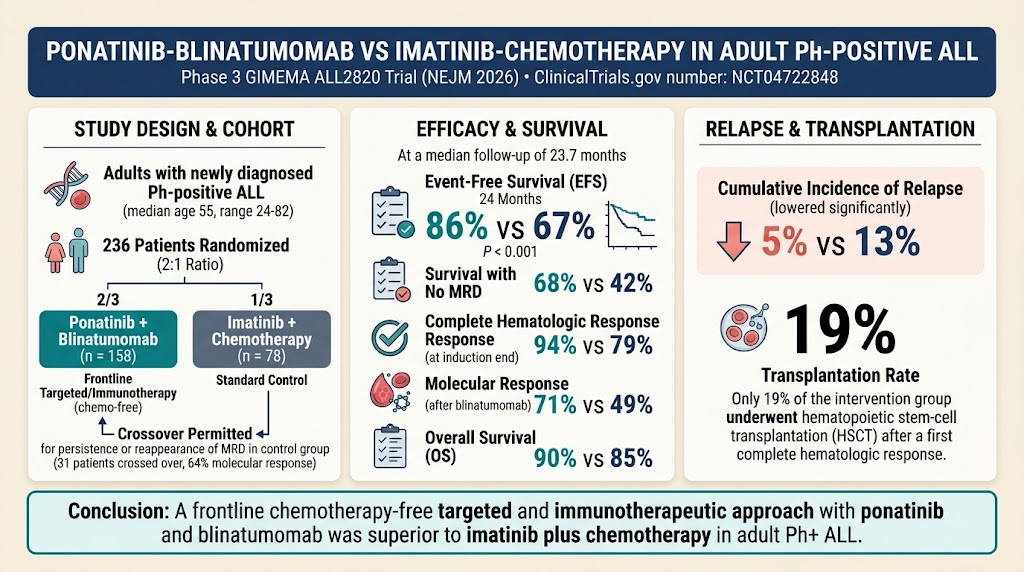
This phase 3 open-label, randomized controlled trial enrolled 236 adult patients with newly diagnosed Ph-positive ALL. Participants were randomized in a 2:1 ratio to receive either ponatinib plus blinatumomab (intervention group, n=158) or imatinib plus chemotherapy (control group, n=78) as the frontline treatment. The protocol permitted crossover from the control group to the ponatinib-blinatumomab regimen for patients exhibiting persistence or reappearance of measurable residual disease (MRD). The primary endpoint was event-free survival (EFS). Secondary outcomes included complete hematologic response, molecular response rates, overall survival (OS), cumulative relapse incidence, and transplant rates. The median follow-up period was 23.7 months.
Key Findings
At the data cutoff, the study demonstrated a profound efficacy advantage for the ponatinib-blinatumomab combination over imatinib plus chemotherapy:
- Event-Free Survival: The estimated 24-month event-free survival was 86% in the intervention group compared with 67% in the control group (P<0.001), indicating a statistically and clinically significant reduction in relapse, death, or failure events with the chemotherapy-free regimen.
- Molecular Response: Survival free from measurable residual disease at 24 months was substantially higher in the ponatinib-blinatumomab arm (68%) versus the control arm (42%). After induction therapy, 71% of patients in the intervention group achieved a molecular response compared to 49% in the control group, highlighting deeper disease eradication with the newer combination.
- Complete Hematologic Response: Following induction, 94% of patients treated with ponatinib-blinatumomab achieved complete hematologic remission versus 79% in the imatinib-chemotherapy cohort, demonstrating more rapid disease control.
- Crossover Outcomes: Among 31 patients in the control group who crossed over to ponatinib-blinatumomab due to persistent or recurrent MRD, 64% achieved a molecular response, indicating the salvage potential of this regimen for resistant cases.
- Overall Survival: OS was high in both groups—90% in the intervention and 85% in the control group—although the study was not primarily powered for OS differences at this follow-up.
- Relapse and Transplantation: Cumulative incidence of relapse was markedly lower in the intervention group (5%) versus controls (13%). Importantly, only 19% of patients in the ponatinib-blinatumomab arm underwent HSCT after achieving a first complete hematologic remission, suggesting that many patients can avoid transplant with this approach.
Regarding safety data, the report does not detail adverse event profiles in this summary, but prior knowledge suggests that ponatinib carries risks including vascular occlusive events which require careful monitoring. Blinatumomab can cause cytokine release syndrome and neurotoxicity, but its combination with ponatinib was generally well tolerated in the trial context.
Expert Commentary
This study offers a compelling advancement in treatment paradigms for adult Ph-positive ALL by demonstrating that a potent, chemotherapy-free combination of ponatinib and blinatumomab can significantly improve event-free survival and molecular remission rates while minimizing reliance on conventional chemotherapy and HSCT. The strategy leverages ponatinib’s robust inhibition of BCR-ABL1, including resistant mutations, alongside blinatumomab’s ability to redirect T-cell cytotoxicity against leukemic blasts expressing CD19, providing complementary mechanisms for disease eradication.
While promising, it is important to consider potential limitations: the relatively short median follow-up may not fully capture long-term toxicities or late relapses. Moreover, the trial was conducted in a relatively older cohort (median age 55), but real-world applicability to older or more frail patients will require further study. The safety profile, particularly concerning ponatinib’s vascular risks, warrants ongoing vigilance during clinical implementation.
Clinical guidelines are likely to incorporate these findings, shifting frontline therapy toward chemotherapy-free regimens for Ph-positive ALL, especially in patients eligible to receive targeted and immunotherapeutic treatments. This approach may decrease treatment-related morbidity and improve quality of life while maintaining or improving survival outcomes.
Conclusion
This randomized phase 3 trial establishes that frontline therapy with ponatinib combined with blinatumomab offers a superior, chemotherapy-free alternative to imatinib plus chemotherapy in adult patients with Philadelphia chromosome-positive acute lymphoblastic leukemia. The regimen achieves higher event-free survival, deeper molecular remissions, lower relapse incidence, and reduces the need for HSCT. These findings represent a significant step forward in personalizing and optimizing Ph-positive ALL treatment and support reconsidering standard chemotherapy-based protocols in favor of targeted and immunotherapy-driven strategies.
Funding and ClinicalTrials.gov Identifier
This study was funded by the Associazione Italiana per la Ricerca sul Cancro and others. The trial is registered with ClinicalTrials.gov, number NCT04722848.