Highlight
- Silent corticotroph adenomas (SCAs) often go undetected until histopathological examination post-surgery.
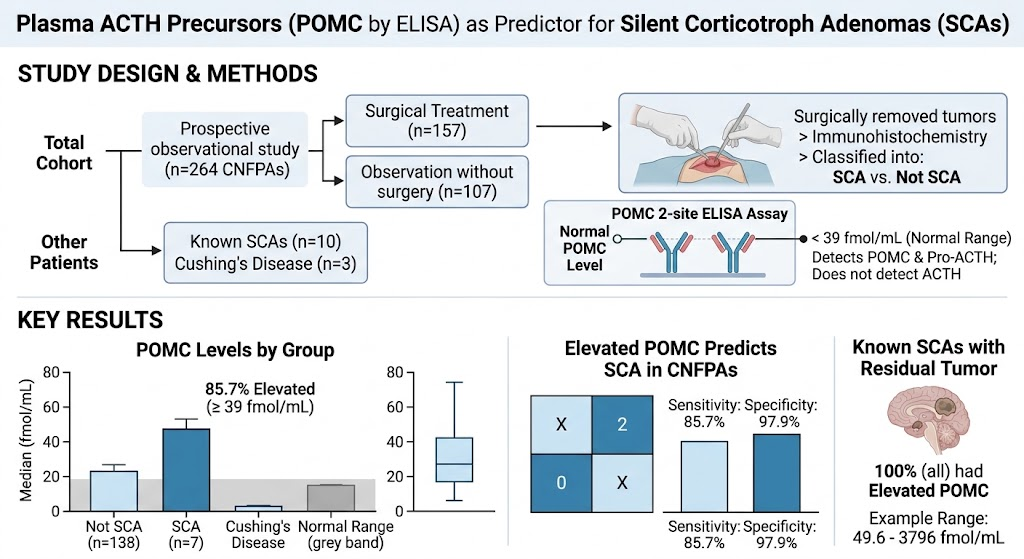
- Plasma levels of pro-opiomelanocortin (POMC), measured by a specific ELISA, are significantly elevated in SCAs compared to other clinically non-functioning pituitary adenomas (CNFPAs).
- Elevated plasma POMC demonstrates high sensitivity (85.7%) and specificity (97.9%) for predicting the presence of SCAs among CNFPAs.
- Plasma POMC measurement could become a valuable non-invasive biomarker for initial evaluation and postoperative monitoring of SCAs.
Study Background
Silently functioning corticotroph adenomas (SCAs) represent a subset of clinically non-functioning pituitary adenomas (CNFPAs) characterized by histological evidence of corticotroph lineage without clinical hypercortisolism. These tumors do not secrete biologically active adrenocorticotropic hormone (ACTH) despite immunopositivity for ACTH on pathology, which complicates their preoperative identification. Current diagnostic limitations lead to reliance on surgical resection and pathological classification to identify SCAs. Given their potential for more aggressive behavior and higher recurrence rates compared to other non-functioning adenomas, early identification is clinically important.
Pro-opiomelanocortin (POMC) is the precursor polypeptide for ACTH and related peptides. Defective or incomplete processing of POMC in SCAs may result in secretion of ACTH precursors rather than active ACTH. Elevated plasma levels of POMC have previously been reported in patients with overtly functioning corticotroph tumors causing Cushing disease and ectopic ACTH secretion. However, plasma POMC has not been systematically evaluated in CNFPA cohorts to assess its potential as a predictive biomarker for SCAs.
Study Design
This prospective observational study enrolled 264 patients diagnosed with CNFPAs, of whom 157 underwent surgical treatment with subsequent pathological assessment and 107 were managed conservatively without surgery. The study also included 10 patients with pathologically confirmed SCAs and 3 patients with Cushing disease as positive controls.
Plasma samples were analyzed using a two-site ELISA specifically designed to detect POMC and pro-ACTH but not mature ACTH, with a normal reference level defined as < 39 fmol/mL. Among surgically treated patients, tumor specimens underwent detailed immunohistochemical analysis to categorize adenomas as SCA or Not SCA based on corticotroph markers.
Key Findings
Plasma POMC levels were significantly elevated in the SCA group (median 73 fmol/mL) compared to the Not SCA group (median 14 fmol/mL), with p < 0.001. Most SCAs (85.7%) showed plasma POMC levels above the normal threshold (≥ 39 fmol/mL). Among CNFPAs, elevated plasma POMC had a high diagnostic performance, with sensitivity of 85.7% and specificity of 97.9% for predicting SCA presence.
Notably, all known SCAs with visible residual tumor post-surgery had markedly elevated plasma POMC ranging broadly from 49.6 to 3796 fmol/mL, supporting its potential utility for monitoring residual or recurrent disease.
The control patients with confirmed Cushing disease also exhibited elevated POMC, consistent with prior observations linking ACTH precursor levels to functioning corticotroph adenomas.
Interpretation of Results
The data indicate a strong association between elevated plasma POMC and histologically confirmed SCAs among clinically non-functioning pituitary adenomas. This suggests incomplete processing of POMC in SCAs leads to the accumulation and secretion of precursor forms detectable in peripheral blood.
The high specificity and sensitivity imply that plasma POMC assays could reduce reliance on invasive diagnostics and histopathology for SCA detection, enabling more targeted surgical planning and follow-up strategies.
Expert Commentary
SCAs pose significant diagnostic challenges due to their silent clinical phenotype yet aggressive histopathological behavior. Current guidelines do not include plasma biomarkers to differentiate SCAs from other CNFPAs preoperatively. This study by Garber et al. provides compelling evidence that plasma POMC measurement could bridge this gap.
The use of a highly specific ELISA that discriminates POMC from mature ACTH enhances assay validity in this context. However, further validation in larger, multicenter cohorts and standardization of assay protocols are essential before clinical adoption.
Limitations include the relatively small number of pathologically confirmed SCAs and potential variability in POMC levels due to factors such as hypothalamic-pituitary axis status or sample handling. Additionally, the longitudinal utility of POMC for detecting tumor recurrence needs prospective evaluation.
Conclusion
Elevated plasma POMC measured by a sensitive ELISA assay shows high promise as a non-invasive biomarker for identifying silent corticotroph adenomas among clinically non-functioning pituitary adenomas. Incorporation of plasma POMC measurement into initial diagnostic workup could facilitate earlier and more accurate detection of SCAs, guiding surgical and surveillance strategies to improve patient outcomes.
Future research should focus on validating these findings in larger cohorts, optimizing assay methods, and exploring the role of plasma POMC monitoring in postoperative and long-term management to detect residual or recurrent adenomas.
Funding and Clinicaltrials.gov
The study was supported by institutional funding as per the original publication. No clinical trial registration was indicated.
References
Garber A, Page-Wilson G, Sun Y, Canoll P, Bruce JN, Jin Z, Khandji AG, Panigrahi S, White A, Walker L, Wardlaw SL, Freda PU. Plasma ACTH Precursors measured by Pro-opiomelanocortin (POMC) ELISA as a Predictor of Silent Corticotroph Adenomas. The Journal of Clinical Endocrinology and Metabolism. 2026 Aug 25. PMID: 42640040. https://pubmed.ncbi.nlm.nih.gov/42640040/