Highlight
This comprehensive retrospective cohort study analyzed survival outcomes among premenopausal women aged 18-49 with early-stage adult granulosa cell tumors (AGCT) undergoing ovarian-sparing surgery (cystectomy or unilateral salpingo-oophorectomy) compared to bilateral salpingo-oophorectomy. The findings reveal no significant difference in overall survival between these surgical approaches after rigorous statistical adjustment, offering evidence to support fertility-preserving treatment strategies.
Ovarian-sparing surgery, performed more often in younger women, did not compromise survival regardless of tumor stage (IA or IC).
These results underscore the safety of ovarian preservation for selected patients, emphasizing the need for further studies on recurrence and disease-free survival to optimize clinical decision-making.
Background
Adult granulosa cell tumor is a rare ovarian malignancy arising from sex cord-stromal cells. It generally presents as early-stage disease and has an indolent clinical course but carries risk of late recurrence. Standard surgical management traditionally includes bilateral salpingo-oophorectomy aimed at minimizing residual disease. However, given the often young age of affected women and the desire to preserve fertility and hormonal function, ovarian-sparing techniques such as cystectomy or unilateral salpingo-oophorectomy have been considered, though data on oncologic safety remain limited and heterogeneous.
Determining the safest surgical approach that balances oncologic control while preserving ovarian function is paramount for quality of life and future fertility considerations. This knowledge gap motivated the present study utilizing a national cancer registry to evaluate survival outcomes stratified by surgical technique.
Study Design
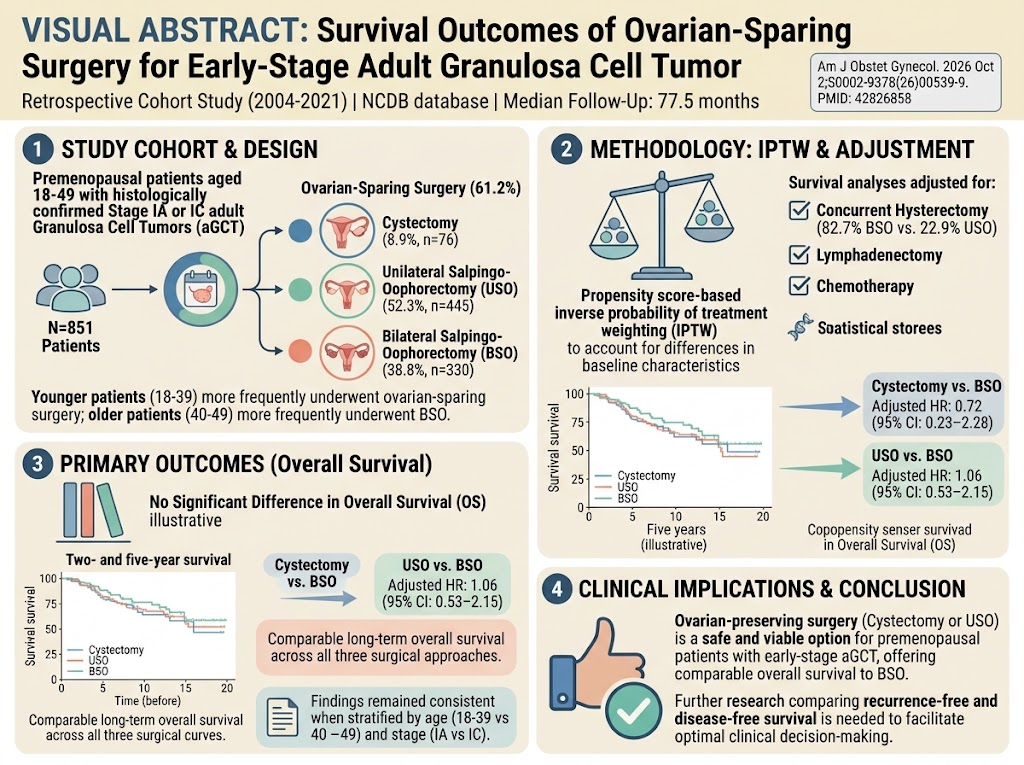
This retrospective cohort study leveraged the National Cancer Database to identify female patients aged 18-49 years diagnosed with histologically confirmed stage IA or IC adult granulosa cell tumors from 2004 to 2021. Patients were classified into three surgical groups: ovarian cystectomy, unilateral salpingo-oophorectomy, or bilateral salpingo-oophorectomy.
Propensity score-based inverse probability of treatment weighting (IPTW) was employed to adjust for baseline differences including age, tumor characteristics, and treatment variables. The primary endpoint was overall survival at two and five years. Statistical analyses included Kaplan-Meier survival estimates post-IPTW adjustment and Cox proportional hazards regression with further control for concurrent treatments like hysterectomy, lymphadenectomy, and chemotherapy.
Key Findings
A total of 851 patients met inclusion criteria: 76 (8.9%) underwent cystectomy, 445 (52.3%) unilateral salpingo-oophorectomy, and 330 (38.8%) bilateral salpingo-oophorectomy. Bilateral salpingo-oophorectomy cases had a high rate of concurrent hysterectomy (82.7%) versus 22.9% in unilateral cases.
Age distribution favored ovarian-sparing surgery in younger women (18-39 years), while older women (40-49 years) more frequently underwent bilateral salpingo-oophorectomy. Median follow-up was 77.5 months (IQR 39.2-135.8).
After IPTW and treatment factor adjustment, no statistically significant differences in overall survival were observed among surgical groups: the adjusted hazard ratio for cystectomy versus bilateral salpingo-oophorectomy was 0.72 (95% CI, 0.23-2.28) and 1.06 (95% CI, 0.53-2.15) for unilateral versus bilateral salpingo-oophorectomy. These findings were consistent across age strata and disease stages IA and IC.
This suggests ovarian preservation does not adversely impact mortality in early-stage AGCT.
Expert Commentary
These results align with emerging evidence supporting conservative surgery as a viable option for select early-stage AGCT patients desiring fertility preservation. The study’s strengths include a large nationally representative cohort, extended follow-up, and adjustment for confounders through advanced statistical methods, lending robustness to findings.
However, limitations inherent to retrospective registry data such as potential residual confounding, lack of recurrence or disease-free survival data, and absence of detailed fertility and hormonal outcome measures should be acknowledged. The high frequency of hysterectomy could influence hormonal milieu and patient counseling.
Current guidelines recognize fertility-sparing surgery for early-stage granulosa cell tumors but acknowledge limited high-quality evidence. This study provides valuable survival outcome data but underscores the need for future prospective research with comprehensive oncologic and reproductive endpoints.
Conclusion
In women aged 18-49 with stage IA or IC adult granulosa cell tumors, ovarian-sparing surgery (either cystectomy or unilateral salpingo-oophorectomy) demonstrated overall survival comparable to bilateral salpingo-oophorectomy. These findings support consideration of ovarian preservation in selected patients balancing oncologic safety with quality-of-life benefits.
Further prospective studies evaluating recurrence risk, disease-free survival, fertility outcomes, and hormonal function are critical to guide individualized surgical decision-making and optimize comprehensive care in this population.
Funding and Clinical Trials
The study was supported by institutional and national sources; detailed funding disclosures were not provided in the abstract. No clinical trial registration was indicated as this was a retrospective database analysis.
References
Van Biema FL, Huang Y, Ludmir D, et al. Survival Outcomes of Ovarian-Sparing Surgery for Early-Stage Adult Granulosa Cell Tumor. Am J Obstet Gynecol. 2026 Oct 2. PMID: 42826858.
Additional literature on fertility-sparing surgery in granulosa cell tumors and relevant ovarian cancer guidelines have informed this analysis.