Introduction
The rapid advancement and integration of artificial intelligence (AI), particularly generative large language models (LLMs), into obstetric and gynecologic care represent a profound transformation in clinical practice. These tools are increasingly utilized for patient education, clinical documentation, counseling, medical education, and retrieval of medical evidence. However, the pace of AI adoption has outstripped the development of formal training programs, specialty-specific standards, and governance frameworks. Consequently, the pivotal clinical question has evolved from “if” to “how” obstetricians and gynecologists can competently and safely incorporate AI into their care delivery protocols.
Background and Clinical Context
Obstetrics and gynecology involve complex clinical decision-making scenarios that directly impact maternal and fetal outcomes and women’s reproductive health. Traditionally, new technologies such as ultrasound and electronic fetal monitoring were integrated with detailed training regimens to safeguard patient safety and optimize clinical outcomes. The field now confronts a new frontier: AI systems that offer augmented diagnostic, educational, and administrative support but also pose risks related to accuracy, bias, privacy, and clinical accountability. The stakes are high given the intimate and sensitive nature of care in this specialty and the potential consequences of erroneous AI-assisted recommendations.
Defining Clinical AI Competence in Obstetrics and Gynecology
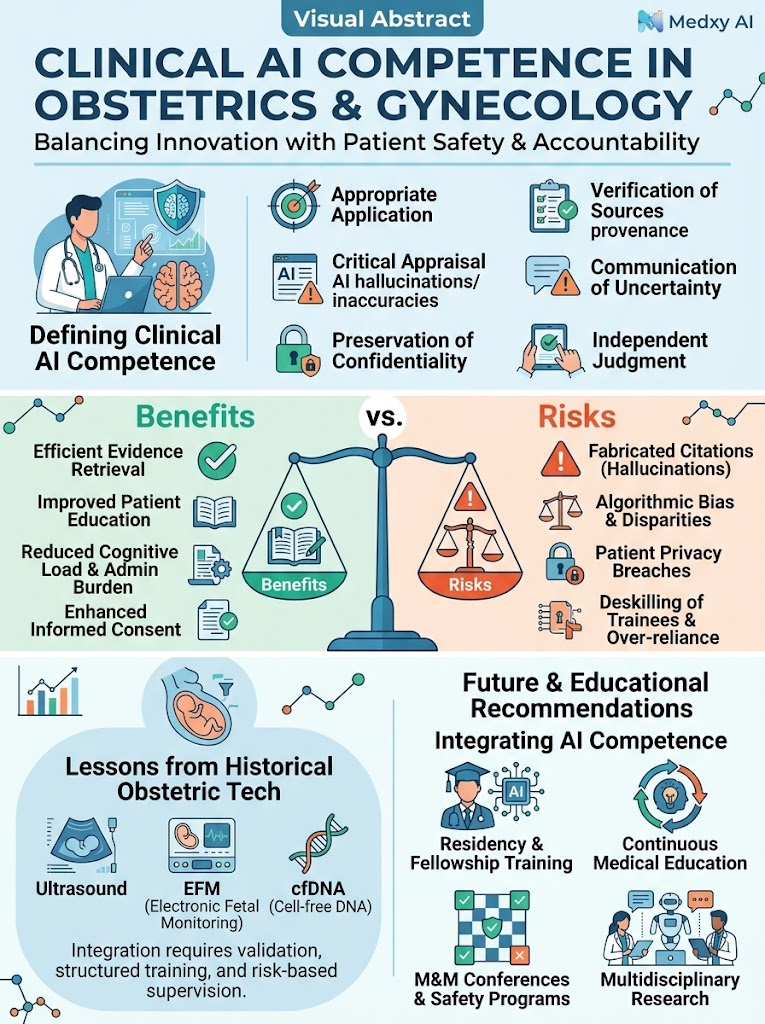
Clinical AI competence refers to a physician’s ability to effectively and responsibly use AI tools in appropriate clinical contexts. This competence encompasses several critical domains:
- Appropriate Application: Selecting AI tools that fit the clinical task at hand without over-reliance.
- Critical Appraisal: Recognizing AI hallucinations (fabricated or inaccurate outputs), outdated guidelines, and identifying incorrect or misleading recommendations.
- Verification of Sources: Confirming the provenance and reliability of AI-generated evidence and citations.
- Preservation of Confidentiality: Ensuring patient data privacy within AI interactions.
- Communication of Uncertainty: Transparently discussing AI-generated information limitations with patients and clinical teams.
- Maintenance of Independent Judgment: Sustaining clinician responsibility and clinical reasoning without undue delegation to AI.
Benefits of AI in Obstetrics and Gynecology
The potential advantages of AI integration in this specialty include:
- Improved readability and personalization of patient-facing educational materials, enhancing health literacy and informed consent.
- More efficient evidence retrieval during clinical decision-making, leading to up-to-date and evidence-based care.
- Support for documentation and administrative tasks, reducing clinician burden and allowing greater focus on patient interaction.
- Assistance with informed consent processes by providing standardized, comprehensive information tailored to patient needs.
- Reduction of cognitive overload during complex care situations through decision aids and pattern recognition.
Risks and Challenges
Despite these benefits, significant risks must be managed carefully:
- Fabricated Citations and Inaccurate Recommendations: AI systems may generate plausible but false references or propose inappropriate clinical advice, jeopardizing patient safety.
- Algorithmic Bias: AI may replicate and perpetuate systemic biases, potentially exacerbating health disparities in diverse patient populations.
- Privacy Breaches: Inadequate data protections could expose sensitive patient information, undermining trust and violating regulations.
- Deskilling of Trainees: Over-reliance on AI could impede the development of critical clinical reasoning skills in trainees.
- Inappropriate Delegation: Delegating core clinical judgments to AI may erode physician accountability and responsibility.
Lessons from Historical Obstetric Technologies
Experience with technologies such as ultrasound, electronic fetal monitoring, and cell-free DNA screening highlights the importance of balanced integration. The obstetrics and gynecology community historically has avoided reflexive rejection or uncritical adoption of new tools. Instead, careful evaluation, validation, structured training, and risk-based supervision have been the cornerstones of successful integration. AI demands a similar approach, requiring structured use, supervision, meticulous version control, and application proportional to clinical risk.
Educational and Governance Recommendations
Incorporating clinical AI competence into obstetrics and gynecology education should be gradual and systematic:
- Residency and Fellowship Training: Integrate AI literacy, critical appraisal skills, and ethical considerations into curricula.
- Continuing Medical Education: Offer ongoing updates as AI technology evolves.
- Departmental Teaching and Morbidity & Mortality Conferences: Encourage open discussion of AI-related errors and near misses to foster a culture of safety.
- Patient Safety Programs: Monitor AI tool impact on outcomes with outcome-based evaluation and quality improvement initiatives.
Future Directions and Research Needs
Continued research is essential to optimize AI deployment in obstetrics and gynecology. Priorities include comprehensive validation studies, bias mitigation strategies, secure data handling frameworks, and effectiveness assessments in diverse clinical settings. Multidisciplinary collaboration involving clinicians, AI developers, ethicists, and policy-makers will be crucial to establish evidence-based guidelines and regulatory oversight.
Conclusion
Artificial intelligence presents a transformative opportunity in obstetrics and gynecology but also complex challenges requiring clinical AI competence for safe, accountable, and responsible use. Adoption must be thoughtfully structured with rigorous training, continuous outcome monitoring, and robust governance. Embracing this competence as a core professional skill will help realize AI’s benefits while safeguarding patient safety and ensuring physician accountability in this sensitive and critical specialty.