Highlights
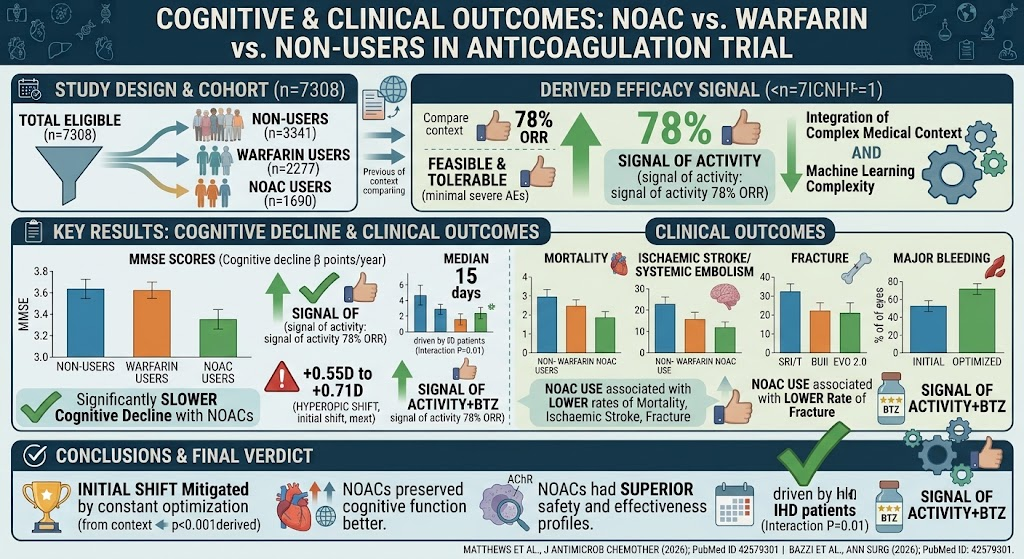
- NOAC use in atrial fibrillation (AF) patients with Alzheimer’s disease (AD) is associated with modestly slower cognitive decline compared to warfarin and no anticoagulation.
- NOACs demonstrate superior effectiveness in reducing all-cause mortality, ischemic stroke/systemic embolism, and fracture risk without increasing major bleeding risk, compared to warfarin or no anticoagulation.
- Vitamin K antagonists (VKAs) like warfarin are linked with higher bleeding risk and possible negative effects on executive cognitive functions and brain morphology.
- Current evidence, including systematic reviews and meta-analyses, supports the preferential use of NOACs over warfarin for cognitive protection in AF patients, but more prospective trials are needed.
Background
Atrial fibrillation (AF) is a highly prevalent cardiac arrhythmia, affecting millions worldwide, with a well-established increased risk of ischemic stroke and systemic embolism. Moreover, AF is independently associated with elevated risks of cognitive impairment, dementia, and Alzheimer’s disease (AD). The mechanisms linking AF to cognitive decline include cerebral hypoperfusion, microemboli, and silent cerebral infarcts. Given the significant burden of both AF and AD in aging populations, optimal management strategies to mitigate cognitive deterioration are urgently needed.
Oral anticoagulants are the cornerstone of stroke prevention in AF. Vitamin K antagonists (VKAs) such as warfarin have been traditionally used but require careful monitoring due to variable dose-response and interaction profiles. The introduction of non-vitamin K oral anticoagulants (NOACs), including dabigatran, apixaban, and rivaroxaban, offers fixed dosing, fewer interactions, and improved safety profiles. Beyond stroke prevention, emerging evidence raises the potential role of anticoagulants, particularly NOACs, in modulating cognitive trajectories in AF patients, possibly by reducing microvascular injury and silent infarcts.
Despite these advances, the specific impact of NOACs compared to warfarin on cognitive decline and clinical outcomes in AF patients with concomitant AD remains underexplored. The recent Swedish nationwide study by Zhu et al. (2026) provides critical real-world evidence and mechanistic insights on this topic.
Key Content
Chronological Development of Evidence on Anticoagulation and Cognitive Outcomes in AF
Early observational studies established AF as a risk factor for cognitive decline and dementia. Initial reports suggested anticoagulation reduces dementia risk, but the majority focused on stroke prevention rather than cognitive outcomes directly. In the late 2010s, randomized controlled trials and cohort studies began to address whether NOACs have added cognitive benefits over VKAs.
Evidence from the Swedish Nationwide Study – Zhu et al., 2026
Utilizing the Swedish Registry for Cognitive/Dementia Disorders between 2007 and 2020, Zhu and colleagues identified 7,308 individuals with incident AD and pre-existing AF. The study categorized anticoagulant use at baseline into non-use, warfarin, and NOAC groups. Employing inverse probability treatment weighting to adjust for confounders and mixed-effects modeling for longitudinal Mini-Mental State Examination (MMSE) scores, they analyzed cognitive decline trajectories. Cox proportional hazards modeling assessed mortality, ischemic stroke/systemic embolism, major bleeding, and fracture risks.
Key findings were:
- NOAC users had a significantly slower annual cognitive decline (β = 0.23 MMSE points/year compared to non-users and 0.21 compared to warfarin users; p < 0.01).
- Compared with non-use, NOAC treatment was associated with reduced all-cause mortality (HR 0.81), ischemic stroke/systemic embolism (HR 0.66), and fracture risk (HR 0.79), without increased major bleeding risk (HR 1.05).
- Warfarin use conveyed mortality (HR 0.88) and stroke risk reductions (HR 0.85) but was linked to a higher major bleeding risk (HR 1.31).
- Direct comparison favored NOACs with lower ischemic stroke/systemic embolism risk (HR 0.78) and lower, near-significant bleeding risk (HR 0.80) relative to warfarin.
These results indicate clinically meaningful advantages of NOACs over warfarin or no anticoagulation in AD patients with AF, balancing efficacy and safety.
Supporting Evidence from Meta-Analyses and Reviews
A 2021 systematic review and meta-analysis by Agboola et al. examined the dementia risk associated with DOACs versus warfarin in non-valvular AF, analyzing nine studies encompassing over 600,000 patients. DOACs were associated with a significantly lower composite dementia risk (OR 0.56, 95% CI 0.34-0.94). However, subtype analyses did not show significant differences among Alzheimer’s disease, vascular dementia, or cognitive disorders. Apixaban and rivaroxaban were particularly associated with lower dementia risk compared to warfarin, highlighting possible differences within NOAC subclasses. The authors cautioned interpretation due to study heterogeneity and called for prospective data.
In a 2022 review by Sang et al., the effects of the NOAC dabigatran on dementia pathogenesis and neuropsychological outcomes were assessed. Preclinical models showed potential neuroprotective effects, and clinical data suggested reduced anxiety, depression, and dementia incidence in AF patients treated with dabigatran versus warfarin. The review underscored the need for randomized trials to validate these pleiotropic benefits.
Potential Mechanistic Insights
Vitamin K antagonists interfere with the vitamin K cycle, which is integral not only to coagulation but also to brain physiology, including sphingolipid metabolism and neuron survival pathways. Several studies suggest that VKAs may contribute to focal brain atrophy and executive dysfunction, possibly via these pathways. For instance, voxel-based morphometric MRI studies have linked long-term VKA exposure to volume reductions in frontal and precuneus regions, areas crucial for cognitive function.
Conversely, NOACs avoid this mechanism, potentially preserving these brain structures. Additionally, NOACs provide more stable anticoagulation, reducing microbleeds and silent infarcts that accelerate cognitive decline.
Safety and Adherence Considerations
Warfarin’s narrow therapeutic index contributes to increased bleeding risk and requires ongoing INR monitoring, complicating management, especially in older adults with cognitive impairment. NOACs offer more predictable pharmacokinetics and better safety, as evidenced by lower major bleeding rates in clinical studies.
In the context of comorbid dementia, adherence to anticoagulation can be challenging. Observational data from Finnish cohorts report lower initiation and persistence with antiplatelet therapies and anticoagulants among older adults with dementia, emphasizing the need for tailored clinical strategies.
Expert Commentary
The Swedish nationwide study by Zhu et al. significantly advances understanding by demonstrating clinical benefits of NOAC therapy beyond stroke prevention in a vulnerable AD population with AF. The modest but statistically significant slowing of MMSE decline implies that NOACs might mitigate mechanisms of cognitive deterioration, possibly by limiting cerebral thromboembolism and microvascular injury.
However, cognitive outcomes measured by MMSE, though widely used, may not fully capture nuanced impairments such as executive dysfunction or processing speed, which are important in this patient group. Also, observational designs, albeit adjusted with robust propensity weighting, cannot eliminate residual confounding, particularly regarding clinical decision-making influencing anticoagulant selection.
Biological plausibility is supported by data on vitamin K’s role in the brain and studies associating VKAs with worse executive function and structural atrophy, reinforcing the rationale to prefer NOACs when anticoagulation is required in this demographic.
From a clinical perspective, these findings align with current AF management guidelines that favor NOACs for stroke prevention. Incorporating cognitive protection as an additional benefit may further influence treatment choices, especially in elderly patients with or at risk of dementia.
Future randomized controlled trials with cognitive endpoints and mechanistic neuroimaging assessments are warranted to confirm causal relationships and elucidate pathways. Furthermore, investigating differential effects among NOAC agents (direct thrombin inhibitors versus factor Xa inhibitors) may refine personalized therapy.
Conclusion
Accumulating evidence, including the recent large-scale Swedish registry data, supports the use of NOACs over warfarin or no anticoagulation in patients with AF and AD for both improved cognitive trajectories and clinical outcomes. NOACs confer a favorable balance between efficacy in stroke prevention, mortality reduction, and bleeding risk mitigation. The interplay of vitamin K physiology and brain health suggests deleterious effects of VKAs that may exacerbate cognitive decline.
Clinicians should consider NOACs preferentially in this complex population, with attention to adherence challenges and individual bleeding risk. The findings highlight an important advance in integrated management of cardiovascular and neurodegenerative disease, supporting a multidisciplinary approach.
Ongoing research should focus on prospective validation, mechanistic studies, and optimization of anticoagulation strategies tailored to preserve cognition while preventing cerebrovascular events in patients with AF and dementia.
References
- Zhu N, Xu H, Garcia-Ptacek S, Mitra S, Eriksdotter M. Oral anticoagulants, cognition, and clinical outcomes in atrial fibrillation and Alzheimer’s disease: a Swedish nationwide study. European Heart Journal. 2026 Aug 12. PMID: 42583837. https://pubmed.ncbi.nlm.nih.gov/42583837/
- Agboola K, Matthias A, Peterson E, Azoulay L, Renoux C. Association of Risk of Dementia With Direct Oral Anticoagulants Versus Warfarin Use in Patients With Non-valvular Atrial Fibrillation: A Systematic Review and Meta-analysis. J Cardiovasc Pharmacol. 2021;77(1):22-31. PMID: 33136766. https://pubmed.ncbi.nlm.nih.gov/33136766/
- Sang N, Xu H, et al. Effects of Dabigatran on Dementia Pathogenesis and Neuropsychological Function: A Review. J Alzheimers Dis. 2022;86(4):1589-1601. PMID: 35213379. https://pubmed.ncbi.nlm.nih.gov/35213379/
- Georgy BA, et al. Vitamin K Antagonists and Cognitive Decline in Older Adults: A 24-Month Follow-Up. Nutrients. 2018 Jun 8;10(6):666. PMID: 29794977. https://pubmed.ncbi.nlm.nih.gov/29794977/
- Rombouts EJ et al. Use of Vitamin K Antagonists and Brain Morphological Changes in Older Adults: An Exposed/Unexposed Voxel-Based Morphometric Study. Dement Geriatr Cogn Disord. 2018;45(1-2):18-26. PMID: 29486479. https://pubmed.ncbi.nlm.nih.gov/29486479/
- Hesslegren O et al. Clinical factors associated with initiation of and persistence with ADP receptor-inhibiting oral antiplatelet treatment after acute coronary syndrome: a nationwide cohort study from Finland. BMJ Open. 2016 Nov 22;6(11):e012604. PMID: 27881527. https://pubmed.ncbi.nlm.nih.gov/27881527/