Highlights
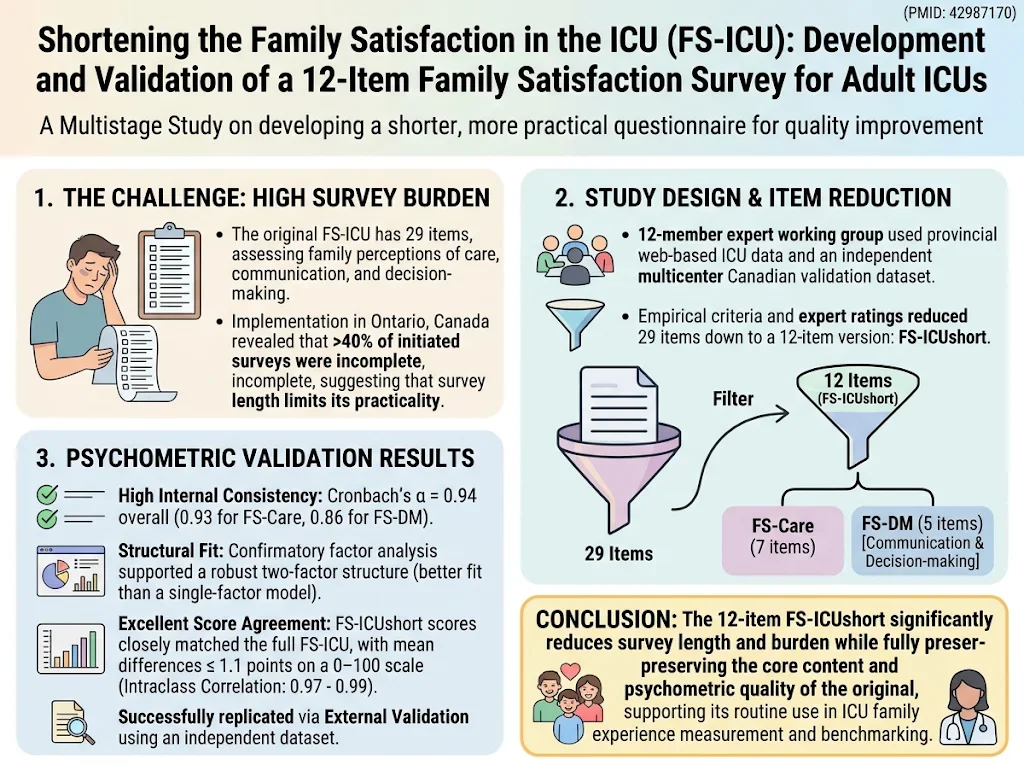
- The FS-ICUshort reduces the original 29-item FS-ICU survey to 12 items without compromising psychometric integrity.
- It encompasses two core domains: satisfaction with care and communication/decision-making, reflecting family priorities.
- High internal consistency (Cronbach’s α >0.85) and strong validity metrics were confirmed, including external multicenter validation.
- Shortened survey length addresses practical challenges in large-scale ICU quality improvement initiatives by reducing incomplete responses.
Background
Family satisfaction in adult intensive care units (ICUs) is a critical quality metric linked to patient-centered care, emotional well-being, and clinical outcomes. The Family Satisfaction in the ICU (FS-ICU) survey, with 29 items, has been widely adopted internationally for assessing family perceptions regarding care processes, communication quality, and participation in decision-making. Nevertheless, in large-scale implementations, survey length has adversely affected completion rates, thereby limiting its utility in routine quality improvement and benchmarking. Recognizing the imperative to balance content validity with feasibility, the recent study by Neilipovitz et al. (2026) embarked on developing and validating a concise version of the FS-ICU tailored for adult ICUs.Key Content
Development and Psychometric Evaluation of FS-ICUshort
The study leveraged comprehensive provincial FS-ICU data collected electronically across Ontario adult ICUs, where more than 40% incomplete response rates highlighted the need for reduction. A 12-member multidisciplinary expert working group, comprising ICU clinicians, administrators, patient experience and quality improvement specialists, applied empirical item reduction and expert consensus methodologies. As a result, the FS-ICU was condensed from 29 to 12 core items, partitioned into two domains:- Satisfaction-with-care (FS-Care): 7 items
- Communication and decision-making (FS-DM): 5 items
Comparative Agreement and External Validation
The FS-ICUshort demonstrated remarkable agreement with the full FS-ICU survey. Mean score differences on the 0-100 scale were minimal (≤1.1 points), and intraclass correlation coefficients ranged from 0.97 to 0.99. These psychometric characteristics held true within an external validation cohort derived from a multicenter Canadian revised FS-ICU dataset, reinforcing the generalizability and external validity of the shortened instrument.Contextualizing FS-ICUshort within Family-Centered Care Literature
Parallel contemporary studies reinforce the significance of streamlined, reliable family experience instruments. Nurse-led family liaison services, demonstrated in a UK quaternary ICU (PMID: 41739004), improved family satisfaction particularly around communication and emotional support, underscoring the survey domains targeted by FS-ICUshort. Meanwhile, the Quick FICS instrument in an American ICU context provided 5- and 10-item communication-focused scales, further validating the trend towards concise instruments balancing psychometric integrity with feasibility (PMID: 37343901). Moreover, interventions focusing on family-centered transitional care led by ICU liaison nurses reduced family stress and enhanced satisfaction, highlighting the clinical utility of reliable family satisfaction measures in guiding patient- and family-centered care innovations (PMID: 35396917). International efforts, such as the Japanese EMPATHIC-30 survey adaptation (PMID: 38981794) and the European Quality Questionnaire including FS-ICU components (PMID: 33260777), emphasize cross-cultural applicability and the need to tailor family satisfaction tools according to cultural sensitivities and healthcare system contexts. Nonetheless, the considerable length of such tools poses practical challenges mitigated in part by the FS-ICUshort’s brevity.Expert Commentary
Neilipovitz et al.’s development of FS-ICUshort addresses critical barriers in family satisfaction measurement in adult ICUs—primarily the trade-off between comprehensive assessment and respondent burden. The multidisciplinary approach integrating empirical data and expert input strengthens content validity while enhancing acceptability and response completion. The preservation of core domains – satisfaction with care and communication/decision-making – aligns with established determinants of family experience quality in critical care settings. Confirming the two-factor model further supports analytic clarity in differentiating key facets impacting family satisfaction. Clinically, the FS-ICUshort’s brevity facilitates embedding family experience assessments into routine ICU workflows, electronic health records, and quality benchmarking systems. This is particularly timely as ICUs globally are integrating family liaison roles and implementing structured communication rounds to enhance family engagement and multidisciplinary collaboration (PMID: 41027645). Limitations include the initial development sample restricted to Ontario, which may differ culturally or operationally from other regions, although robust external validation partially addresses this concern. Additionally, the reduction necessarily omits nuanced items; thus, contexts requiring granular understanding may still benefit from the full FS-ICU. Future directions include longitudinal implementation studies evaluating FS-ICUshort’s sensitivity to quality improvement interventions and further cross-cultural validations. Integrating survey data with psychosocial support initiatives may also optimize family-centered care outcomes.Conclusion
The FS-ICUshort represents an important advancement in ICU family satisfaction measurement, maintaining psychometric rigor while improving practicality. By enhancing survey completion rates without sacrificing core content, it supports widespread, routine application in adult critical care settings for quality improvement and benchmarking. Its deployment complements evolving interventions aimed at enhancing family experience, such as nurse-led liaison roles and structured communication frameworks, ultimately fostering a patient- and family-centered ICU culture.References
- Neilipovitz DT, Day AG, Wincen A, Iruthayanathan R, Heyland DK, Xisto N. Shortening the Family Satisfaction in the ICU (FS-ICU): Development and Validation of a 12-Item Family Satisfaction Survey for Adult ICUs. Crit Care Med. 2026 Nov 5; PMID:42987170.
- Tipton PW, et al. Nurse-Led Family Liaison in Adult Intensive Care: From Pandemic Innovation to an Integrated Model for Patient- and Family-Centred Care. Nurs Crit Care. 2026 Mar;31(2):e70409. PMID:41739004.
- Balakrishnan M, et al. The Quick FICS: 5 and 10 Item Versions of the Family Inpatient Communication Survey. J Pain Symptom Manage. 2023 Oct;66(4):e461-e468. PMID:37343901.
- Zhou J, et al. The effect of an ICU liaison nurse-led family-centred transition intervention program in an adult ICU. Nurs Crit Care. 2023 May;28(3):435-445. PMID:35396917.
- Kawaguchi R, et al. EMpowerment of PArents in THe Intensive Care: A multicentre validation study in Japan. Aust Crit Care. 2025 Jan;38(1):101072. PMID:38981794.
- Giovannetti S, et al. Validation and Analysis of the European Quality Questionnaire in Italian Language. Int J Environ Res Public Health. 2020 Nov 28;17(23):8852. PMID:33260777.
- Stang A, et al. Redesigning Intensive Care Unit Rounds to Improve Collaboration at a Military Hospital. Crit Care Nurse. 2025 Oct 1;45(5):16-26. PMID:41027645.
Specialty calculators
For clinical reference; use professional judgment.