Highlight
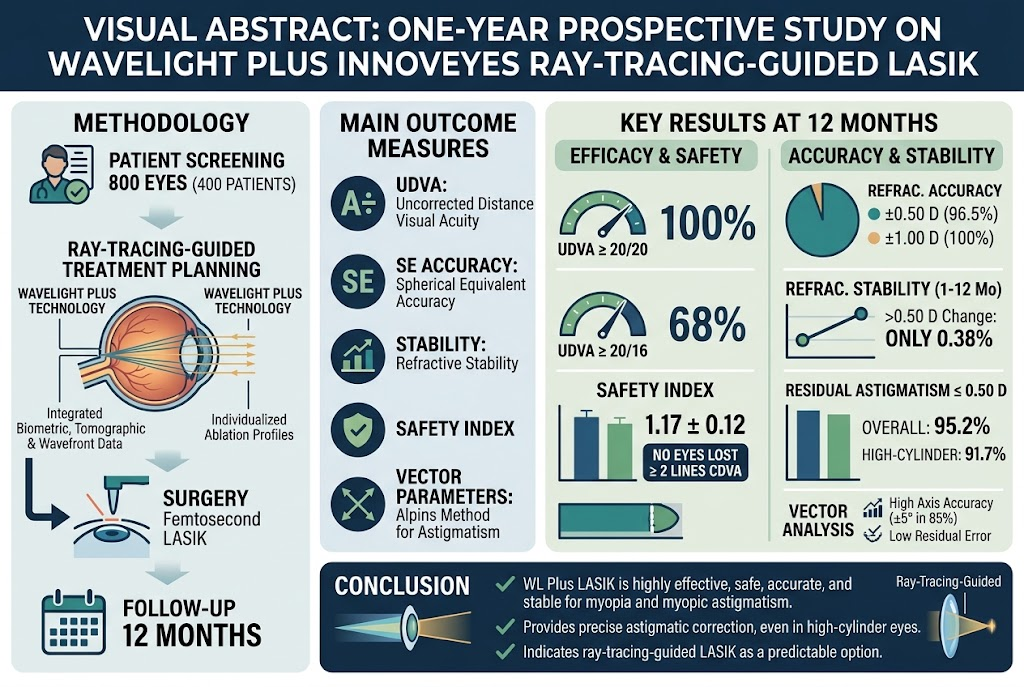
- WaveLight Plus InnovEyes ray-tracing-guided LASIK (WL Plus LASIK) demonstrated 100% of eyes achieving uncorrected distance visual acuity (UDVA) of 20/20 or better at 12 months postoperatively.
- High refractive accuracy with 96.5% of eyes within ±0.50 diopters (D) of target spherical equivalent, and minimal refractive regression over one year.
- Astigmatic correction was precise with low residual astigmatism and high axis alignment, including in eyes with preoperative cylinder greater than or equal to 1.50 D.
- No significant safety concerns noted; no eyes lost two or more lines of corrected distance visual acuity (CDVA).
Study Background
Myopia and myopic astigmatism are highly prevalent refractive errors that significantly impact visual function and quality of life globally. Laser in situ keratomileusis (LASIK) is a widely adopted surgical modality for refractive correction, with ongoing innovations aimed at improving visual outcomes and minimizing postoperative complications. Traditional LASIK treatment planning often relies on subjective refraction and standardized ablation profiles, which may not fully account for individual ocular wavefront aberrations and biomechanical variations.
The WaveLight Plus InnovEyes system introduces an advanced ray-tracing-guided approach, integrating multimodal biometric, tomographic, and wavefront data to generate individualized ablation profiles. This reconciliation of wavefront-derived refraction with cycloplegic manifest refraction aims to improve the precision of refractive corrections, especially for astigmatism. However, robust prospective data evaluating its long-term efficacy, safety, and refractive stability are limited.
Study Design
This prospective, non-randomized interventional study enrolled 400 patients (800 eyes) diagnosed with myopia or myopic astigmatism eligible for LASIK correction. A predefined subgroup of 300 eyes had a preoperative cylinder of ≥1.50 D to assess astigmatic treatment accuracy specifically.
All patients underwent femtosecond LASIK with WaveLight Plus InnovEyes ray-tracing-guided treatment planning. Data inputs included biometric measurements, corneal tomography, wavefront analysis, and manifest refraction under cycloplegia. These data were integrated to create personalized ablation profiles targeting both spherical and astigmatic errors.
Patients were followed for 12 months with regular assessments of uncorrected and corrected distance visual acuities, refractive error, and vector analysis of astigmatic correction using the Alpins method. Safety indices and refractive stability were evaluated over this period.
Key Findings
Efficacy and Visual Outcomes
At the 12-month follow-up, all eyes (100%) achieved UDVA of 20/20 or better, with 68% attaining 20/16 or better. The mean postoperative UDVA was remarkably good at -0.07 ± 0.05 logMAR (approximately 20/17 Snellen equivalent), correlating with an efficacy index of 1.17 ± 0.12, indicating that uncorrected vision postoperatively surpassed preoperative corrected vision.
Safety Outcomes
The safety index was also 1.17 ± 0.12, with no eyes experiencing loss of two or more lines of CDVA, demonstrating excellent preservation or enhancement of best-corrected visual function. No significant adverse events or complications were reported during the study period.
Refractive Accuracy and Stability
The mean postoperative spherical equivalent (SE) refraction was close to emmetropia at -0.08 ± 0.24 D, with excellent predictability (coefficient of determination R² = 0.99). Precision was underscored by 96.5% of eyes within ±0.50 D and 100% within ±1.00 D of the target SE.
Refractive stability was robust; only 0.38% of eyes showed a clinically meaningful change (>0.50 D) between 1 month and 12 months postoperative, reflecting sustained correction without significant regression.
Astigmatic Correction and Vector Analysis
Overall residual astigmatism was low; 95.2% of eyes had ≤0.50 D postoperatively. In the high-cylinder subgroup (≥1.50 D), 91.7% achieved this threshold, indicating consistent astigmatism control even in more complex eyes.
Vector analysis using the Alpins method revealed mild undercorrection with a mean correction index (CI) of 0.94 overall and 0.93 in the high-cylinder cohort. Residual astigmatic error quantified by the difference vector (DV) was minimal at 0.15 D overall and 0.21 D in the subgroup. Axis alignment was accurate, with 85% of eyes in the high-cylinder group achieving axis error within ±5°, an important metric for functional visual quality.
Expert Commentary
WaveLight Plus InnovEyes ray-tracing-guided LASIK exemplifies the next generation of personalized refractive surgery by merging advanced ocular biometry and wavefront data for nuanced ablation design. Such integration allows correction not just of lower-order aberrations like sphere and cylinder but also potentially reduces higher-order aberrations that impact visual quality.
The high efficacy and safety indices align with or exceed contemporary LASIK standards, with particularly encouraging results in eyes with significant astigmatism, a traditionally challenging group to treat precisely. The remarkable refractive stability over one year suggests durable corneal reshaping effects and minimal ectatic risk with this technology.
Limitations include the non-randomized design and lack of a direct comparator group employing conventional LASIK or other wavefront-guided platforms, which will be important for future confirmatory studies. Additionally, longer-term data beyond one year would strengthen evidence around safety and regression risks.
Conclusion
This large prospective cohort study establishes WaveLight Plus InnovEyes ray-tracing-guided LASIK as a safe, effective, and highly precise intervention for correction of myopia and myopic astigmatism. The approach achieves excellent visual acuity outcomes with minimal residual refractive error and high astigmatic axis accuracy, including in high-cylinder eyes. Its stability over one year supports its role as a predictable refractive surgery option, likely enhancing patient satisfaction and visual function.
Future studies comparing ray-tracing-guided LASIK directly with conventional and wavefront-optimized LASIK technologies as well as evaluations of higher-order aberration outcomes and patient-reported quality of vision will further elucidate its clinical utility.
Funding and Clinical Trial Registration
The referenced study did not specify funding sources or clinical trial registration details within the abstract. For further confirmation, consulting the original publication is recommended.
References
1. Shetty R, Shah A, Singh P, Narasimhan R, Roy AS, Bhatkal A, Khamar P. Stability, Safety, and Efficacy of WaveLight Plus InnovEyes Ray-Tracing-Guided LASIK in Myopia and Myopic Astigmatism: A One-Year Prospective Study. American Journal of Ophthalmology. 2026 Sep 10; (PMID: 42722116).
2. Alpins N. Astigmatism analysis by the Alpins method. J Cataract Refract Surg. 2001;27(1):31-49.
3. Randleman JB, Russell B, Ward MA, Thompson KP, Stulting RD. Risk Factors and Prognosis for Corneal Ectasia after LASIK. Ophthalmology. 2003;110(2):267-275.
4. Reinstein DZ, Archer TJ, Gobbe M. The role of corneal wavefront-guided laser in situ keratomileusis in minimizing higher order aberrations after refractive surgery. Expert Rev Ophthalmol. 2012;7(3):241-259.