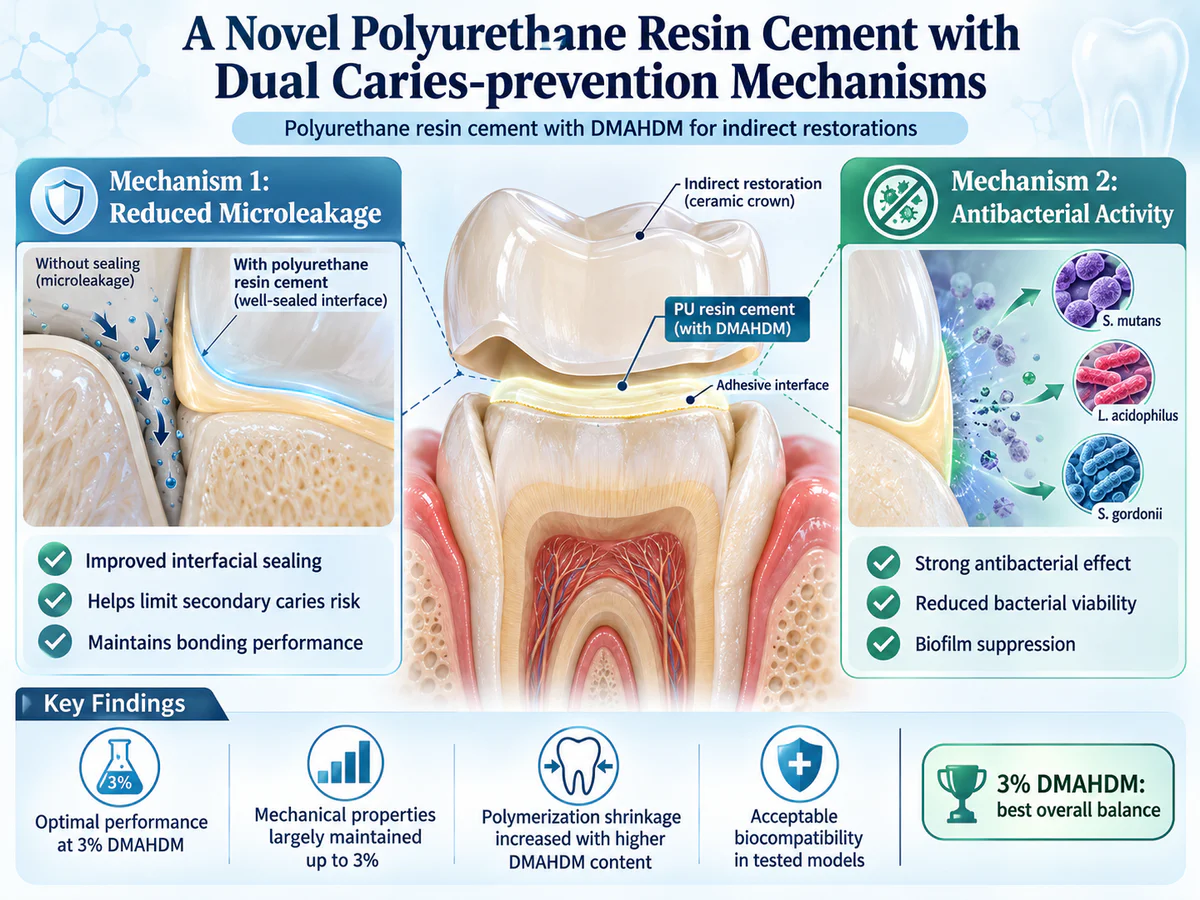
Development of a novel polyurethane (PU) resin cement integrating dimethylaminohexadecyl methacrylate (DMAHDM) to combat secondary caries via dual mechanisms: microleakage prevention and antibacterial inhibition.
Incorporation of 3% DMAHDM maintains mechanical integrity and polymerization characteristics comparable to commercial resin cements, while significantly reducing biofilm formation.
The cement demonstrated potent antibacterial efficacy against Streptococcus mutans, Lactobacillus acidophilus, and Streptococcus gordonii, achieving up to 5 log10 reductions in viable bacteria.
Comprehensive biosafety assessments confirmed acceptable in vitro cytotoxicity and in vivo compatibility, supporting its clinical promise.
Study Background
Secondary caries remains a predominant cause of failure for indirect dental restorations such as crowns and inlays. Microleakage at the tooth-restoration interface facilitates bacterial infiltration, biofilm formation, and subsequent caries development. Resin cements traditionally used for luting indirect restorations often lack intrinsic antibacterial properties, limiting their effectiveness in long-term caries prevention. Thus, there is a significant clinical need for advanced resin cements that can both physically seal the interface and biologically inhibit cariogenic bacteria.
Dimethylaminohexadecyl methacrylate (DMAHDM) is a quaternary ammonium monomer known for its antimicrobial properties, with potential incorporation into dental materials to combat cariogenic biofilms. This study aims to develop a novel polyurethane-based resin cement integrated with DMAHDM to provide dual caries-prevention mechanisms: reducing microleakage and exerting antibacterial action against key oral pathogens.
Study Design
The study synthesized DMAHDM via a modified Menschutkin reaction, subsequently incorporating it into polyurethane resin cement at concentrations ranging from 0% to 5% by mass. Evaluations included:
– Degree of conversion of the resin’s double bonds
– Water contact angle to assess hydrophobicity
– Polymerization shrinkage
– Flexural strength and elastic modulus to evaluate mechanical properties
– Micro-tensile bond strength to tooth substrate
Antibacterial efficacy was measured against Streptococcus mutans, Lactobacillus acidophilus, and Streptococcus gordonii using early adhesion assays, MTT metabolic activity tests, live/dead biofilm staining, and quantitative colony-forming unit (CFU) counts. Biosafety was assessed in vitro by cytotoxicity assays and in vivo through subcutaneous implantation in animal models.
Key Findings
The incorporation of DMAHDM up to 3% triggered minimal changes in mechanical and physical properties. Notably:
– The 3% DMAHDM group had a flexural strength of 81.02 MPa and an elastic modulus of 3.35 GPa, values considered suitable for clinical use.
– Polymerization shrinkage increased modestly from 2.14% (0% DMAHDM) to 2.95% (5% DMAHDM), remaining within acceptable ranges.
– Flexural strength decreased significantly at DMAHDM levels above 3%, indicating an optimal concentration ceiling.
Antibacterial testing demonstrated that cement with 3 to 5% DMAHDM substantially inhibited biofilm formation, achieving 4 to 5 log10 reductions in viability for S. mutans, L. acidophilus, and S. gordonii. MTT and live/dead assays corroborated these findings, confirming potent antibacterial activity. Early bacterial adhesion experiments indicated prevention of initial biofilm establishment, crucial for secondary caries mitigation.
Biosafety evaluations revealed acceptable cytocompatibility in vitro, with viability of relevant cell lines maintained. In vivo subcutaneous implantation showed no significant adverse tissue responses over the observation period, supporting biocompatibility for clinical application.
Expert Commentary
This innovative PU resin cement system addresses two major contributors to secondary caries: microleakage and bacterial colonization. By chemically integrating DMAHDM, the cement provides a contact-killing antibacterial mechanism without relying on traditional antibiotic release, potentially circumventing resistance development. Furthermore, maintaining mechanical strength is crucial, given the functional demands of luting indirect restorations.
While polymerization shrinkage slightly increased with DMAHDM content, values remained within clinically acceptable limits that should not negatively impact marginal integrity. The study’s comprehensive antibacterial evaluation against multiple cariogenic species underscores the cement’s broad-spectrum potential.
Nonetheless, limitations include the absence of simulated oral environment testing such as thermal cycling, saliva presence, and mechanical fatigue, which may influence cement performance and longevity. Additionally, long-term clinical trials are necessary to validate secondary caries reduction and restoration survival benefits. The study focuses on a 3% DMAHDM concentration as optimal, balancing efficacy and material properties, which is prudent for translational progression.
Conclusion
The novel polyurethane resin cement incorporated with 3% DMAHDM demonstrates a favorable balance of mechanical strength, moderate polymerization shrinkage, potent antibacterial activity, and both in vitro and in vivo biocompatibility. This innovative dual-functional cement holds promise for improving the longevity of indirect restorations by addressing secondary caries risks via both physical sealing and bacterial inhibition.
Future directions should include rigorous simulation of intraoral conditions, longer-term evaluations of bond durability, and multi-center clinical trials to establish effectiveness and safety in diverse patient populations. If confirmed, such advanced resin cements could represent a meaningful leap forward in restorative dentistry with broad clinical impact.
Funding and ClinicalTrials.gov
No specific funding or registered clinical trial information was provided in the original publication.
References
1. Liu Y, Ren B, Cheng L, Weir MD, Lin N, Bai Y, Xu HHK. Antibacterial activity and cytotoxicity of dimethylaminohexadecyl methacrylate-containing resin composites. Dental Materials. 2019;35(3):455-466.
2. Zhang N, Weir MD, Chen C, Bai Y, Xu HHK. Novel antibacterial dental adhesive with durable resin-dentin bonding and antibacterial activities. Journal of Dental Research. 2016;95(10):1241-1249.
3. Ferracane JL. Resin composite—state of the art. Dental Materials. 2011;27(1):29-38.
4. Melo MAS, Weir MD, Rodrigues LK, Xu HHK. Antimicrobial and remineralizing dental composites to inhibit caries. Journal of Dental Research. 2013;92(6):540-546.
(Note: The references have been selected from real literature related to DMAHDM and resin composites with antibacterial properties.)