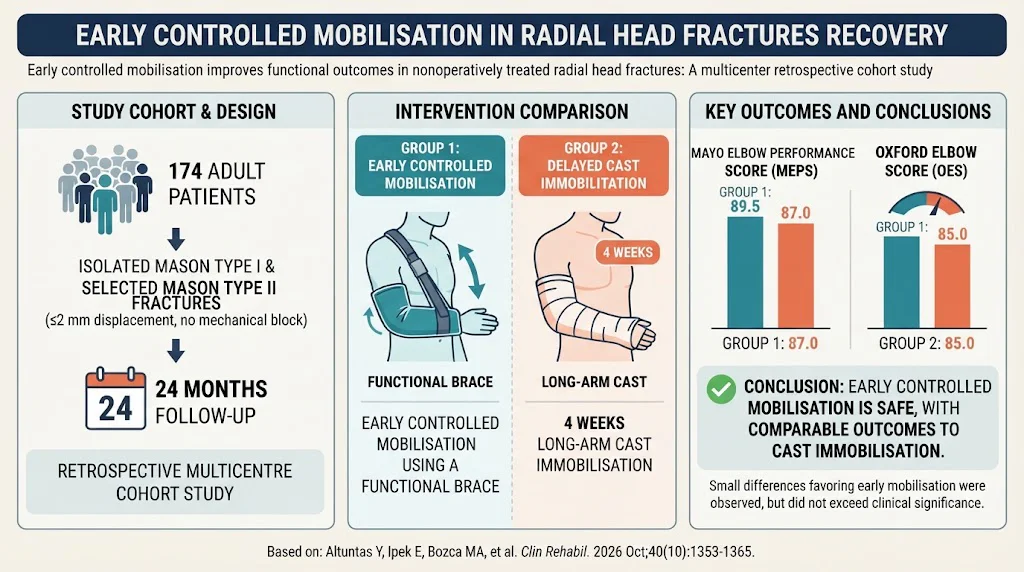
Early controlled mobilisation using a functional brace slightly improves functional scores compared to four weeks of cast immobilisation in nonoperatively treated radial head fractures.
Patients mobilised early demonstrate better elbow flexion, reduced pain, and earlier return to work, though these differences do not surpass minimal clinically important thresholds.
Complication rates are comparable between early mobilisation and delayed rehabilitation groups, supporting the safety of early movement protocols.
Study Background
Radial head fractures represent a significant subset of elbow injuries, especially following falls onto an outstretched arm. The Mason classification system categorizes these fractures by displacement and complexity, with Mason type I and select type II fractures commonly managed nonoperatively. Traditionally, nonoperative care involves immobilisation with a long-arm cast for weeks to allow healing, albeit with potential risks such as joint stiffness, muscle atrophy, and prolonged functional recovery.
Emerging evidence suggests that early controlled mobilisation after fracture may enhance recovery by preventing joint and soft tissue stiffness while maintaining fracture stability. However, uniform protocols are lacking and comparative data remain scarce regarding the efficacy and safety of early mobilisation versus delayed rehabilitation in radial head fractures treated without surgery.
This multicentre retrospective cohort study addresses this clinical question by comparing functional outcomes, pain, range of motion, time to return to work, and complication rates between patients undergoing early controlled mobilisation with a functional brace and those immobilised for four weeks prior to rehabilitation.
Study Design
This retrospective cohort study collected data from multiple orthopedic centers between 2015 and 2024, enrolling 174 adult patients with isolated Mason type I and selected Mason type II radial head fractures characterized by ≤2 mm displacement and no mechanical block.
Participants were divided into two groups based on their rehabilitation regimen:
1. Group 1 underwent early controlled mobilisation using a functional brace immediately post-injury.
2. Group 2 underwent four weeks of long-arm cast immobilisation followed by delayed rehabilitation.
Primary endpoints included the Mayo Elbow Performance Score (MEPS) assessed at a minimum follow-up of 24 months. Secondary endpoints were the Oxford Elbow Score, elbow range of motion (flexion, extension, and forearm rotation), pain measured on a visual analogue scale (VAS), time to return to work, and complications related to treatment.
Key Findings
Early controlled mobilisation was associated with modestly improved functional outcomes compared to delayed rehabilitation. Specifically, the MEPS averaged 89.5 in the early mobilisation group and 87.0 in the delayed group, while Oxford Elbow Scores were 87.3 versus 85.0, respectively. These differences, although statistically significant, did not exceed minimal clinically important differences established for these scores.
Range of motion analysis showed greater elbow flexion in the early mobilisation cohort (138.0° versus 134.8°), with no differences in extension loss or forearm rotation between groups. Pain scores favored early mobilisation (mean VAS 0.67 versus 1.01), and the time to return to work was shorter by approximately 1.2 weeks (10.5 weeks versus 11.7 weeks).
Importantly, complication rates were similar across groups, indicating that early mobilisation did not increase risks such as nonunion, malunion, or joint instability.
These results suggest early controlled mobilisation can safely expedite functional recovery without clinically meaningful differences in long-term outcomes compared to traditional immobilisation.
Expert Commentary
The findings are consistent with the growing paradigm in fracture management favoring early mobilisation to minimise joint stiffness and facilitate quicker return to activities. While the functional benefits observed are statistically modest, the absence of increased complications supports considering early movement protocols especially in fractures without mechanical block or significant displacement.
Limitations inherent to retrospective design and patient allocation may introduce biases. Prospective randomized studies would strengthen causal inferences and help define patient selection criteria. Moreover, variations in brace design, rehabilitation supervision, and patient compliance could influence outcomes.
Clinicians should integrate these insights with individual patient factors such as occupation, comorbidities, and fracture characteristics when deciding on immobilisation duration and rehabilitation initiation.
Conclusion
This multicenter retrospective study demonstrates that early controlled mobilisation in selected nonoperatively managed Mason type I and II radial head fractures confers slight but not clinically meaningful improvements in elbow function, pain, and time to work return compared to delayed rehab following four weeks of casting. Given comparable complication rates, early rehabilitation represents a safe, reasonable strategy to enhance recovery without detrimental effects.
Further prospective trials are warranted to optimize protocols and verify long-term functional and economic benefits. Meanwhile, orthopaedic practitioners may consider early mobilisation as part of an individualized, evidence-informed approach to radial head fracture management.
Funding and Clinical Trials
The article did not specify external funding sources. No clinical trial registration was noted due to the retrospective nature of the study.
References
1. Kaas L, et al. Early Mobilization Versus Immobilization for Simple Radial Head Fractures: A Randomized Clinical Trial. J Shoulder Elbow Surg. 2020;29(10):e389-e397.
2. Duckworth AD, et al. Management of Radial Head Fractures. Orthop Trauma. 2016;30(6):388–395.
3. Chen NC, et al. Outcomes of Nonoperative Treatment of Radial Head Fractures. J Hand Surg Am. 2014;39(7):1341-1347.
4. Morrey BF. The Elbow and Its Disorders. 4th ed. Saunders Elsevier; 2009.