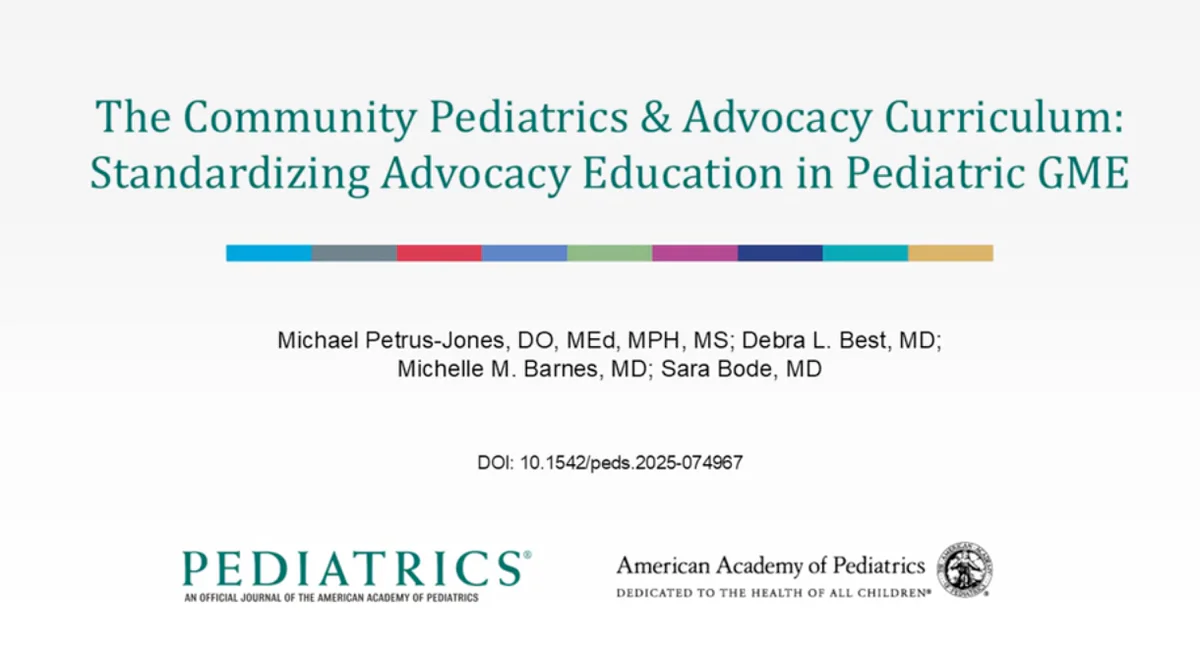
Pediatricians have long served not only as clinicians but also as advocates for children, families, and communities. During the past decade, graduate medical education (GME) leaders, specialty boards, and professional societies have emphasized that advocacy skills are core competencies for pediatricians. In response, Petrus-Jones and colleagues (Pediatrics, 2026) present The Community Pediatrics & Advocacy Curriculum: Standardizing Advocacy Education in Pediatric GME — a consensus-based curricular framework developed and curated through the American Academy of Pediatrics (AAP) Community Pediatrics Training Initiative (CPTI) and expert peer review (Petrus-Jones et al., 2026; PMID: 42906918).
This consensus product arrives amid growing expectations: accrediting and certifying organizations increasingly require demonstrable skills in advocacy, systems-based practice, and population health. Despite those expectations, programs have varied widely in how they teach, assess, and credential advocacy. The new curriculum aims to give pediatric residency and fellowship programs a feasible, evidence-informed baseline: clear goals and objectives, sample activities, assessment strategies, and an organizing socioecological model of pediatrician advocacy.
Why this curriculum matters now
– Accreditation and certification drivers: The Accreditation Council for Graduate Medical Education (ACGME) requires training programs to address systems-based practice and professionalism; the American Board of Pediatrics (ABP) increasingly recognizes community child health and advocacy in certification and continuing professional development. Programs need practical tools to translate these requirements into learning experiences and assessments.
– Variable prior practice: Prior curricula were heterogeneous in scope and evaluative approach, with inconsistent alignment to competencies and limited resources for program directors.
– Societal urgency: Rising child health inequities (housing instability, food insecurity, environmental threats) demand pediatricians who are prepared to act across clinical, community, and policy levels.
New Guideline Highlights
The core product described by Petrus-Jones et al. is a modular curriculum framework anchored on a socioecological model of pediatrician advocacy. The framework has three linked aims: define competency domains; map experiential and didactic learning activities to those domains; and provide feasible assessment tools.
Major recommendations and themes
– Adopt a socioecological model of advocacy. Pediatrician advocacy spans individual patient encounters, practice- and clinic-level change, community partnerships, and policy/legislative engagement. The curriculum centers these concentric levels and encourages trainees to practice across them.
– Standardize core objectives. The curriculum proposes a set of universal goals and competency-linked learning objectives that programs should adopt as a baseline, while allowing local adaptation to community needs.
– Use competency-based assessment. Programs should document learner competence using observable behaviors, workplace-based assessments, reflective portfolios, and objective structured advocacy assessments where feasible.
– Prioritize feasibility. Recommended activities include short, high-yield interventions (e.g., screening for social determinants of health and referral workflows), plus longitudinal community projects for deeper skill-building.
– Emphasize interprofessional and community partnerships. Trainees should work alongside social workers, community health workers, public health officials, school nurses, and family leaders.
Key takeaways for clinicians and program leaders
– The curriculum provides ready-to-use learning objectives and exemplar activities that can be mapped to ACGME competencies.
– Implementation can be staged: start with universal, clinic-based activities and build toward community engagement and policy exposure.
– Assessment is integral: document learning through a combination of direct observation, project deliverables, and reflective practice.
Updated Recommendations and Key Changes
Although the new curriculum does not replace formal accreditation requirements, it represents an important standardization step compared with prior AAP and local curricula. Key changes from earlier guidance include:
– Explicit socioecological organizing framework: Prior curricula tended to mix community and clinical advocacy without a unifying model. The new framework clarifies levels of action (individual, practice, community, policy) and maps objectives to each level.
– Consensus-derived exemplar activities and assessment tools: Earlier resources offered ideas and case studies; this product compiles peer-reviewed, expert-vetted activities and sample assessment rubrics to facilitate implementation.
– Stronger alignment with competency-based assessment: The curriculum recommends specific workplace-based assessment formats and learner milestones to document progression.
– Greater emphasis on feasibility and equity: The task force prioritized activities feasible within 1–2 hours per rotation (for early exposure), while recommending longitudinal projects for deeper competency. Equity-oriented practice and structural determinants of health are explicit curricular threads.
Evidence and rationale for updates
The authors cite a growing literature that links experiential, community-engaged learning with improved trainee confidence and advocacy participation. Implementation challenges reported in prior studies—variability in curricular time, limited faculty development, and inconsistent assessment—drove the need for standardized tools and feasible activity sets. The consensus process harnessed both literature and field experience from the AAP CPTI network to shape recommendations.
Topic-by-Topic Recommendations
Below are the core domains, representative learning objectives, exemplar activities, and recommended assessment approaches from the consensus curriculum. Each domain is framed by level of advocacy action and mapped to suggested fidelity and assessment.
1) Foundational Knowledge and Professional Identity (Cross-cutting)
– Core objectives: Understand the pediatrician’s ethical and professional obligation to advocate; describe social determinants of child health; explain the socioecological advocacy model.
– Exemplar activities: Short didactic module (30–60 minutes); case-based discussion linking social needs screening to care plans.
– Assessment: Multiple-choice/short-answer knowledge checks; reflective writing on role and responsibilities.
2) Clinical-Patient Level Advocacy
– Objectives: Screen for social determinants of health; use community resource directories; write effective community resource referrals and patient-facing advocacy letters.
– Activities: Integrate standardized screening tools into clinic flow; role-play counseling and referral conversations; create a “social needs” workflow.
– Assessment: Direct observation of screening encounters; chart audits for documentation and referral completion.
3) Practice- and Systems-Level Advocacy
– Objectives: Identify systems barriers within a clinic/hospital (e.g., access to subspecialty care, interpreter services); lead quality improvement (QI) projects to address identified barriers.
– Activities: Short QI cycles (Plan-Do-Study-Act) to improve referral timeliness or MMR vaccination rates; build a team-based clinic protocol for food or housing instability.
– Assessment: Project deliverables (run charts, PDSA documentation); faculty evaluation of leadership and systems thinking.
4) Community-Level Advocacy and Partnership
– Objectives: Map community assets and gaps; co-design initiatives with community partners; participate in community advisory boards.
– Activities: Conduct a community asset map; partner with a local school or public health department on a vaccination or asthma-control campaign.
– Assessment: Product-based evaluation (community project summary), partner feedback, trainee reflection on community engagement principles.
5) Policy and Legislative Advocacy
– Objectives: Describe local/state policy processes; draft policy memos or testimony; engage in advocacy through professional organizations.
– Activities: Attend a legislative day (virtual or in-person); write a sample letter to an elected official; produce a policy brief on a child health issue.
– Assessment: Review of written policy products; observed oral testimony in simulated or real settings.
Recommendation strengths and implementation categories (consensus-based)
– Essential (core expected for all trainees): Clinical screening and referral workflows; foundational didactics; direct observation of screening and basic documentation.
– Recommended (strongly encouraged where feasible): Practice-level QI projects; short community engagement experiences; structured reflective assignments.
– Advanced (for elective or fellowship training): Longitudinal community-based projects, policy leadership experiences, publication or legislative testimony.
Assessment and Entrustable Outcomes
The curriculum emphasizes competency-based assessment. Recommendations include:
– Workplace-based assessments aligned to observable behaviors (e.g., Direct Observation of Clinical Encounter, mini-CEX adapted for advocacy items).
– Portfolio artifacts: project summaries, policy memos, reflective narratives, community partner feedback.
– Milestone descriptors: early (recognizes social determinants, screens reliably), intermediate (leads a clinic QI cycle), advanced (sustains a community partnership or leads policy advocacy).
While the consensus stops short of a formal psychometric validation of assessment tools, the authors provide sample rubrics and recommend local validation and faculty development to ensure reliable scoring.
Expert Commentary and Insights
Committee perspectives
– The expert panel framed advocacy as a set of practical, learnable skills that can and should be integrated into everyday training rather than treated as optional extras. They emphasized that advocacy competency includes both knowledge and the ability to mobilize resources, lead teams, and collaborate with communities.
– Many contributors underscored feasibility: short, replicable activities are more likely to be sustained in busy programs than time-intensive electives alone.
Areas of consensus
– Advocacy belongs in core curricula and should be assessed.
– Programs must partner with community stakeholders and value their leadership; trainees should be taught to practice in ways that are respectful and reciprocal.
Controversies and unresolved issues
– Degree of standardization: Some educators worry that over-standardization could constrain program flexibility and local adaptation; others argue standardization is necessary to ensure minimum competency across programs.
– Assessment validity: There remains no single validated instrument for assessing advocacy competence; the authors recommend mixed-methods assessment and longitudinal evidence of impact.
– Scope of advocacy in training: Debates continue about how much policy-level experience is realistically required for all trainees versus reserved for those pursuing community pediatrics or primary care tracks.
Future trends and research needs
– Validation studies of assessment tools and rubrics.
– Evaluations linking trainee advocacy activities to patient- or community-level outcomes.
– Scalable faculty development models to build preceptor confidence in teaching and assessing advocacy.
Practical Implications
How programs can adopt the curriculum
– Start small: integrate screening and referral workflows and a short didactic module in the first year.
– Build partnerships: identify at least one community partner and a faculty champion to supervise projects.
– Use the provided rubrics and portfolio templates; pilot them and refine locally.
– Track progress: tie advocacy activities to ACGME competencies and milestones to satisfy reporting needs.
Impact on clinical practice and systems
– Clinically, routine social needs screening and referral systems can improve access to services and patient follow-up.
– For hospitals and clinics, practice-level QI projects driven by trainees can improve equity-oriented care processes (e.g., language access, transportation supports).
– For communities, sustained partnerships led by pediatric programs can amplify child health promotion and policy initiatives.
Vignette: Applying the curriculum
Maria, a third-year pediatrics resident, completes a 4-week clinic block using the new curriculum. She screens families with a standard social needs tool, identifies several households with food insecurity, and uses a clinic referral workflow to connect families to a local food pantry and WIC benefits. For her longitudinal project, Maria partners with a community health worker and a school nurse to plan a weekend food distribution. She documents her reflections and submits a project summary to her portfolio. Her faculty preceptor evaluates her using the provided rubric; community partners provide feedback. Maria receives credit toward her milestone for practice- and community-level advocacy.
References
Pivotal sources for this summary and tools described include:
– Petrus-Jones M, Best DL, Barnes MM, Bode S. The Community Pediatrics & Advocacy Curriculum: Standardizing Advocacy Education in Pediatric GME. Pediatrics. 2026 Oct 22. PMID: 42906918. https://pubmed.ncbi.nlm.nih.gov/42906918/
– Accreditation Council for Graduate Medical Education (ACGME). Common Program Requirements. https://www.acgme.org/what-we-do/accreditation/common-program-requirements/ (accessed 2026).
– American Academy of Pediatrics. Community Pediatrics (including Community Pediatrics Training Initiative). https://www.aap.org/ (see Community Pediatrics pages and CPTI resources) (accessed 2026).
– American Board of Pediatrics. Maintenance of Certification and Content Specifications. https://www.abp.org/ (accessed 2026).
Note: The primary consensus curriculum described above is detailed in the 2026 Pediatrics publication by Petrus-Jones et al., which compiles the AAP CPTI expert consensus and provides downloadable curricular modules, sample rubrics, and exemplar activities for program implementation.
Closing thoughts
The Community Pediatrics & Advocacy Curriculum represents a pragmatic, consensus-driven attempt to standardize advocacy education across pediatric GME. By organizing learning around a socioecological model, providing feasible activities that scale from clinic workflows to policy engagement, and offering competency-linked assessments, the curriculum gives programs a practical roadmap. Moving forward, the field will need multi-institutional evaluations to validate assessments and demonstrate that trainee advocacy leads to measurable improvements in child and community health.
Further reading and resources
– AAP Community Pediatrics Training Initiative (CPTI) materials and implementation guides (see the AAP website).
– ACGME program requirements for Pediatrics and Milestone documentation guidance.
– Selected literature on advocacy education in residency (see reviews on advocacy curricula and experiential learning in medical education journals).

 By
No Comments