Highlight
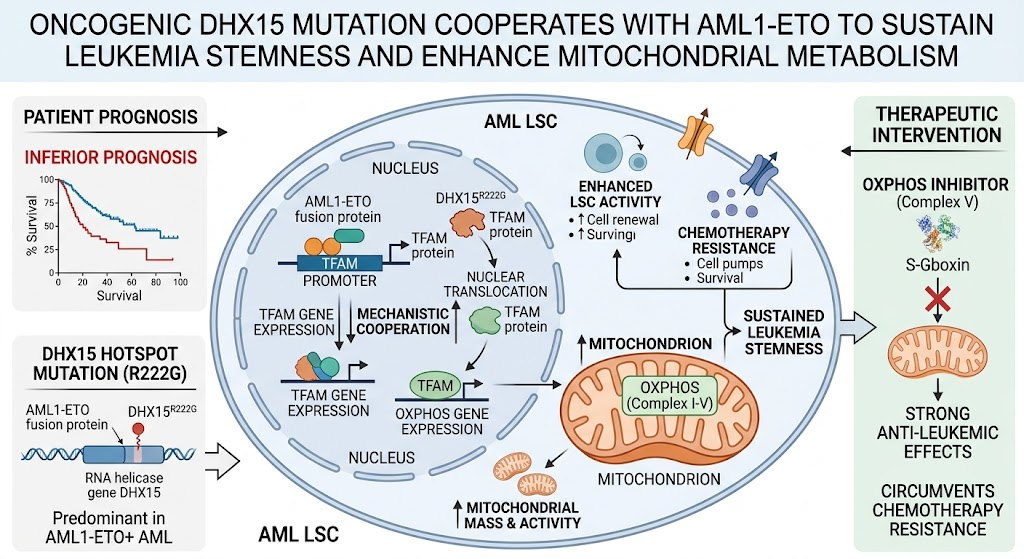
- DHX15 R222G mutation, enriched in AML patients with RUNX1::RUNX1T1 (AML1-ETO) translocation, predicts poor clinical outcomes in pediatric AML.
- DHX15R222G cooperates with AML1-ETO fusion protein to boost leukemia stem cell (LSC) self-renewal and chemotherapy resistance.
- Mechanistically, AML1-ETO upregulates mitochondrial transcription factor A (TFAM), while DHX15R222G stabilizes TFAM protein and promotes its nuclear translocation, synergistically enhancing mitochondrial oxidative phosphorylation (OXPHOS).
- Pharmacologic inhibition of OXPHOS using Complex V inhibitor S-Gboxin effectively suppresses LSC activity and overcomes chemotherapy resistance in DHX15R222G AML.
Study Background
Acute myeloid leukemia (AML) is a heterogeneous hematologic malignancy characterized by clonal expansion of myeloid progenitor cells. The RUNX1::RUNX1T1 translocation, also referred to as AML1-ETO, represents one of the most common cytogenetic abnormalities in AML, particularly among pediatric patients. This fusion gene modifies transcription programs and contributes to leukemogenesis. However, clinical outcomes remain highly variable, and disease relapse due to chemoresistant leukemia stem cells poses a significant challenge.
The RNA helicase DHX15 gene has recently emerged as a recurrent mutational hotspot in AML, especially in cases harboring the AML1-ETO translocation. The mutation R222G in DHX15 has been recurrently detected, but its functional impact and clinical relevance have not been fully elucidated. New insights into how mutations modulate leukemia biology and stemness are essential for developing precision interventions to improve outcomes.
Study Design
This study investigated the clinical implications and mechanistic function of the DHX15 R222G mutation in pediatric AML patients with the AML1-ETO translocation. Patient samples were analyzed to correlate DHX15 mutations with survival outcomes. Functional and mechanistic analyses were performed using cellular and molecular biology techniques to define the interaction of DHX15R222G with AML1-ETO in leukemia stem cells.
The study employed biochemical assays to evaluate mitochondrial respiration, gene expression profiling to assess oxidative phosphorylation-related genes, and pharmacologic intervention using the Complex V inhibitor S-Gboxin to test therapeutic vulnerability. Leukemia stem cell activity and chemoresistance were assessed in vitro and in vivo.
Key Findings
Clinical analysis demonstrated that pediatric AML patients harboring the DHX15 R222G mutation exhibited significantly worse prognosis compared to patients without the mutation, highlighting its diagnostic and prognostic significance for risk stratification.
Functional assays revealed that DHX15R222G mutated protein functions synergistically with AML1-ETO fusion protein to enhance LSC activity, a critical driver of leukemic maintenance and relapse. This cooperation notably increased resistance to standard chemotherapy regimens.
Mechanistically, AML1-ETO fusion protein transcriptionally activates mitochondrial transcription factor A (TFAM), a master regulator of mitochondrial DNA replication and expression. Concurrently, DHX15R222G mutation promotes TFAM protein stabilization and its nuclear translocation, leading to upregulation of oxidative phosphorylation (OXPHOS)-associated gene expression and enhanced mitochondrial respiration in leukemia cells.
This metabolic reprogramming supports energy-dependent LSC functions, sustaining stemness and survival under therapeutic stress.
Importantly, treatment with S-Gboxin, a selective Complex V (ATP synthase) inhibitor targeting OXPHOS, exerted potent anti-leukemic effects. S-Gboxin effectively reduced leukemia stemness and overcame chemotherapy resistance in AML cells positive for both AML1-ETO and DHX15 R222G mutation, underscoring a novel therapeutic vulnerability.
Expert Commentary
This study offers compelling evidence that mutation-driven metabolic rewiring plays a pivotal role in AML pathogenesis and therapy resistance. The identification of DHX15R222G as a mutation that stabilizes TFAM and enhances mitochondrial bioenergetics provides a mechanistic link between oncogenic mutations and metabolic dependencies of leukemia stem cells.
Targeting mitochondrial metabolism with OXPHOS inhibitors like S-Gboxin represents a promising therapeutic strategy, particularly for molecularly defined AML subsets characterized by DHX15 mutations. These findings align with an increasing recognition that leukemic stem cells depend on mitochondrial respiration, distinguishing them from bulk blasts relying on glycolysis.
However, further clinical validation in larger and adult AML cohorts is warranted to confirm prognostic value and therapeutic efficacy. The safety, specificity, and potential resistance mechanisms to OXPHOS inhibition also require investigation before clinical translation.
Conclusion
The oncogenic DHX15 R222G mutation acts in concert with AML1-ETO fusion protein to enhance mitochondrial metabolism and sustain leukemia stemness, promoting poor outcomes and chemoresistance in AML. This discovery identifies DHX15R222G as an informative genetic biomarker for risk stratification and suggests that OXPHOS inhibition could be a targeted therapeutic approach for resistant AML harboring this mutation.
These insights deepen understanding of leukemia metabolism and open new pathways for precision therapeutics to eradicate leukemia stem cells and improve survival.
Funding and ClinicalTrials.gov
The study by Li et al. did not disclose specific funding information or clinical trial registration in the abstract. Further information may be accessed at the original publication.
References
- Li Q, Xing P, Xu J, et al. Oncogenic DHX15 mutation enhances mitochondrial metabolism and sustains leukemia stemness. Leukemia. 2026 Aug 21. PMID: 42629390. https://pubmed.ncbi.nlm.nih.gov/42629390/
- Kuntz EM, et al. Targeting mitochondrial oxidative phosphorylation eradicates therapy-resistant chronic myeloid leukemia stem cells. Nat Med. 2017;23(10):1234-1240.
- Lagadinou ED, et al. BCL-2 inhibition targets oxidative phosphorylation and selectively eradicates quiescent human leukemia stem cells. Cell Stem Cell. 2013;12(3):329-341.
- Palchaudhuri R, et al. Leukemia stem cells evade chemotherapy by metabolic adaptation to an adipose tissue niche. Nat Commun. 2016;7:10207.