Highlight
- Self-reported occupational exposure to dust and fumes is prevalent among nearly 60% of people with a history of smoking.
- Combined exposure to dust and fumes increases future respiratory exacerbations by 38% compared to no exposure.
- Occupational exposure to both dust and fumes also elevates the risk for atherosclerotic cardiovascular disease (ASCVD) and pneumonia in this population.
- No significant association was found between occupational exposure and future cancer or blood clot events.
Study Background
Occupational exposure to inhaled agents such as dust and fumes contributes significantly to adverse respiratory health outcomes. While prior research has documented associations between such exposures and worsened respiratory symptoms and lung function, the impact on long-term clinical outcomes—including respiratory exacerbations, cardiovascular events, and infections—remains less well defined, especially among individuals with a history of tobacco smoke exposure. Tobacco smoking independently increases the risk for multiple systemic diseases including chronic obstructive pulmonary disease (COPD) and cardiovascular disease, and occupational exposures may compound these risks.
Understanding how occupational inhalational exposures affect future clinical outcomes in smokers is critical to guide workplace safety policies, enhance risk stratification, and improve preventive care strategies in this vulnerable population.
Study Design
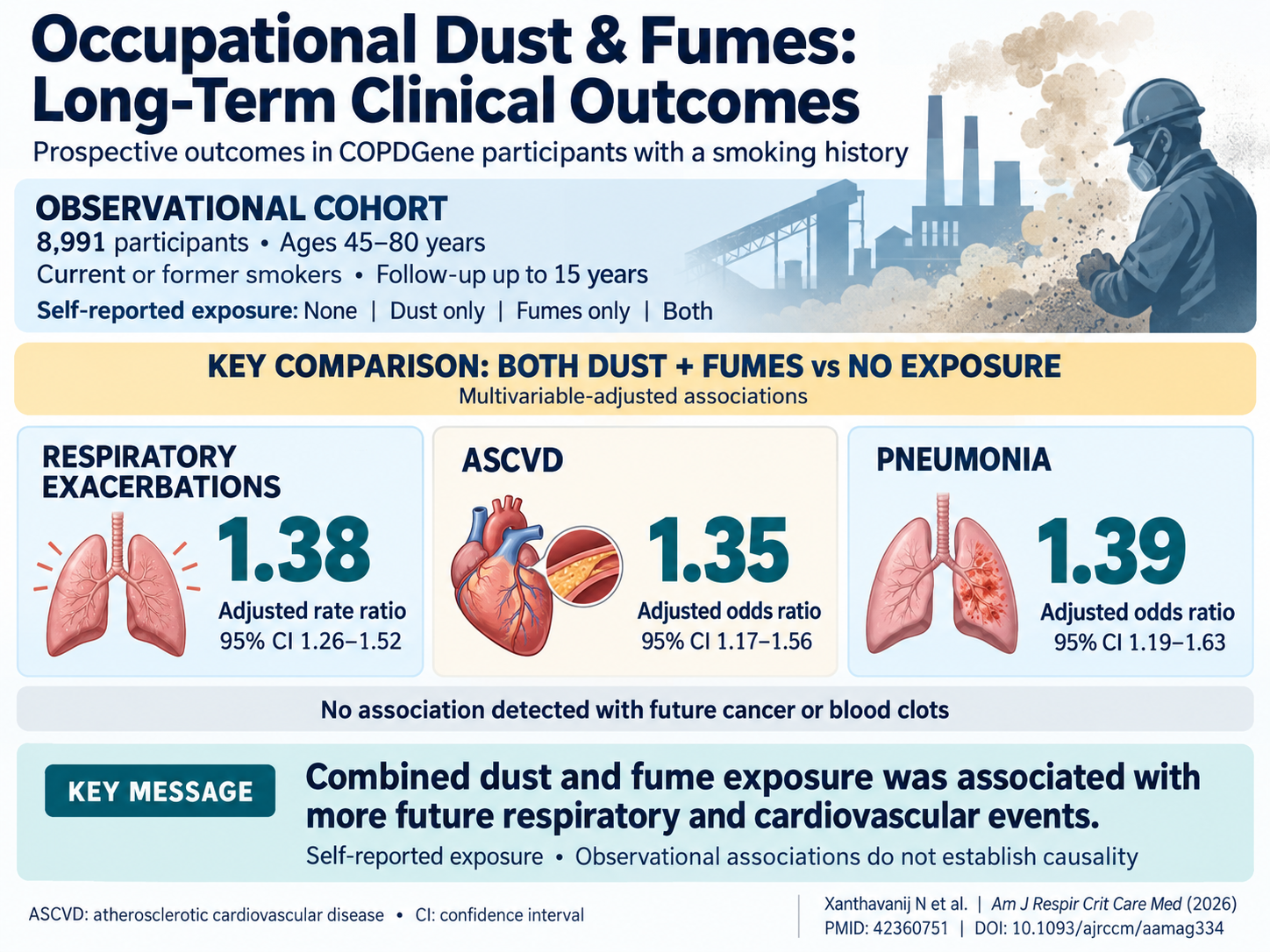
This prospective cohort study utilized data from the COPDGene study (NCT00608764), enrolling 8,991 adults aged 45 to 80 years with a current or former history of smoking. Participants were stratified into four mutually exclusive occupational exposure groups based on baseline questionnaire responses: no exposure, dust-only exposure, fumes-only exposure, and combined dust-and-fumes exposure.
Follow-up extended for up to 15 years to assess clinical outcomes including the frequency of respiratory exacerbations—defined as episodes requiring steroid and/or antibiotic treatment—and the incidence of binary outcomes such as atherosclerotic cardiovascular disease (ASCVD), cancer, pneumonia, and blood clots.
Multivariable models adjusted for potential confounders including age, sex, smoking status, and other relevant covariates estimated associations between exposure categories and outcomes.
Key Findings
The study cohort had a mean age of 60 years, with a near-equal distribution of male and female participants, and approximately half were current smokers.
Occupational exposure prevalence was 12% for dust-only, 12.4% for fumes-only, and 34.4% for combined dust and fumes exposure.
Compared to those with no occupational exposure, participants reporting combined dust and fumes exposure exhibited a significantly increased rate of future respiratory exacerbations (adjusted rate ratio 1.38; 95% confidence interval [CI], 1.26–1.52), indicating a 38% higher risk of exacerbations over the follow-up duration.
Similarly, combined exposure was associated with higher adjusted odds of future ASCVD (odds ratio [OR] 1.35; 95% CI, 1.17–1.56) and pneumonia (OR 1.39; 95% CI, 1.19–1.63), highlighting a clear link between occupational inhalational hazards and systemic vascular and infectious complications.
No statistically significant associations were observed for future cancer or blood clot events in relation to occupational exposure categories.
Exposure to dust-only or fumes-only alone did not consistently show the same magnitude of risk increase as combined exposure, underscoring a potentially additive or synergistic effect of mixed inhalational agents.
Expert Commentary
The findings reinforce the critical role of occupational environments in modulating long-term health risks beyond pulmonary function deterioration, particularly among tobacco-exposed populations.
Mechanistically, inhalation of dust and fumes may trigger persistent airway inflammation, oxidative stress, and systemic endothelial dysfunction, pathways known to contribute to respiratory exacerbations and atherosclerosis progression. The absence of association with cancer in this cohort might reflect the dominant carcinogenic effects of tobacco or require longer follow-up for detection.
This study’s strengths include its large well-characterized smoker cohort, prospective design, and multivariable adjustment; however, reliance on self-reported occupational exposure data may introduce recall bias and exposure misclassification. Also, generalizability beyond tobacco-exposed populations requires further validation.
Clinicians should be aware of occupational histories during risk assessment and counsel patients accordingly. Moreover, policy makers and occupational health specialists should intensify efforts to reduce workplace dust and fume exposures, particularly in industries with high smoking rates.
Conclusion
In individuals with current or former smoking history, self-reported occupational exposure to combined dust and fumes significantly elevates the risk of future adverse clinical outcomes, including respiratory exacerbations, atherosclerotic cardiovascular disease, and pneumonia.
These data highlight the importance of integrated occupational and smoking cessation interventions to mitigate long-term health risks. Further research is warranted to elaborate mechanistic pathways and evaluate the impact of specific occupational agents.
Funding and Clinical Trials Registration
The study was conducted under the COPDGene Research Group and supported by the National Heart, Lung, and Blood Institute.
ClinicalTrials.gov Identifier: NCT00608764 (COPDGene).
References
1. Xanthavanij N, Deshpande R, Yu J, et al. Occupational exposure to dust and fumes increases risk for future adverse clinical outcomes. Am J Respir Crit Care Med. 2026;212(10):2618-2627. doi:10.1164/rccm.202602-0407OC
2. Balmes JR. Occupational contributions to chronic obstructive pulmonary disease. Curr Opin Pulm Med. 2014;20(2):133-138. doi:10.1097/MCP.0000000000000034
3. Eisner MD, Balmes J, Katz PP, et al. Lifetime environmental tobacco smoke exposure and the risk of chronic obstructive pulmonary disease. Environ Health. 2005;4:7. doi:10.1186/1476-069X-4-7
4. Blanc PD, Annesi-Maesano I, Balmes JR, et al. The Occupational Burden of Nonmalignant Respiratory Diseases. An Official American Thoracic Society and European Respiratory Society Statement. Am J Respir Crit Care Med. 2019;199(11):1312-1334. doi:10.1164/rccm.201904-0734ST