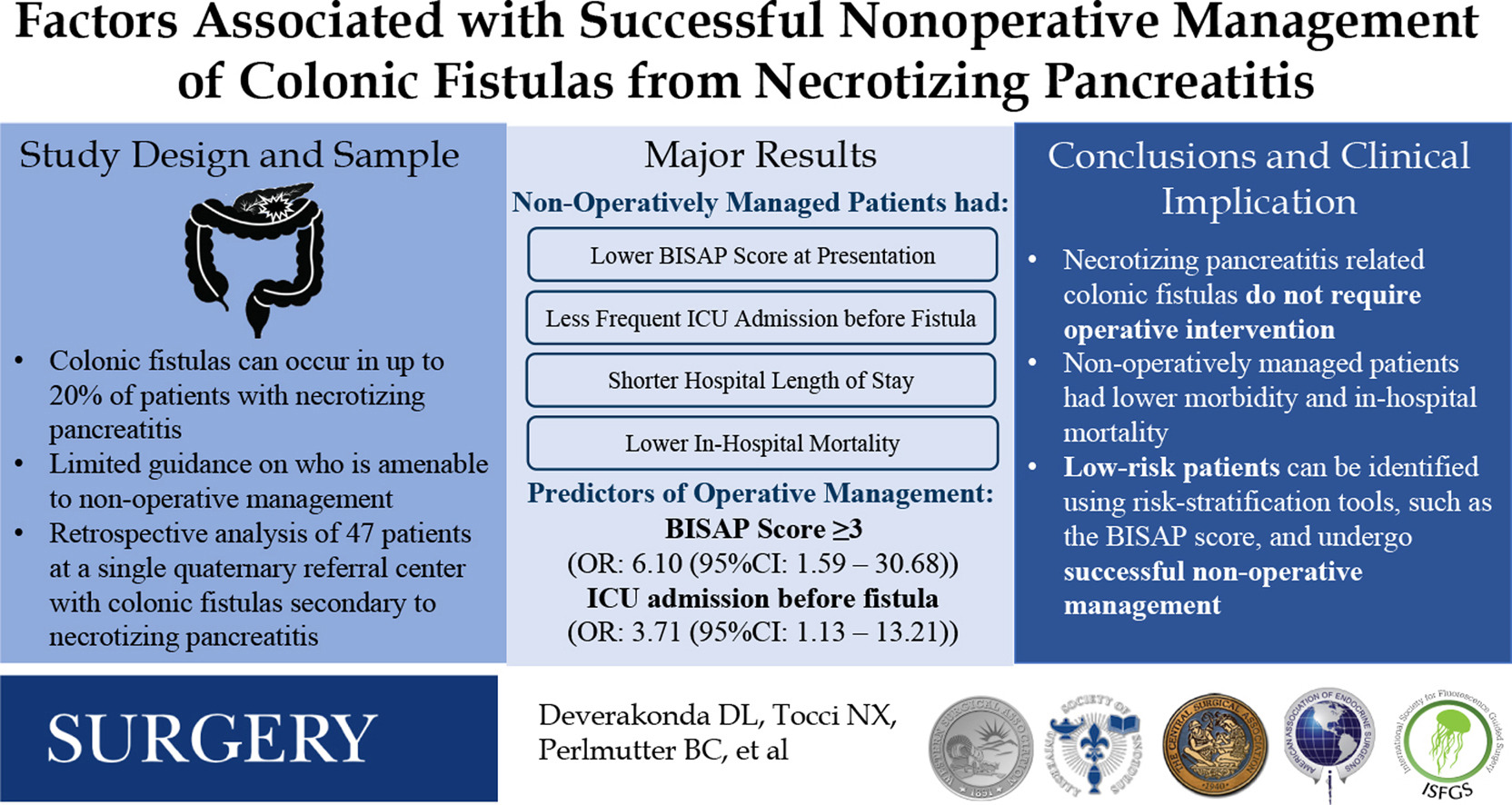
Highlight
- Colonic fistulas complicate necrotizing pancreatitis but do not invariably require surgery.
- Nonoperative management is feasible and often successful in patients with low BISAP scores and less critical illness.
- Operative intervention is more likely in patients presenting with higher severity (BISAP ≥3) and critical care needs.
- Survival outcomes do not significantly differ between nonoperative and operative approaches, highlighting tailored treatment strategies.
Study Background
Necrotizing pancreatitis, a severe form of acute pancreatitis characterized by pancreatic tissue necrosis, carries significant morbidity and mortality. Among its complications are colonic fistulas, abnormal connections between the colon and pancreatic or peripancreatic collections, arising either from the inflammatory process itself or iatrogenically from drain erosion. These fistulas pose diagnostic and therapeutic challenges because their presence may suggest the need for operative intervention, which carries risks in this already critically ill population.
Currently, there is no consensus on the optimal management strategy for colonic fistulas secondary to necrotizing pancreatitis. Surgical intervention has traditionally been favored to control ongoing contamination and sepsis, but the invasive nature of surgery can complicate recovery. Conversely, advances in percutaneous and endoscopic drainage techniques have opened avenues for nonoperative management, potentially avoiding surgical morbidity in selected patients. The balance between nonoperative and operative approaches requires clearer evidence to guide clinical decisions.
Study Design
This study retrospectively analyzed data from a comprehensive institutional necrotizing pancreatitis registry spanning 2015 to 2025. Adult patients who developed colonic fistulas secondary to necrotizing pancreatitis were identified. Patients were classified into two cohorts based on their initial management approach: nonoperative management and operative management.
The nonoperative group included patients managed primarily with percutaneous or endoscopic drainage techniques, while the operative group included those who underwent upfront surgery or required operative intervention subsequently. The primary aim was to compare clinical characteristics and outcomes between these cohorts and identify predictive factors for selecting nonoperative management.
Key variables analyzed included the Bedside Index for Severity in Acute Pancreatitis (BISAP) score on admission—an established prognostic tool assessing severity of acute pancreatitis—length of hospital stay, intensive care unit (ICU) admission rates, survival, and nature of the fistula (e.g., drain-related).
Key Findings
Out of 1,092 necrotizing pancreatitis patients, 47 (approximately 4.3%) developed colonic fistulas. The median time from initial pancreatitis diagnosis to fistula formation was 58 days, reflecting a late complication in the disease course.
Nonoperative management was initiated in 20 patients (43%), most often involving percutaneous drainage (55%) and less commonly endoscopic interventions (20%). The operative group comprised 27 patients (57%), with a mix of initial percutaneous drainage and upfront surgery.
Of the 23 patients whose fistulas were related to drain erosion, management was almost evenly split between nonoperative (50%) and operative (48%) approaches, indicating that drain-related fistulas do not uniformly necessitate surgery.
Critically, patients managed nonoperatively had significantly lower BISAP scores at admission (median 1.0 versus 3.0, P = .04). A BISAP score of 3 or higher strongly predicted the need for operative management (odds ratio 6.10, 95% confidence interval 1.59-30.68, P = .007). This finding underscores the value of initial clinical severity in guiding treatment.
Additionally, nonoperative patients experienced shorter hospitalizations (median 10 versus 39 days, P < .01) and less frequent ICU admissions (35% versus 78%, P < .01), pointing toward less severe overall illness and resource utilization.
Survival did not significantly differ between the groups (P = .07), suggesting that conservative management, when appropriately selected, does not compromise patient outcomes.
Expert Commentary
The findings from Deverakonda et al. contribute practically important insights into managing a difficult complication of necrotizing pancreatitis. The identification of the BISAP score as a useful predictor for successful nonoperative treatment reinforces the principle of stratifying care based on disease severity. This approach aligns with growing evidence that not all pancreatic or peripancreatic fistulas require immediate surgical correction.
It is important to interpret these results within the context of the study’s retrospective design and relatively small sample size, which can limit generalizability. Nevertheless, the data advocate for a selective, patient-tailored approach whereby clinicians reserve surgery for those with high clinical severity or failed conservative therapy.
The study also highlights the role of modern drainage techniques as effective interventions in stabilizing patients and potentially allowing fistula healing without surgery. Drain-related fistulas represent a particular subgroup where less invasive measures might be prioritized.
Future prospective studies and multi-institutional registries could further validate these findings and refine criteria to optimize timing and modality of intervention.
Conclusion
Colonic fistulas occurring in the setting of necrotizing pancreatitis represent a significant clinical challenge but do not invariably mandate operative intervention. This study supports a nuanced approach, which incorporates the patient’s clinical severity, primarily assessed by the BISAP score and critical care needs, to guide management decisions.
Low-risk patients presenting with lower BISAP scores can often be managed successfully with nonoperative interventions such as percutaneous or endoscopic drainage, which are associated with shorter hospital stays and fewer ICU admissions without compromising survival. Conversely, patients with more severe acute pancreatitis may benefit from early operative management.
Implementing severity-based algorithms can improve patient outcomes and resource utilization in this complex disease spectrum, emphasizing the importance of individualized care strategies.
Funding and Clinicaltrials.gov
The study was conducted as a retrospective institutional registry analysis. No external funding or ClinicalTrials.gov registration was reported.
References
- Deverakonda DL, Tocci NX, Perlmutter BC, et al. Factors associated with successful nonoperative management of colonic fistulas from necrotizing pancreatitis. Surgery. 2026 Sep 7;110618. PMID: 42786087.
- Singh VK, Wu BU, Bollen TL, et al. A prospective evaluation of the bedside index for severity in acute pancreatitis score. Am J Gastroenterol. 2009 Jul;104(7):1844-50.
- Steenberg JD, Gluck M. Endoscopic management of pancreatic fluid collections. Gastrointest Endosc Clin N Am. 2010;20(3):525-540.