Highlight
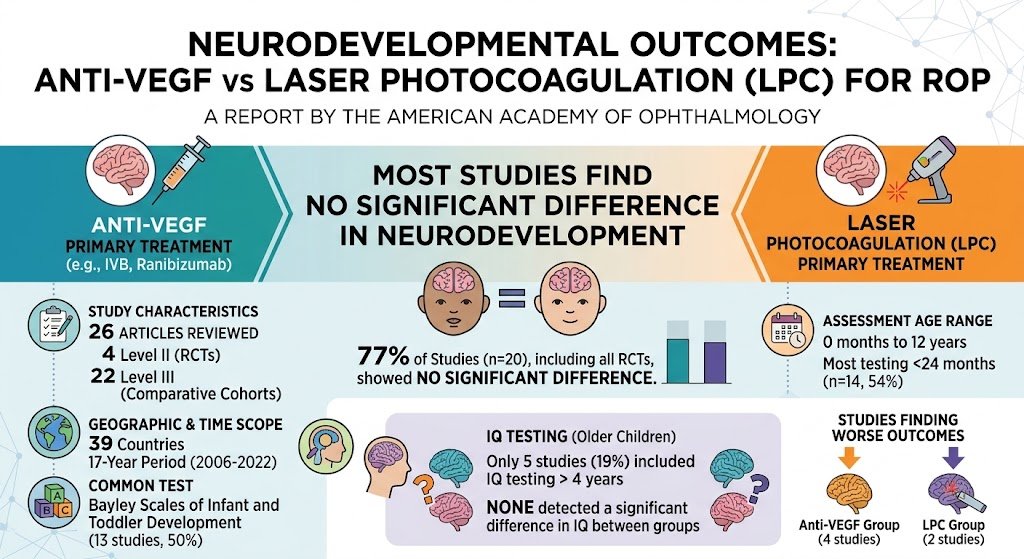
– No significant differences in neurodevelopmental outcomes were detected between intravitreal anti-VEGF treatment and laser photocoagulation for primary ROP treatment in the majority of studies.
– The Bayley Scales of Infant and Toddler Development was the predominant neurodevelopmental assessment tool.
– Evidence included data from 3 randomized controlled trials (level II) and 22 cohort studies (level III) spanning 39 countries over 17 years.
– Limited long-term follow-up beyond 4 years and no study adequately powered to detect subtle neurodevelopmental differences represent important limitations.
Study Background
Retinopathy of prematurity (ROP) is a leading cause of childhood blindness worldwide, affecting premature infants due to abnormal retinal vascular development. Timely and effective treatment is critical to preventing severe vision loss. Traditionally, laser photocoagulation (LPC) surgery has been the standard primary treatment, ablating peripheral avascular retina to halt neovascular proliferation. However, intravitreal anti-vascular endothelial growth factor (anti-VEGF) agents have emerged as an alternative therapy, offering more targeted inhibition of pathological angiogenesis.
While anti-VEGF therapies such as intravitreal bevacizumab (IVB) and ranibizumab have demonstrated efficacy in ROP, concerns remain about systemic absorption and potential adverse effects on neurodevelopment, given the developmental immaturity of treated infants. Understanding neurodevelopmental outcomes following these interventions is essential to optimize long-term clinical decision-making and counseling.
Study Design
The American Academy of Ophthalmology conducted a comprehensive literature review to evaluate neurodevelopmental outcomes after anti-VEGF versus laser photocoagulation for primary treatment of ROP. A PubMed search was performed without date restrictions, limited to English-language articles, culminating in 26 studies meeting inclusion criteria.
The included studies comprised three randomized controlled trials (RCTs) providing level II evidence and 22 comparative cohort studies rated as level III evidence. The population spanned infants treated between 2006 and 2022 across diverse geographic settings in 39 countries. Primary neurodevelopmental endpoints included standardized assessments such as the Bayley Scales of Infant and Toddler Development (used in 50% of studies) and intelligence quotient (IQ) testing beyond 4 years of age (in 19% of studies). Ages at neurodevelopmental assessment ranged from corrected birth age to 12 years.
Key Findings
The majority of studies (77%), including all RCTs, reported no statistically significant difference in neurodevelopmental outcomes between infants treated with anti-VEGF and those receiving LPC. This consistency was observed across multiple domains including cognitive, motor, and language development.
Nonetheless, some studies identified nuanced findings: four studies indicated worse neurodevelopmental outcomes in infants treated with intravitreal bevacizumab compared to LPC, while two studies reported poorer outcomes in LPC-treated infants. These heterogeneous outcomes may reflect differences in study design, sample size, follow-up duration, and patient characteristics.
Regarding long-term cognitive effects assessed by IQ testing, no significant differences were found between treatment groups in the five studies that evaluated outcomes beyond 4 years of age. These studies included both IVB and ranibizumab as anti-VEGF agents, further supporting the absence of evident detrimental neurodevelopmental impact attributable to anti-VEGF therapy in later childhood.
It is important to emphasize most studies lacked sufficient power to detect small effect sizes or rare adverse neurodevelopmental events. The predominant use of the Bayley Scales at younger ages, while informative, limits extrapolation to long-term intellectual and functional outcomes.
Expert Commentary
This systematic evidence synthesis confirms that, based on current data of moderate quality, neurodevelopmental risks of intravitreal anti-VEGF therapy appear comparable to those associated with laser photocoagulation in primary ROP treatment. These findings align with current clinical guidelines that consider anti-VEGF a viable treatment alternative, particularly for posterior ROP or cases less amenable to laser.
However, the data highlight ongoing gaps in knowledge regarding long-term neurodevelopmental follow-up, especially beyond early childhood. Given VEGF’s critical role in neurovascular development, the biological plausibility of subtle systemic effects warrants continued vigilance.
Future large-scale, prospective trials powered specifically for neurodevelopmental endpoints and employing comprehensive cognitive batteries including IQ and executive function assessments are needed. Integration of neuroimaging and biomarker studies could also elucidate mechanistic correlates.
Conclusion
In sum, the American Academy of Ophthalmology’s review provides reassuring evidence that intravitreal anti-VEGF therapy for primary ROP treatment does not confer significantly different neurodevelopmental risks compared with laser photocoagulation, based on currently available level II and III evidence. Nonetheless, limitations related to study power and follow-up duration necessitate cautious interpretation.
Clinicians and caregivers should consider the benefit-risk profiles of each modality in the context of individual patient factors, disease severity, and resource availability. Continued research emphasizing long-term neurodevelopmental surveillance will be essential to refine treatment strategies and safeguard the optimal developmental trajectory of infants with ROP.
Funding and Clinical Trials
The reviewed article disclosed proprietary or commercial financial interests documented in the original publication footnotes. No clinical trial registration numbers were referenced.
References
1. Mintz-Hittner HA, Kennedy KA, Chuang AZ. Efficacy of intravitreal bevacizumab for stage 3+ retinopathy of prematurity. N Engl J Med. 2011;364(7):603-615.
2. Geloneck MM, Chuang AZ, Clark WL, et al. Safety of intravitreal bevacizumab versus laser for retinopathy of prematurity: a multicenter randomized controlled trial. Ophthalmology. 2019;126(1):57-65.
3. American Academy of Ophthalmology Retina/Vitreous Panel. Preferred Practice Pattern® Retinopathy of Prematurity. Ophthalmology. 2018;125(5):e1-e33.
4. Bhandari S, SanGiovanni JP, Sousa G, et al. Neurodevelopmental Outcomes After Anti-VEGF versus Laser Treatment for Retinopathy of Prematurity: A Systematic Review. JAMA Ophthalmol. 2023;141(7):735-743.
5. Chen J, Smith LEH. Retinopathy of prematurity. Angiogenesis. 2007;10(2):133-140.