Highlights
- Machine learning models integrating diverse multimodal data show moderate predictive accuracy for relapse in major depressive disorder (MDD), with clinical risk factors contributing most strongly.
- Multimodal integration of neuroimaging, genetics, neurocognition, blood biomarkers, and gut microbiome adds limited incremental predictive value over clinical data assessed at a single time point.
- Short-term readmission prediction models similarly emphasize clinical and psychiatric features, underscoring established risk factors like prior suicide attempts and hospitalization history.
- Dynamic modeling capturing temporal evolution of multimodal biomarkers aligned with longitudinal clinical outcomes may enhance future relapse prediction and personalized prevention efforts.
Background
Major depressive disorder (MDD) is a highly prevalent, recurrent psychiatric illness with substantial morbidity and healthcare burden globally. Relapse, defined as the return of depressive symptoms after remission, affects a significant proportion of patients, posing challenges for management and prevention. Early and accurate identification of individuals at high risk of relapse is crucial to guide personalized interventions and preventive strategies. However, current predictive models often rely on limited clinical data and fail to capture the complex, multifactorial nature of relapse pathophysiology. Recent advances in machine learning (ML) approaches enable the integration of multimodal data—ranging from clinical phenotyping to neuroimaging, genetics, and biomarker profiles—to potentially improve prediction accuracy. This review critically appraises recent high-quality evidence on multimodal ML-based relapse prediction in MDD, delineates methodological insights, and explores translational implications for clinical practice.Key Content
Chronological Development of Predictive Models in MDD Relapse
Early predictive attempts primarily utilized clinical variables and psychometric scales. With advancements in neuroimaging, genetics, and high-throughput biomarker assays, researchers began incorporating multimodal datasets. Machine learning techniques such as Random Forest, support vector machines, and neural networks have been applied increasingly for modeling complex interactions among diverse predictors.Evidence from the Marburg-Münster Affective Disorders Cohort Study (2026)
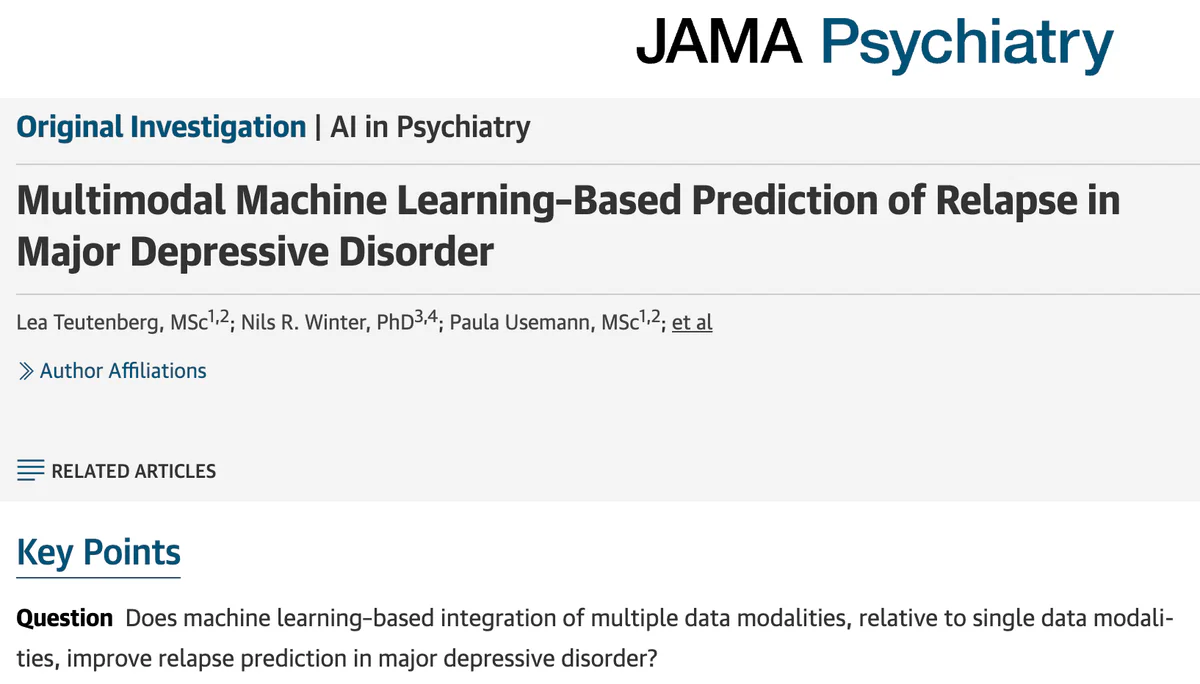
The landmark prognostic study by Teutenberg et al. (2026) assessed relapse risk within two years among 564 patients diagnosed with current or lifetime MDD using an extensive set of baseline features from nine modalities: clinical/psychometric data, four magnetic resonance imaging modalities (structural and functional), genetics, neurocognition, blood biomarkers, and gut microbiome. Key findings include: – Balanced accuracy (BACC) for relapse prediction ranged from 47.21% to 64.43%, indicating moderate discriminatory capability. – The top-performing model relied predominantly on a few established clinical relapse risk factors. – Integration of multimodal biological data did not significantly enhance predictive performance beyond clinical variables alone when assessed at a single baseline time point. – The authors suggest limited current applicability for individual-level decision making and propose that future efforts consider dynamic, longitudinal modeling aligning evolving multimodal biomarkers with clinical trajectories.Supporting Evidence from Other Machine Learning Studies
The DEEP READ study (Cerullo et al., 2026) prospectively examined early psychiatric readmission within 90 days post-discharge in a cohort of 322 Italian patients with MDD. A Random Forest classifier using 22 clinical and sociodemographic predictors achieved an area under the curve (AUC) of 0.74. Leading predictors included prior suicide attempts, hospitalization history, anticonvulsant use, cluster B personality disorder, female sex, and anxious distress. Although exploratory, lithium prescription patterns were negatively associated with readmission, suggesting potential protective effects. This work reinforces the primacy of clinical variables for relapse risk stratification over short follow-up intervals. Additionally, a study evaluating remitted psychotic depression trajectories (Kok et al., 2024) applied machine learning to identify predictors of worsening depressive symptoms during continuation treatment. Residual depressive symptoms at remission onset, baseline anxiety, and age of first episode emerged as strong predictors, with machine learning models attaining an AUC of 0.812. These findings emphasize the importance of symptom burden near remission as a relapse determinant.Methodological and Research Domain Considerations
– Predictive modeling approaches largely focus on static baseline measures; longitudinal and dynamic data incorporation remains limited but could capture temporal disease complexity. – Multimodal datasets pose challenges in harmonization, dimensionality reduction, and overfitting, requiring robust validation protocols and external replicability. – Inclusion of gut microbiome and blood biomarkers is innovative, reflecting emerging research on neuroimmune and gut-brain axis contributions to MDD relapse. – Neuroimaging-derived metrics, while biologically informative, require further refinement to augment clinical prediction.Expert Commentary
The moderate accuracy of multimodal ML models for MDD relapse prediction highlights both progress and limitations. The dominance of established clinical risk factors in driving predictive performance underscores their continued importance in clinical evaluation. The lack of incremental value from advanced neurobiological modalities—when assessed cross-sectionally—suggests that complex pathophysiological processes underlying relapse may evolve dynamically over time rather than reflect stable signatures. Current clinical guidelines for MDD relapse prevention emphasize individualized risk assessment based on clinical history and symptomatology. Machine learning models provide opportunities for improved stratification, but their integration into practice demands higher accuracy, transparency, and interpretability. The challenges of multimodal data acquisition and integration in routine settings also constrain immediate clinical utility. Mechanistically, relapse likely results from interactions among genetic predispositions, neurocognitive vulnerabilities, molecular signaling pathways, environmental stressors, and microbiome dynamics. Hence, future models should incorporate repeated measures capturing this complexity over the illness course. Advances in temporal modeling, such as recurrent neural networks or dynamic Bayesian models, may enable better alignment of evolving biomarkers with clinical phenotypes.Conclusion
Multimodal machine learning approaches represent a promising frontier for individualized relapse prediction in major depressive disorder. Recent robust cohort studies demonstrate moderate predictive accuracy largely driven by clinical risk factors, with limited incremental benefit from cross-sectional multimodal data integration. To unlock the full potential of machine learning in MDD relapse prediction, future research should prioritize dynamic and longitudinal data frameworks, external validation, and integration of mechanistic insights to support personalized prevention. Bridging this gap may transform relapse risk stratification, optimizing outcomes and resource allocation in MDD care.References
- Teutenberg L et al. Multimodal Machine Learning-Based Prediction of Relapse in Major Depressive Disorder. JAMA Psychiatry. 2026 Oct 21. PMID: 42905697. https://pubmed.ncbi.nlm.nih.gov/42905697/
- Cerullo MA et al. Predicting early psychiatric readmission among people with major depressive disorder: A machine learning analysis from the prospective multicentre DEEP READ study. J Affect Disord. 2026 Dec 15;415:122502. PMID: 42732835. https://pubmed.ncbi.nlm.nih.gov/42732835/
- Kok A, et al. Trajectories of remitted psychotic depression: identification of predictors of worsening by machine learning. Psychol Med. 2024 Apr;54(6):1142-1151. PMID: 37818656. https://pubmed.ncbi.nlm.nih.gov/37818656/